
During Bangalore’s monsoon, Skin and Fungal Infections can become more common because humidity, sweating and damp clothing create an environment where certain fungi thrive. Moreover, sweaty commutes, wet shoes, tight clothing and prolonged moisture on the skin can make irritation and fungal growth more likely.
However, not every rash or itching problem is a fungal infection. Instead, similar symptoms can occur with eczema, bacterial infections, allergies, contact dermatitis and other skin conditions. Therefore, the appearance of a rash alone may not be enough to identify its cause.
For people dealing with Bangalore’s humid monsoon, particularly diabetics and people with other health conditions, persistent or recurrent skin infections may sometimes prompt additional testing.
This Blog Includes:
- Article Title: Rainy Season Skin and Fungal Infections in Bangalore – Tests to Consider
- Publisher: Prima Diagnostics
- Type: Seasonal / Symptom Healthcare Blog
- Topics Covered: Skin and Fungal Infections, Monsoon Skin Problems, Fungal Infections, Ringworm, Athlete’s Foot, Skin-Fold Infections, Humidity, Sweating, Damp Clothing, Diabetes, Blood Sugar, HbA1c, CBC, KOH Examination, Recurrent Infections, Low Immunity, Monsoon Health, Skin Care and Home Sample Collection.
- Services Covered: KOH Examination when available, Blood Glucose Testing, HbA1c Testing, CBC Testing, Laboratory Diagnostics, Preventive Health Testing and Home Sample Collection.
- Monsoon Skin Guidance: Explains why warm and humid rainy-season conditions can favour fungal growth when sweat and moisture remain on the skin.
- Common Infection Guidance: Covers ringworm, athlete’s foot and fungal infections affecting moist skin folds while clarifying that similar symptoms can have non-fungal causes.
- KOH Guidance: Explains that a potassium hydroxide examination can evaluate skin, hair or nail specimens for fungal elements and may help confirm a suspected fungal infection.
- Blood Test Guidance: Explains the possible role of blood glucose, HbA1c and CBC in selected cases where recurrent, persistent or severe skin infections raise concerns about diabetes, immune issues or other underlying conditions.
- Diabetes Guidance: Explains why people with diabetes may be more susceptible to certain infections and why recurrent fungal infections may prompt review of glucose control.
- HbA1c Guidance: Explains that HbA1c reflects average blood glucose over approximately the previous two to three months and can provide longer-term glucose information.
- CBC Guidance: Explains that CBC may be considered in selected persistent or severe infections but cannot independently diagnose fungal infection.
- Safety Guidance: Advises prompt medical assessment for rapidly spreading, painful, severely inflamed lesions, significant pus, fever or other concerning symptoms.
- Service Focus: KOH Examination, Blood Sugar Testing, HbA1c Testing, CBC Testing, Laboratory Diagnostics, Preventive Health Screening and Home Sample Collection.
- FAQ Section: Included.
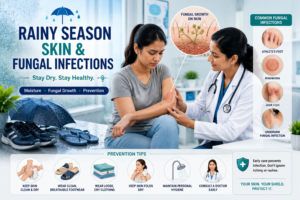
When a monsoon skin infection needs a blood test
A monsoon-related skin infection does not automatically require a blood test. However, blood tests such as blood glucose or HbA1c and, in selected situations, a CBC may be considered when infections are recurrent, unusually persistent, widespread, severe, or associated with symptoms or risk factors suggesting diabetes, immune problems or another underlying condition. A KOH examination can help confirm whether certain skin lesions contain fungal elements.
Why Skin and Fungal Infections Rise During Monsoon
Humidity Creates a Favourable Environment
Fungi tend to grow well in warm, moist environments.
Consequently, Bangalore’s humid rainy-season conditions can contribute to fungal growth, particularly in areas where sweat and moisture remain trapped.
For example, the:
- Groin
- Feet
- Armpits
- Skin folds
- Areas beneath tight clothing
can stay damp for longer periods.
Therefore, keeping skin dry and changing out of wet clothing can be particularly important during monsoon.
Sweaty Commutes and Damp Clothing
Why Daily Travel Can Make It Worse
Bangalore commuters may experience a combination of heat, humidity and rain during the same journey.
Furthermore, wet socks, shoes, rain-soaked clothes and prolonged sitting during a commute can keep certain areas of the body moist.
As a result, people who spend hours travelling or working in damp clothing may notice more itching, redness or irritation.
However, good hygiene alone cannot prevent every fungal infection.
Common Bangalore Monsoon Skin Problems
Ringworm and Other Superficial Fungal Infections
Ringworm, despite its name, is caused by fungi rather than worms.
It may produce:
- Itchy patches
- Scaling
- Redness
- Ring-shaped or expanding lesions
Consequently, persistent circular or scaly rashes may require medical assessment.
Athlete’s Foot
Feet can be particularly vulnerable during rainy weather.
Wet footwear and sweaty socks can create a moist environment between the toes.
Therefore, symptoms such as itching, peeling, cracking or scaling between the toes should not be ignored.
Fungal Infections in Skin Folds
Moisture can accumulate in areas such as the groin and under skin folds.
As a result, redness, itching, burning, and irritation may develop.
However, not every rash in these areas is fungal.
Therefore, a healthcare professional may recommend examination or testing when the diagnosis is uncertain.
When Is It More Than a Skin Problem?
Recurrent Infections Can Be a Clue
An occasional fungal infection does not automatically indicate an underlying disease.
Nevertheless, when infections repeatedly return despite appropriate treatment, your doctor may look for contributing factors.
These can include:
- Diabetes
- Certain medications
- Immune-system problems
- Persistent moisture exposure
- Obesity or skin-fold problems
- Other medical conditions
Consequently, recurrent infection may sometimes justify a broader health evaluation.
Diabetes and Fungal Skin Infections
Why Blood Sugar Matters
Persistently elevated blood glucose can affect the body’s ability to fight infections effectively.
Therefore, people with diabetes may be more prone to certain skin infections, including fungal infections.
Moreover, some individuals may have diabetes without obvious symptoms.
As a result, recurrent fungal infections can sometimes be one reason a healthcare professional considers glucose testing.
When to Consider a Sugar Test
Fasting Blood Sugar
Fasting blood sugar measures glucose after the required fasting period.
Therefore, it can provide a current measurement of blood glucose and may be used for diabetes screening or monitoring.
HbA1c
HbA1c reflects average blood glucose over approximately the previous two to three months.
Consequently, it provides a longer-term view than a single glucose reading.
Tests to Consider
Blood glucose testing may be considered when a person has recurrent infections or other diabetes risk factors.
However, a fungal infection alone does not establish diabetes.
HbA1c can be useful when healthcare professionals want to understand longer-term glucose patterns.
Therefore, it may be considered when recurrent infections occur alongside other diabetes symptoms or risk factors.
- CBC
A Complete Blood Count (CBC) measures different blood-cell components.
Depending on the clinical situation, CBC may be considered when an infection is persistent, severe or accompanied by other concerning symptoms.
Nevertheless, CBC cannot by itself determine whether a skin infection is fungal.
- KOH Examination
What Is a KOH Test?
A potassium hydroxide (KOH) examination is a direct test that can help identify fungal elements in a skin, hair or nail specimen.
A small sample from the affected area may be examined under a microscope after preparation with potassium hydroxide.
Consequently, KOH testing can be useful when the diagnosis of a fungal infection needs confirmation.
Why KOH Can Be Better Than Guessing
Several skin conditions can look similar.
Therefore, treating every itchy rash as a fungal infection may result in inappropriate treatment.
A KOH examination can provide direct evidence of fungal elements in suitable cases.
However, a negative result does not always exclude every fungal infection, and the doctor may consider the overall clinical picture.
Do You Need All Four Tests?
Not Necessarily
This is important.
You do not automatically need blood sugar, HbA1c, CBC and KOH together.
Instead, the tests depend on:
- Skin findings
- Duration of infection
- Recurrence
- Severity
- Diabetes risk
- Other symptoms
- Medical history
Therefore, a dermatologist or healthcare professional can decide which investigation is most useful.
Diabetics and Skin Infections
Why Extra Attention Matters
People with known diabetes should pay attention to persistent skin infections.
Moreover, recurring infections may sometimes indicate that glucose control needs review.
Therefore, continue your prescribed diabetes monitoring and discuss recurrent infections with your healthcare provider.
Don’t Stop Diabetes Medication
If you already have diabetes, do not change or stop your medication simply because you develop a fungal infection.
Instead, continue your prescribed treatment unless your healthcare professional instructs you otherwise.
Consequently, both the infection and glucose control can be managed appropriately.
What Other Symptoms Should Diabetics Watch?
In addition to recurrent infections, diabetes can cause:
- Increased thirst
- Frequent urination
- Unexplained weight loss
- Fatigue
- Blurred vision
However, these symptoms can have several causes.
Therefore, appropriate glucose testing is more useful than assuming the cause.
Low Immunity and Recurrent Fungal Infections
When Should Immune Problems Be Considered?
Most people with occasional fungal infections do not have an immune disorder.
Nevertheless, unusually frequent, severe, widespread or difficult-to-treat infections may prompt a doctor to investigate underlying factors.
Depending on the clinical situation, this may include blood counts and other investigations.
When Should You See a Doctor?
Persistent Rash
If a rash does not improve with appropriate care, it should be evaluated.
Rapidly Spreading Infection
A rapidly expanding, painful or severely inflamed skin lesion requires medical attention.
Pus, Fever or Significant Pain
These symptoms may indicate bacterial infection or another complication rather than a simple fungal infection.
Therefore, seek medical evaluation promptly.
Recurrent Infections
If the same infection repeatedly returns, discuss potential underlying causes with a healthcare professional.
Monsoon Skin Care Tips
Keep Skin Dry
After getting wet in the rain, change into dry clothes as soon as practical.
Furthermore, dry areas between the toes and other skin folds carefully.
Change Wet Socks and Shoes
Do not remain in wet footwear for unnecessarily long periods.
Therefore, alternate footwear where possible and allow shoes to dry thoroughly.
Choose Breathable Clothing
Loose, breathable clothing can help reduce trapped moisture.
Consequently, it may help keep vulnerable areas drier.
Avoid Sharing Towels
Fungal infections can sometimes spread through shared personal items.
Therefore, avoid sharing towels, clothing or footwear when infection is suspected.
Can You Prevent Every Fungal Infection?
Prevention Helps, But Isn’t Perfect
Good hygiene, dry skin and appropriate clothing can reduce risk.
However, fungal infections can still occur.
Therefore, persistent symptoms should be evaluated rather than repeatedly self-treated.
Home Collection for Bangalore Residents
When Blood Tests Are Needed
During Bangalore’s rainy season, travelling through wet roads and traffic may be inconvenient.
Consequently, home sample collection can be useful when blood tests such as fasting glucose, HbA1c or CBC have been recommended and the service is available for your location.
However, a KOH examination generally involves obtaining a sample directly from the affected skin, hair or nail and may require an appropriate diagnostic or clinical setting.
Therefore, home collection is not suitable for every type of skin-related investigation.
How to Book the Right Test
Step 1: Get the Skin Problem Evaluated
First, identify whether the rash actually appears fungal or whether another condition needs to be considered.
Step 2: Ask Whether Testing Is Necessary
Next, your doctor can decide whether a KOH examination or blood tests are appropriate.
Step 3: Add Blood Tests Only When Indicated
If diabetes or another underlying issue is suspected, appropriate blood tests can be added.
Step 4: Follow Treatment and Retesting Advice
Finally, complete the recommended treatment and any follow-up testing.
As a result, you avoid unnecessary investigations while still identifying underlying problems when appropriate.
When a Monsoon Skin and fungal Infection Needs a Blood Test
A blood test becomes more relevant when a skin infection is:
Recurrent
The infection repeatedly returns.
Persistent
Symptoms continue despite appropriate treatment.
Severe
The infection is widespread or associated with significant inflammation.
Associated With Diabetes Risk
You also have symptoms or risk factors for diabetes.
Associated With Other Health Concerns
There are signs suggesting an immune, metabolic or systemic issue.
Therefore, not every monsoon fungal infection needs a blood test, but selected cases may benefit from broader evaluation.
Frequently Asked Questions
When does a monsoon skin and fungal infection need a blood test?
A blood test may be considered when infections are recurrent, persistent, unusually severe, or accompanied by diabetes symptoms, immune concerns or other clinical risk factors. Common options include blood glucose, HbA1c and, in selected cases, CBC.
Does every skin and fungal infection require a blood test?
No. Many superficial fungal infections can be evaluated clinically, and a KOH examination may be used to confirm fungal elements when appropriate.
What is a KOH test for fungal infection?
KOH examination involves testing a sample from affected skin, hair or nails for fungal elements under a microscope. It can help distinguish fungal infection from some other skin conditions.
Can diabetes cause recurrent fungal infections?
Diabetes can increase susceptibility to certain infections. Therefore, recurrent fungal infections may sometimes prompt healthcare professionals to consider blood glucose or HbA1c testing.
Can humid Bangalore weather cause fungal infections?
Warm, humid conditions can create an environment that favours fungal growth, particularly when sweat and moisture remain on the skin. However, humidity alone does not guarantee that an infection will develop.
Are monsoon rashes always fungal?
No. Eczema, allergies, bacterial infections, contact dermatitis and other skin conditions can resemble fungal infections.
Should diabetics worry more about skin infections?
People with diabetes may be more susceptible to certain infections, particularly when glucose control is poor. Therefore, persistent or recurrent skin infections should be discussed with a healthcare professional.
Can I get blood tests through home collection in Bangalore?
Eligible blood tests such as glucose, HbA1c and CBC may be available through home collection depending on location and appointment availability.
Can KOH testing be done through home collection?
KOH testing requires a specimen from the affected skin, hair or nail and may need an appropriate clinical or diagnostic setting. Confirm availability with the testing provider.
What should I do if the rash is spreading quickly?
A rapidly spreading, painful, severely inflamed or infected-looking rash should be medically evaluated promptly rather than managed solely through self-treatment.
Conclusion
During Bangalore’s humid monsoon, Skin and Fungal Infections can become more common because sweat, damp clothing and prolonged moisture can create favourable conditions for fungal growth.
Nevertheless, not every itchy or scaly rash is fungal, and not every fungal infection requires blood testing.
Therefore, a KOH examination may be considered when fungal infection needs confirmation, while blood glucose, HbA1c or CBC may be appropriate when recurrent or persistent infections raise concerns about diabetes, immunity or another underlying condition.
Moreover, people with diabetes should pay particular attention to infections that keep returning or fail to improve.
Consequently, the best approach is to evaluate the skin problem first and then choose targeted testing rather than ordering every available investigation.