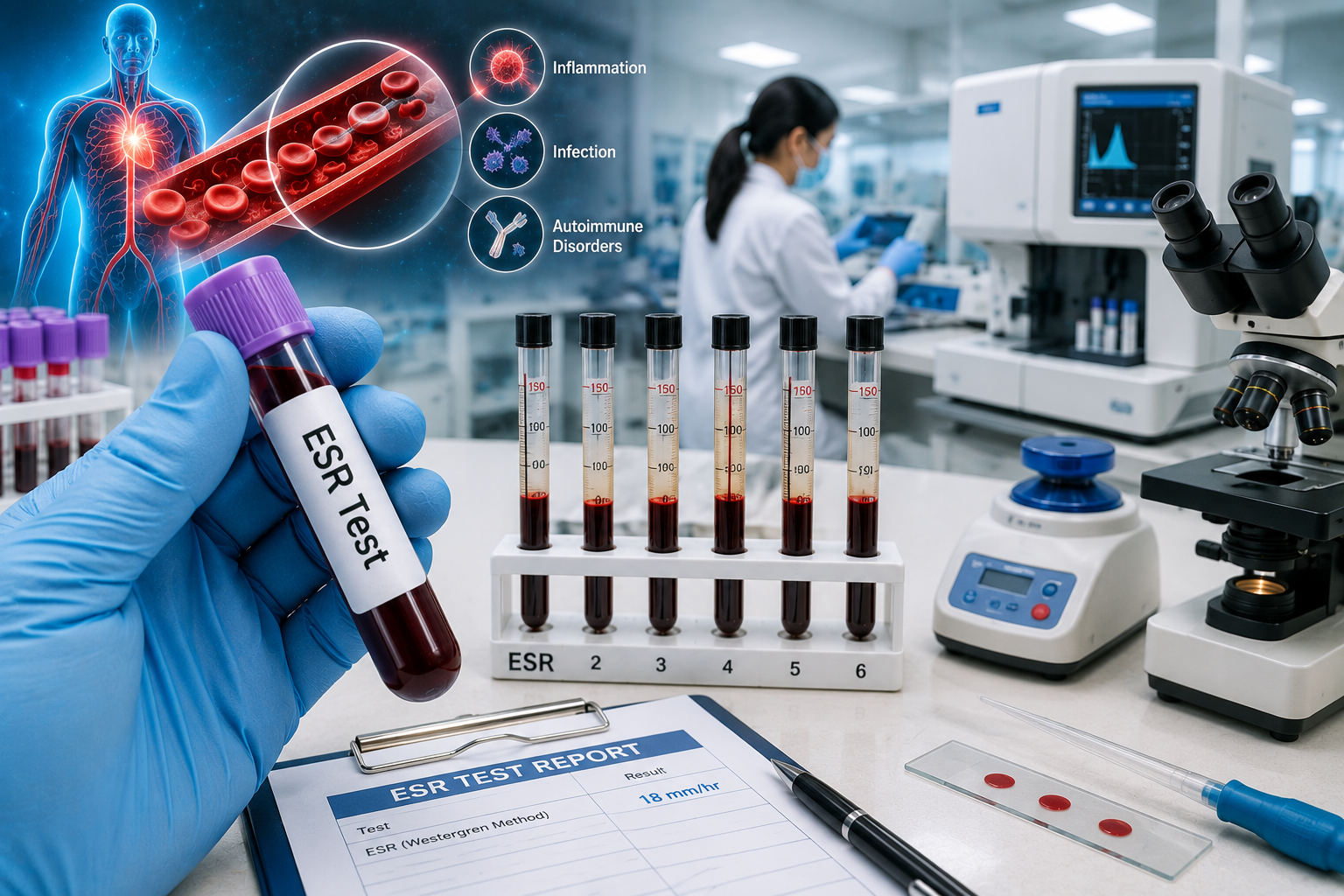
When your doctor recommends an
ESR test, it is natural to wonder what the test measures and why it is important. Unlike tests that diagnose a specific disease, the
Erythrocyte Sedimentation Rate (ESR) is a general marker that helps identify whether inflammation is present somewhere in the body. Although an abnormal ESR result does not reveal the exact cause, it provides valuable clues that guide further medical evaluation.
If you are searching for information about the
ESR test, understanding how it works, when it is ordered, what high ESR means, and how it differs from other inflammatory markers such as
C-Reactive Protein (CRP) can help you better understand your doctor's recommendation. Furthermore, knowing the normal ESR range and preparation requirements can make the testing process easier and less stressful.
Across Bengaluru, ESR testing is commonly requested for patients with persistent fever, joint pain, prolonged infections, suspected autoimmune conditions, tuberculosis (TB) evaluation, and chronic inflammatory diseases. Consequently, it remains one of the most frequently performed blood tests in routine clinical practice.
At
Prima Diagnostics, we perform ESR testing using standardized laboratory methods, experienced professionals, advanced diagnostic equipment, and strict quality-control procedures to ensure reliable results. Combined with fast digital reports and comprehensive laboratory services, our goal is to support timely diagnosis and informed healthcare decisions.
In this guide, we explain what the ESR test measures, why doctors continue to rely on this long-established investigation, common causes of high ESR, the difference between ESR and CRP, normal ESR values by age and gender, test preparation, cost considerations, and frequently asked questions.
This Blog Includes:
- Article Title: ESR Test Explained - Why Your Doctor Ordered It
- Publisher: Prima Diagnostics
- Type: Test Explainer Healthcare Blog
- Topics Covered: ESR Test, Erythrocyte Sedimentation Rate, Inflammation, High ESR, Low ESR, ESR vs CRP, Autoimmune Diseases, Joint Pain, Tuberculosis Screening, Fever Evaluation, Normal ESR Range, ESR Test Preparation, and Laboratory Diagnostics
- Services Covered: ESR Test, CRP Test, Complete Blood Count (CBC), Fever Panel, Autoimmune Screening, Rheumatology Investigations, Preventive Health Check-ups, Home Sample Collection, Digital Reports, and Laboratory Diagnostics
- Tests Included: Erythrocyte Sedimentation Rate (ESR), C-Reactive Protein (CRP), Complete Blood Count (CBC), Rheumatoid Factor (RF), Anti-CCP Antibody Test, Antinuclear Antibody (ANA) Test, Liver Function Test (LFT), Kidney Function Test (KFT), Blood Culture (when indicated), and Additional Inflammatory Marker Tests
- Conditions Covered: Acute Inflammation, Chronic Inflammation, Bacterial Infections, Viral Infections, Tuberculosis (TB), Rheumatoid Arthritis, Systemic Lupus Erythematosus (SLE), Vasculitis, Autoimmune Disorders, Anemia, Certain Malignancies, and Chronic Inflammatory Diseases
- Service Focus: Inflammation Assessment, Fever Investigation, Joint Pain Evaluation, Autoimmune Disease Screening, Tuberculosis Assessment, Preventive Healthcare, Laboratory Diagnostics, and Early Disease Detection
- Healthcare Service: ESR Testing, Inflammatory Marker Testing, Laboratory Diagnostics, Fever Evaluation, Autoimmune Disease Screening, Preventive Health Check-ups, Home Sample Collection, and Routine Blood Testing
- FAQ Section: Included.
 What Is an ESR Test and What Does a High ESR Mean?
The
ESR (Erythrocyte Sedimentation Rate) test measures how quickly red blood cells settle to the bottom of a test tube over one hour. A
high ESR may suggest inflammation somewhere in the body, but it does not identify the exact cause. Elevated ESR can be associated with infections, autoimmune diseases, inflammatory conditions, tuberculosis, certain cancers, pregnancy, or other medical conditions. Therefore, ESR results should always be interpreted alongside symptoms, medical history, physical examination, and other laboratory tests.
What ESR Measures
The ESR test measures the
rate at which red blood cells (erythrocytes) settle in a vertical tube of blood during one hour.
Normally, red blood cells settle relatively slowly.
However, during inflammation, changes in blood proteins cause red blood cells to clump together and settle more quickly.
Therefore, a faster sedimentation rate may indicate the presence of inflammation.
What ESR Does Not Measure
Although ESR is useful, it has certain limitations.
It does
not:
- Diagnose a specific disease
- Identify the exact location of inflammation
- Determine the severity of illness on its own
- Replace other diagnostic investigations
Instead, ESR provides supportive information that helps healthcare providers evaluate a patient's condition.
Why It Is One of the Oldest Tests
The ESR test has been used in medicine for many decades.
Despite the availability of newer laboratory investigations, it continues to play an important role because it is:
- Simple
- Affordable
- Widely available
- Helpful for monitoring inflammatory conditions
- Useful when interpreted alongside other tests
Consequently, ESR remains part of routine clinical practice worldwide.
Why Doctors Still Order ESR
Healthcare providers often request ESR because it helps:
- Detect inflammation
- Monitor chronic inflammatory diseases
- Evaluate prolonged fever
- Support investigation of autoimmune disorders
- Assess treatment response in selected conditions
When Doctors Recommend an ESR Test
An ESR test may be advised when patients experience persistent or unexplained symptoms.
Examples include:
Persistent Fever
Long-lasting fever may require evaluation for underlying infections or inflammatory disorders.
Joint Pain
Patients with chronic joint pain may undergo ESR testing as part of the assessment for inflammatory arthritis and other rheumatologic conditions.
Muscle Pain
Persistent muscle pain associated with inflammation may require additional laboratory evaluation.
Unexplained Fatigue
Long-term fatigue sometimes prompts investigation for inflammatory or chronic diseases.
Suspected Tuberculosis (TB)
Although ESR does not diagnose tuberculosis, it may be included as part of the overall clinical assessment when TB is suspected.
Autoimmune Disorders
Healthcare providers commonly use ESR when evaluating conditions such as rheumatoid arthritis and systemic lupus erythematosus.
High ESR Causes
A high ESR simply indicates that inflammation may be present.
However, many different conditions can increase ESR.
Infections
Both bacterial and certain viral infections may raise ESR.
Autoimmune Diseases
Examples include:
- Rheumatoid arthritis
- Lupus
- Vasculitis
Tuberculosis
TB may be associated with elevated ESR.
However, additional investigations are always necessary for diagnosis.
Chronic Inflammatory Diseases
Long-term inflammatory conditions frequently increase ESR.
Certain Cancers
Some cancers may elevate ESR.
Nevertheless, ESR alone cannot diagnose cancer.
Pregnancy
Pregnancy may naturally increase ESR values.
Anemia
Some types of anemia may also influence ESR results.
Can ESR Be Low?
Although less commonly discussed, ESR may occasionally be lower than expected.
Possible reasons include:
- Certain blood disorders
- Increased red blood cell count
- Specific medical conditions
Low ESR generally receives less clinical attention than elevated ESR and should be interpreted by a healthcare provider.
ESR vs CRP
Both ESR and
C-Reactive Protein (CRP) help detect inflammation.
However, they provide different clinical information.
| ESR |
CRP |
| Measures the sedimentation of red blood cells |
Measures C-reactive protein in blood |
| Changes more gradually |
Changes rapidly |
| Useful for chronic inflammation |
Often useful for acute inflammation |
| May remain elevated longer |
Usually responds quickly to treatment |
In many situations, healthcare providers request both ESR and CRP together.
Normal Range by Age and Gender
Normal ESR values vary according to:
- Age
- Gender
- Laboratory method
Generally:
Adult Men
Lower ESR values are commonly considered normal.
Adult Women
Normal values may be slightly higher than those of men.
Older Adults
ESR tends to increase gradually with age.
Because reference ranges differ between laboratories, always interpret results using your laboratory's reference intervals.
Is Fasting Required?
One advantage of ESR testing is its convenience.
In most cases:
✅ No fasting is required.
However:
- Continue following any specific instructions given by your healthcare provider.
- Inform the laboratory about medications if advised.
- Stay well hydrated unless instructed otherwise.
ESR Test Cost in Bengaluru
Many individuals searching for an
ESR test also want to understand its cost.
The overall price depends on factors such as:
- Laboratory standards
- Testing methodology
- Individual test versus health package
- Additional investigations ordered alongside ESR
Because ESR is frequently included in fever panels, arthritis evaluations, and preventive health packages, patients may benefit from comprehensive laboratory testing based on their healthcare provider's recommendations.
Tests Often Ordered Along With ESR
Since ESR is a non-specific inflammatory marker, healthcare providers frequently combine it with other investigations.
These may include:
CRP Test
Provides additional information about inflammation.
Complete Blood Count (CBC)
Evaluates infection, anemia, and blood cell counts.
Rheumatoid Factor (RF)
May support the evaluation of inflammatory arthritis.
ANA Test
Used in selected autoimmune disease investigations.
Liver and Kidney Function Tests
Help assess overall health status.
ESR Testing in Bengaluru
Across
Bengaluru, ESR testing is commonly performed for individuals with prolonged fever, joint pain, suspected inflammatory disorders, tuberculosis evaluation, autoimmune conditions, and chronic infections. Furthermore, increasing awareness about preventive healthcare has encouraged more patients to undergo timely laboratory investigations before symptoms become severe. Combined with experienced medical evaluation, ESR testing continues to be a valuable component of comprehensive diagnostic assessment.
Why Choose Prima Diagnostics?
Advanced Laboratory Technology
Modern laboratory equipment supports accurate ESR measurement.
Experienced Laboratory Professionals
Samples are processed according to standardized laboratory procedures.
Comprehensive Diagnostic Services
ESR can be combined with other blood tests for a complete clinical evaluation.
Affordable Health Packages
Routine health packages often include ESR along with other useful investigations.
Fast Digital Reports
Timely reporting helps support quicker medical consultation.
Home Sample Collection
Convenient home sample collection is available for eligible laboratory tests.
Frequently Asked Questions (FAQs)
What does an ESR test measure?
The ESR test measures how quickly red blood cells settle in a test tube over one hour, providing an indirect marker of inflammation.
Does a high ESR mean I have a serious disease?
Not necessarily. A high ESR indicates inflammation may be present, but many different conditions can increase ESR. Further evaluation is usually required.
Is fasting required before an ESR test?
No. In most cases, fasting is not required.
Why do doctors order both ESR and CRP?
ESR and CRP provide complementary information about inflammation and are often interpreted together.
Can ESR diagnose tuberculosis?
No. ESR alone cannot diagnose tuberculosis. It is only one part of the overall clinical evaluation.
Why choose Prima Diagnostics?
Prima Diagnostics offers accurate ESR testing, experienced professionals, advanced laboratory technology, affordable health packages, home sample collection, and fast digital reports.
Conclusion
The
ESR test remains one of the most valuable and widely used laboratory investigations for identifying inflammation in the body. Although it does not diagnose a specific disease, it provides important information that helps healthcare providers evaluate infections, autoimmune disorders, chronic inflammatory conditions, and other medical concerns. Moreover, when interpreted alongside symptoms, physical examination, and complementary tests such as CRP and CBC, ESR contributes significantly to accurate diagnosis and ongoing disease monitoring.
At
Prima Diagnostics, we are committed to delivering reliable ESR testing through advanced laboratory technology, standardized testing procedures, experienced professionals, and fast digital reports. Whether your doctor has recommended an ESR test for persistent fever, joint pain, suspected inflammation, or routine evaluation, our comprehensive diagnostic services help support timely medical decisions and better patient care.