
If you have been advised to take a G6PD Deficiency Test, you may be wondering why a simple blood test is important before certain medicines or foods. In particular, G6PD deficiency can make red blood cells more vulnerable to oxidative stress, and exposure to specific medicines, chemicals, or foods can trigger red blood cell destruction in susceptible individuals.
Moreover, Bangalore newborn screening, family history and fava bean/medicine caution are situations where understanding G6PD status can be particularly useful. However, not everyone with G6PD deficiency develops symptoms regularly. Therefore, testing and appropriate medical guidance are important before assuming that a person is affected.
This Blog Includes:
- Article Title: G6PD Deficiency Test – Important Before Certain Medicines
- Publisher: Prima Diagnostics
- Topics Covered: G6PD Deficiency, G6PD Test, Glucose-6-Phosphate Dehydrogenase, Hemolysis, Hemolytic Anemia, Red Blood Cells, G6PD Symptoms, Fava Beans, Medicine Caution, Infection-Related Hemolysis, Family History, Newborn Screening, Neonatal Jaundice, CBC, Bilirubin, Reticulocyte Count, LDH, Haptoglobin, Blood Testing, Home Sample Collection and Patient Education.
- Services Covered: G6PD Deficiency Testing, Blood Testing, CBC Testing, Anemia-Related Testing, Newborn Testing, Preventive Health Testing, Home Sample Collection and Laboratory Diagnostics.
- G6PD Guidance: Explains that G6PD is an enzyme that helps protect red blood cells against oxidative damage and that reduced enzyme activity can make red blood cells more vulnerable to hemolysis.
- Genetic Guidance: Explains that G6PD deficiency is inherited and that family history can be an important risk factor.
- Anemia Guidance: Explains how significant hemolysis can lead to haemoglobin reduction and hemolytic anemia.
- Newborn Screening Guidance: Explains why G6PD testing may be considered for newborns with significant jaundice, relevant family history or other risk factors.
- CBC Guidance: Explains that CBC can help evaluate anemia but cannot independently diagnose G6PD deficiency.
- Safety Focus: Emphasizes medication review, avoidance of known triggers and prompt medical attention when symptoms of hemolysis occur.
- Service Focus: G6PD Testing, Blood Testing, Newborn Screening, CBC Testing, Anemia Evaluation, Hemolysis-Related Testing and Home Sample Collection.
- FAQ Section: Included.
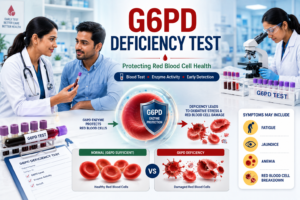
What G6PD deficiency test means and foods to avoid
G6PD deficiency is an inherited condition in which red blood cells have reduced activity of the glucose-6-phosphate dehydrogenase enzyme. This can make red blood cells more vulnerable to oxidative stress. Fava beans and certain medicines can trigger hemolysis in susceptible people, so individuals with confirmed or suspected G6PD deficiency should discuss medicines and dietary precautions with their healthcare provider.
What G6PD Is
Understanding the G6PD Enzyme
G6PD stands for glucose-6-phosphate dehydrogenase.
This enzyme helps red blood cells protect themselves from oxidative damage.
Because red blood cells do not have a nucleus, they rely heavily on protective biochemical pathways to survive.
Consequently, when G6PD activity is significantly reduced, certain oxidative stresses can damage red blood cells and cause them to break down.
This process is called hemolysis.
Is G6PD Deficiency Genetic?
Yes.
G6PD deficiency is an inherited enzyme disorder, and it is associated with changes in the G6PD gene.
Therefore, family history can be important when assessing risk.
However, having a relative with G6PD deficiency does not replace testing.
Why G6PD Deficiency Can Cause Anemia
What Happens During Hemolysis?
When red blood cells are destroyed faster than the body can replace them, haemoglobin levels can fall.
Consequently, a person may develop hemolytic anemia.
Symptoms can include:
- Tiredness
- Weakness
- Pale appearance
- Shortness of breath
- Rapid heartbeat
- Dark or tea-colored urine
- Jaundice
However, symptoms depend on the severity and timing of hemolysis.
Not Everyone With G6PD Deficiency Has Anemia
This is an important distinction.
Many people with G6PD deficiency have no symptoms until they encounter a trigger.
Therefore, a person can have G6PD deficiency while feeling completely healthy.
As a result, identifying the condition before a potential trigger can sometimes be useful.
Foods and Drugs That Can Trigger Problems
Fava Beans and G6PD Deficiency
Fava beans, also known as broad beans, are a well-known potential trigger for hemolysis in susceptible individuals.
Therefore, people with confirmed G6PD deficiency may be advised to avoid fava beans.
However, dietary recommendations should be individualized by a healthcare professional.
Medicines That May Trigger Hemolysis
Certain medicines can cause oxidative stress and may trigger hemolysis in people with G6PD deficiency.
Importantly, the list is specific to the medicine and dose, and recommendations can vary according to the available clinical evidence.
Therefore, never assume that a medicine is safe simply because it is commonly prescribed.
Tell Your Doctor About G6PD Status
If you have confirmed G6PD deficiency, inform every healthcare professional who prescribes medication for you.
Similarly, tell your pharmacist when purchasing medicines.
Consequently, potentially risky medicines can be reviewed before you take them.
Foods and Medicines to Avoid
Why You Should Not Rely on Random Online Lists
Online lists of medicines to avoid can be incomplete or outdated.
Therefore, patients should rely on guidance from a healthcare professional and current drug-safety references.
Important Precaution
Do not stop a prescribed medicine without medical advice.
If you already take a medicine and later discover that you may have G6PD deficiency, contact your healthcare provider before making changes.
Common in Certain Families
Why Family History Matters
G6PD deficiency is more common in some populations and geographic regions.
Consequently, a known family history can increase suspicion.
If a parent, sibling or close relative has confirmed G6PD deficiency, discussing testing with a healthcare professional may be appropriate.
Can Women Carry G6PD Variants?
Yes.
Because the G6PD gene is located on the X chromosome, women can carry G6PD variants and may have variable enzyme activity.
Therefore, women are not automatically unaffected.
Depending on the situation, a healthcare provider may recommend testing for women with a family history, symptoms or relevant clinical concerns.
G6PD Newborn Screening
Why Newborn Testing Can Matter
Newborns may develop jaundice for many reasons.
However, G6PD deficiency can contribute to significant neonatal jaundice in susceptible infants.
Therefore, Bangalore newborn screening may include or lead to G6PD testing when there is a relevant risk or clinical concern.
Which Babies May Need G6PD Testing?
Testing may be considered when there is:
- Family history of G6PD deficiency
- Significant or unexplained neonatal jaundice
- A previous affected sibling
- A relevant ancestry or family background
- Clinical evidence suggesting hemolysis
Consequently, not every newborn automatically needs a G6PD test.
G6PD Test: What Does It Measure?
Measuring Enzyme Activity
The G6PD test generally measures G6PD enzyme activity in red blood cells.
A reduced activity level can support a diagnosis of G6PD deficiency.
However, timing matters.
During or shortly after a hemolytic episode, the blood contains a higher proportion of young red blood cells, or reticulocytes, which can have more G6PD activity than older cells.
Therefore, in some situations, a test performed during acute hemolysis can appear less abnormal than expected.
A healthcare provider may recommend repeat testing when appropriate.
Why Newborn Results Need Careful Interpretation
Age Can Affect Interpretation
Newborn blood values differ from adult values.
Therefore, G6PD activity should be interpreted using appropriate age-related information and the laboratory’s reference range.
Moreover, the clinical situation matters, particularly when a newborn has significant jaundice.
G6PD Deficiency and Anemia Testing
Why CBC May Be Ordered Too
A Complete Blood Count (CBC) can assess haemoglobin and other blood-cell parameters.
Consequently, CBC may be useful when a healthcare professional is evaluating possible anemia or hemolysis.
However, a normal CBC does not rule out G6PD deficiency.
Therefore, G6PD-specific testing may still be appropriate when there is a relevant clinical reason.
Other Tests During Suspected Hemolysis
What Else Might Your Doctor Order?
Depending on the clinical situation, additional investigations can include:
- Reticulocyte count
- Bilirubin
- Lactate dehydrogenase (LDH)
- Haptoglobin
- Peripheral blood smear
- CBC
- Other tests to identify the cause of anemia
Therefore, G6PD testing may form only one part of a broader evaluation.
G6PD Deficiency Symptoms to Watch
Signs of a Possible Hemolytic Episode
After exposure to a potential trigger, symptoms may include:
- Sudden tiredness
- Pale skin
- Yellowing of the eyes or skin
- Dark urine
- Rapid heartbeat
- Shortness of breath
- Back or abdominal discomfort
Consequently, these symptoms should not be ignored, particularly in someone known to have G6PD deficiency.
When Is G6PD Testing Recommended?
Before Certain Medicines
One reason for testing is to identify G6PD deficiency when a medicine with potential oxidative risk is being considered.
Therefore, if a healthcare professional recommends a G6PD test before treatment, completing it can be important.
After Unexplained Hemolytic Anemia
If a patient develops hemolysis without an obvious cause, G6PD deficiency may form part of the differential diagnosis.
Consequently, testing may help identify an inherited explanation.
When There Is a Family History
A strong family history can justify discussing testing with a healthcare professional.
Therefore, knowing your G6PD status can be particularly useful before future medication exposure.
G6PD Deficiency and Infection
Can Infections Trigger Hemolysis?
Yes.
Certain infections themselves can create oxidative stress and trigger hemolysis in people with G6PD deficiency.
Therefore, an episode of infection can sometimes be followed by symptoms of anemia or jaundice.
However, not every infection causes hemolysis.
G6PD Deficiency Test Cost in Bangalore
How Much Does a G6PD Test Cost?
The G6PD Deficiency Test cost in Bangalore varies according to the diagnostic laboratory and testing method.
Moreover, the total price can differ if G6PD testing is booked together with CBC, bilirubin or other anemia-related investigations.
Therefore, before booking, confirm:
- Exact G6PD test name
- Current price
- Whether enzyme activity testing is included
- Home collection availability
- Report delivery process
G6PD Testing Through Home Collection
Can the Sample Be Collected at Home?
For eligible locations and appointments, blood samples for G6PD testing may be collected through home sample collection.
This can be particularly convenient for:
- Families with young children
- Newborn follow-up
- Working parents
- Patients requiring repeat blood tests
However, a newborn or acutely unwell patient may require direct medical assessment rather than waiting for routine home collection.
How to Book a G6PD Test in Bangalore
Step 1: Confirm the Test
First, check whether your healthcare provider has requested a G6PD enzyme activity test or another related investigation.
Step 2: Check Preparation
Next, ask whether any preparation is required.
For a standalone G6PD blood test, special preparation may not always be necessary. However, other tests ordered at the same time may have different requirements.
Step 3: Confirm Location
Then, check whether home collection is available for your area.
Step 4: Review Timing
If testing is being performed during or after a suspected hemolytic episode, ask your doctor whether repeat testing may be required.
Consequently, you can avoid misunderstandings about the result.
What If Your G6PD Result Is Low?
Don’t Self-Diagnose From a Number
A low G6PD activity result may support G6PD deficiency.
However, interpretation depends on:
- Age
- Sex
- Laboratory reference range
- Recent hemolysis
- Reticulocyte count
- Transfusion history
- Clinical symptoms
Therefore, discuss the report with your healthcare provider.
Can G6PD Deficiency Be Cured?
Lifelong Condition, Usually Managed With Avoidance
G6PD deficiency is inherited and generally persists throughout life.
However, many people remain completely healthy by avoiding known triggers and seeking prompt treatment when hemolysis occurs.
Therefore, knowing your status can be more useful than worrying about the condition itself.
Frequently Asked Questions
What does G6PD deficiency mean?
G6PD deficiency is an inherited condition in which red blood cells have reduced glucose-6-phosphate dehydrogenase enzyme activity. As a result, they can be more vulnerable to oxidative stress and hemolysis.
What foods should people with G6PD deficiency avoid?
Fava beans are the best-known food trigger. However, dietary precautions should be discussed with a healthcare professional rather than relying on unverified online lists.
Why is G6PD testing important before certain medicines?
Some medicines can create oxidative stress and trigger hemolysis in susceptible individuals. Therefore, healthcare professionals may recommend G6PD testing before prescribing particular medicines.
Can G6PD deficiency cause anemia?
Yes. If hemolysis is significant, red blood cells can be destroyed faster than they are replaced, resulting in hemolytic anemia.
Can newborns be tested for G6PD deficiency?
Yes, testing may be considered in newborns with significant jaundice, family history or other relevant risk factors.
Does every newborn need a G6PD test?
No. Testing is generally considered based on family history, clinical findings, jaundice or other risk factors and local screening practices.
Can women have G6PD deficiency ?
Yes. Women can have reduced G6PD activity, although the presentation can differ because females have two X chromosomes.
Can infections trigger G6PD-related hemolysis?
Yes. Some infections can trigger oxidative stress and hemolysis in susceptible individuals.
Does a CBC detect G6PD deficiency?
No. CBC can help identify anemia or other blood abnormalities, but G6PD deficiency requires a specific G6PD activity test.
Can I get a G6PD test at home in Bangalore?
Home sample collection may be available for eligible locations and appointments. However, patients with severe jaundice, significant weakness, breathing difficulty or other acute symptoms should seek appropriate medical care promptly.
Conclusion
The G6PD Deficiency Test can be particularly useful when there is a family history, unexplained hemolytic anemia, significant newborn jaundice, or a need to consider medicines that may pose a risk to people with G6PD deficiency.
Moreover, understanding the condition can help families recognize why fava beans and certain medicines require caution.
However, G6PD deficiency is not something that can be diagnosed from symptoms alone. Therefore, appropriate testing and professional interpretation are important.
For Bangalore newborn screening, family-history evaluation, or pre-medication assessment, discuss G6PD testing with your healthcare provider and confirm the appropriate test before booking.