
The homocysteine test measures the amount of homocysteine in your blood. High homocysteine levels can be associated with an increased risk of cardiovascular disease, stroke and blood-vessel problems, particularly when combined with other risk factors or vitamin B12 and folate deficiency. However, a high result does not by itself mean that a person will have a heart attack or stroke.
For people in Bangalore, this test can sometimes be relevant when evaluating nutritional deficiencies, unexplained neurological symptoms, certain cardiovascular risk profiles, or a family history of early heart disease. Moreover, people following vegetarian or vegan diets may need particular attention to vitamin B12 intake because inadequate B12 can contribute to elevated homocysteine.
Therefore, understanding what the homocysteine test measures, when it may be useful and how the result is interpreted can help you make a more informed healthcare decision.
This Blog Includes:
- Article Title: Homocysteine Test – The Hidden Heart and Stroke Risk Marker
- Publisher: Prima Diagnostics
- Type: Test Explainer Healthcare Blog
- Topics Covered: Homocysteine, High Homocysteine, Cardiovascular Risk, Stroke Risk, Vitamin B12 Deficiency, Folate Deficiency, Vitamin B6, Vegetarian Nutrition, Young Heart Disease, Family History of Heart Disease, Kidney Function, Lipid Profile, Heart Health, and Patient Education.
- Services Covered: Homocysteine Blood Test, Vitamin B12 Test, Folate Testing, CBC, Kidney Function Test, Lipid Profile, Heart Health Screening, Preventive Health Testing, Home Sample Collection, Digital Reports, and Laboratory Diagnostics.
- Test Covered: Homocysteine Blood Test for measuring the concentration of homocysteine in the blood.
- Normal Range Guidance: Explains that a commonly used adult homocysteine reference range is approximately 5–15 µmol/L, while emphasizing that laboratory-specific reference ranges may vary and should be used for interpretation.
- Interpretation Guidance: Explains that elevated homocysteine is associated with cardiovascular and cerebrovascular risk but does not independently diagnose heart disease or predict a heart attack or stroke.
- Nutritional Guidance: Explains the relationship between homocysteine and vitamin B12, folate and vitamin B6, including the potential relevance of B12 deficiency among people with low dietary intake of animal-derived foods.
- Risk Assessment Guidance: Homocysteine should be considered alongside established cardiovascular risk factors such as blood pressure, cholesterol, diabetes, smoking, physical activity, body weight and family history.
- Related Tests: Vitamin B12, Folate, CBC, Kidney Function Test, Lipid Profile, ECG and other cardiac investigations as recommended by healthcare providers.
- Preparation Guidance: Follow any specific instructions given by your healthcare provider and the laboratory. Preparation requirements may vary depending on the test and accompanying investigations.
- FAQ Section: Included.
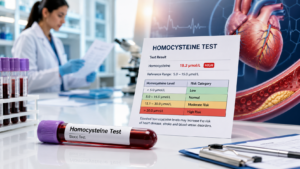
What Is Homocysteine Test?
Understanding This Amino Acid
Homocysteine is an amino acid produced naturally when the body processes methionine, another amino acid obtained from food.
Normally, the body converts homocysteine into other substances through metabolic pathways that depend partly on vitamins such as:
- Vitamin B12
- Folate (vitamin B9)
- Vitamin B6
Consequently, when these pathways are disrupted, homocysteine can accumulate in the bloodstream.
Why Does Homocysteine test Matter?
High Levels and Blood-Vessel Health
Elevated homocysteine has been associated with vascular and cardiovascular risk.
In particular, higher levels may be associated with:
- Damage or dysfunction of the blood-vessel lining
- Increased cardiovascular risk
- Stroke risk
- Certain clotting-related concerns
- Vitamin B12 or folate deficiency
However, it is important to understand the distinction between association and direct causation.
A high homocysteine result does not automatically mean that it is causing a heart problem. Instead, it may be one piece of a larger cardiovascular and nutritional assessment.
Homocysteine and Heart Attack Risk
Can High Homocysteine Cause a Heart Attack?
High homocysteine is associated with cardiovascular risk, but it should not be considered an independent diagnosis of heart disease.
For example, a person may have elevated homocysteine along with:
- High LDL cholesterol
- Diabetes
- High blood pressure
- Smoking
- Obesity
- Family history of premature heart disease
Therefore, cardiovascular risk should be assessed as a whole rather than based on homocysteine alone.
Homocysteine and Stroke Risk
Why Is Stroke Risk Discussed?
Research has found associations between elevated homocysteine and cerebrovascular disease.
However, lowering homocysteine with vitamin supplementation does not necessarily eliminate cardiovascular or stroke risk.
Therefore, a high result should encourage appropriate evaluation rather than creating unnecessary fear.
The Link Between Homocysteine and Vitamin B12
Why B12 Deficiency Can Raise Homocysteine
Vitamin B12 plays an important role in homocysteine metabolism.
When B12 is insufficient, the body’s ability to process homocysteine can be affected.
Consequently, a person with elevated homocysteine may also require evaluation of vitamin B12 status.
This is particularly relevant for people who have dietary risk factors for B12 deficiency.
Bangalore Vegetarian B12 Deficiency Concerns
Why Diet Can Matter
Vegetarian diets can be healthy and nutritionally balanced. However, vitamin B12 is naturally concentrated in animal-derived foods, although fortified foods and supplements can provide B12.
Therefore, people consuming little or no animal-derived food may need to pay particular attention to adequate B12 intake.
This does not mean that every vegetarian person will have B12 deficiency.
Nevertheless, if symptoms, dietary risk or laboratory findings suggest deficiency, B12 testing may be appropriate.
Folate and Homocysteine
Another Important Vitamin
Folate is also involved in homocysteine metabolism.
Therefore, inadequate folate can contribute to elevated homocysteine.
Good dietary sources of folate include:
- Green leafy vegetables
- Beans and lentils
- Citrus fruits
- Nuts
- Fortified foods
However, supplementation should be based on individual requirements and healthcare advice.
Vitamin B6 and Homocysteine
Vitamin B6 also participates in pathways involved in homocysteine metabolism.
Consequently, deficiencies affecting these vitamin-dependent pathways can contribute to abnormal homocysteine levels.
For this reason, a healthcare provider may consider multiple nutritional factors rather than focusing on homocysteine alone.
Who Should Consider a Homocysteine Test?
When Can Testing Be Useful?
A healthcare provider may consider homocysteine testing in selected situations, such as:
- Suspected vitamin B12 deficiency
- Suspected folate deficiency
- Certain neurological symptoms
- Unexplained elevated cardiovascular risk
- Selected patients with premature cardiovascular disease
- Certain family or medical histories
- Evaluation of abnormal vitamin-related laboratory findings
However, homocysteine is not a routine screening test that every healthy adult necessarily needs.
The decision should depend on your clinical situation.
Young Heart Attacks and Homocysteine
Does Homocysteine Explain Early Heart Disease?
When a younger person develops cardiovascular disease unexpectedly, doctors may investigate multiple potential contributors.
These can include:
- Cholesterol abnormalities
- Diabetes
- Blood pressure
- Smoking
- Family history
- Lifestyle factors
- Certain inherited conditions
- Nutritional deficiencies
Homocysteine may sometimes be considered as part of this broader assessment.
However, a high homocysteine level should not be assumed to be the sole explanation for a young heart attack.
Family History and Homocysteine
When Genetics May Matter
A strong family history of premature cardiovascular disease can increase an individual’s overall risk.
Certain inherited conditions can also cause very high homocysteine levels, although these are uncommon.
Therefore, if several close family members have developed cardiovascular disease at unusually young ages, discuss the family history with your healthcare provider.
Homocysteine Normal Range
What Is a Normal Homocysteine Level?
A commonly used adult reference range is approximately 5–15 µmol/L, although the exact reference interval can vary between laboratories and testing methods.
Therefore, always interpret your result using the reference range printed on your own laboratory report.
A result slightly above the laboratory range does not automatically mean that you have cardiovascular disease.
Instead, your doctor may consider your B12, folate, kidney function, medications, age, diet and overall cardiovascular risk.
What Causes High Homocysteine?
Several factors can contribute to elevated levels.
These may include:
Vitamin B12 Deficiency
Insufficient B12 can interfere with normal homocysteine metabolism.
Folate Deficiency
Low folate can also affect homocysteine processing.
Vitamin B6 Problems
B6 participates in another pathway involved in homocysteine metabolism.
Kidney Problems
Kidney function can influence homocysteine levels.
Certain Medications and Medical Conditions
Some medicines and medical conditions can affect vitamin metabolism or homocysteine concentration.
Therefore, finding the underlying reason is more useful than simply focusing on the number.
How Can High Homocysteine Be Lowered?
Treat the Underlying Cause
The appropriate approach depends on why the level is elevated.
If testing identifies a vitamin deficiency, treatment may involve correcting the deficiency under medical guidance.
For example, your healthcare provider may recommend appropriate B12 or folate supplementation.
Improve Your Diet
A balanced diet can provide important nutrients involved in homocysteine metabolism.
Include appropriate amounts of:
- Green leafy vegetables
- Legumes
- Whole grains
- Nuts and seeds
- Fruits
- Fortified foods
- B12-containing foods where appropriate
For people with dietary restrictions, a healthcare provider or dietitian can help develop an appropriate nutritional plan.
Don’t Focus Only on Homocysteine
Even if your homocysteine level improves, cardiovascular prevention remains important.
Therefore, also pay attention to:
- Blood pressure
- LDL cholesterol
- Blood sugar
- Physical activity
- Smoking
- Body weight
- Sleep
- Overall diet
Consequently, treating the broader risk profile is generally more important than chasing one laboratory number.
Tests That May Be Paired With Homocysteine test
Depending on the reason for testing, your healthcare provider may consider additional investigations.
These can include:
Helps assess B12 status when deficiency is suspected.
Folate Test
Can help evaluate folate status.
CBC
A complete blood count can provide additional information when nutritional deficiency is suspected.
Kidney Function Test
Kidney function can influence homocysteine levels.
Cholesterol is a major cardiovascular risk factor and should be evaluated independently.
Heart Checkup
Depending on symptoms and risk factors, your doctor may recommend an ECG, blood pressure assessment or other cardiac investigations.
Homocysteine Test Cost in Bangalore
How Much Does the Test Cost?
The homocysteine test cost in Bangalore varies depending on the diagnostic laboratory, testing platform and whether it is booked as an individual test or as part of a health package.
Therefore, patients should confirm the current price before booking.
At Prima Diagnostics, you can enquire about homocysteine testing, available collection options and related vitamin or cardiovascular investigations.
Is Fasting Required?
Preparation requirements can vary by laboratory and by whether other blood tests are being performed at the same time.
Therefore, follow the laboratory’s instructions before sample collection.
If your healthcare provider has given specific preparation instructions, follow those instructions carefully.
How Long Does It Take to Get the Result?
The reporting time depends on the laboratory and testing process.
Therefore, confirm the expected turnaround time while booking, particularly if the test is being performed alongside other investigations.
Frequently Asked Questions
What does a high homocysteine level mean for your heart?
A high homocysteine level is associated with increased cardiovascular and stroke risk in some studies. However, it does not by itself diagnose heart disease or predict that a heart attack will occur. Other risk factors and underlying causes should be evaluated.
What is the normal homocysteine range?
A commonly used adult range is approximately 5–15 µmol/L, but ranges differ between laboratories. Always use the reference interval printed on your report.
Can B12 deficiency increase homocysteine?
Yes. Vitamin B12 is involved in homocysteine metabolism, so B12 deficiency can contribute to elevated levels.
Can vegetarians have high homocysteine?
They can, particularly if vitamin B12 intake is inadequate. However, being vegetarian does not automatically mean that homocysteine will be high.
Does high homocysteine mean I will have a heart attack?
No. High homocysteine is a risk-associated marker, not a prediction that a heart attack will occur. Overall cardiovascular risk must be assessed.
Can high homocysteine be lowered?
If the elevation is related to vitamin deficiency, correcting the underlying deficiency may lower homocysteine. Your healthcare provider should determine the appropriate treatment.
Should everyone get a homocysteine test?
No. It is not necessarily required as routine screening for every healthy adult. Testing is more useful in selected clinical situations.
What tests should be done with homocysteine?
Depending on the reason for testing, your doctor may consider B12, folate, CBC, kidney function, lipid profile and other investigations.
Conclusion
The homocysteine test can provide useful information about a person’s nutritional status and, in selected situations, their broader cardiovascular risk profile. However, it should not be treated as a standalone “heart attack prediction test.”
For Bangalore residents, particularly people with B12 deficiency risk, vegetarian diets, a strong family history or unexpectedly early cardiovascular disease, homocysteine may sometimes be worth discussing with a healthcare provider.
Moreover, an elevated result does not automatically mean that your heart is unhealthy. Instead, it can prompt a closer look at B12, folate, kidney function and established cardiovascular risk factors such as cholesterol, blood pressure and diabetes.
Ultimately, the most useful approach is to identify the reason for an abnormal result and address the overall risk profile. If your healthcare provider recommends testing, Prima Diagnostics can provide homocysteine testing and related laboratory investigations, with available collection options depending on service coverage.