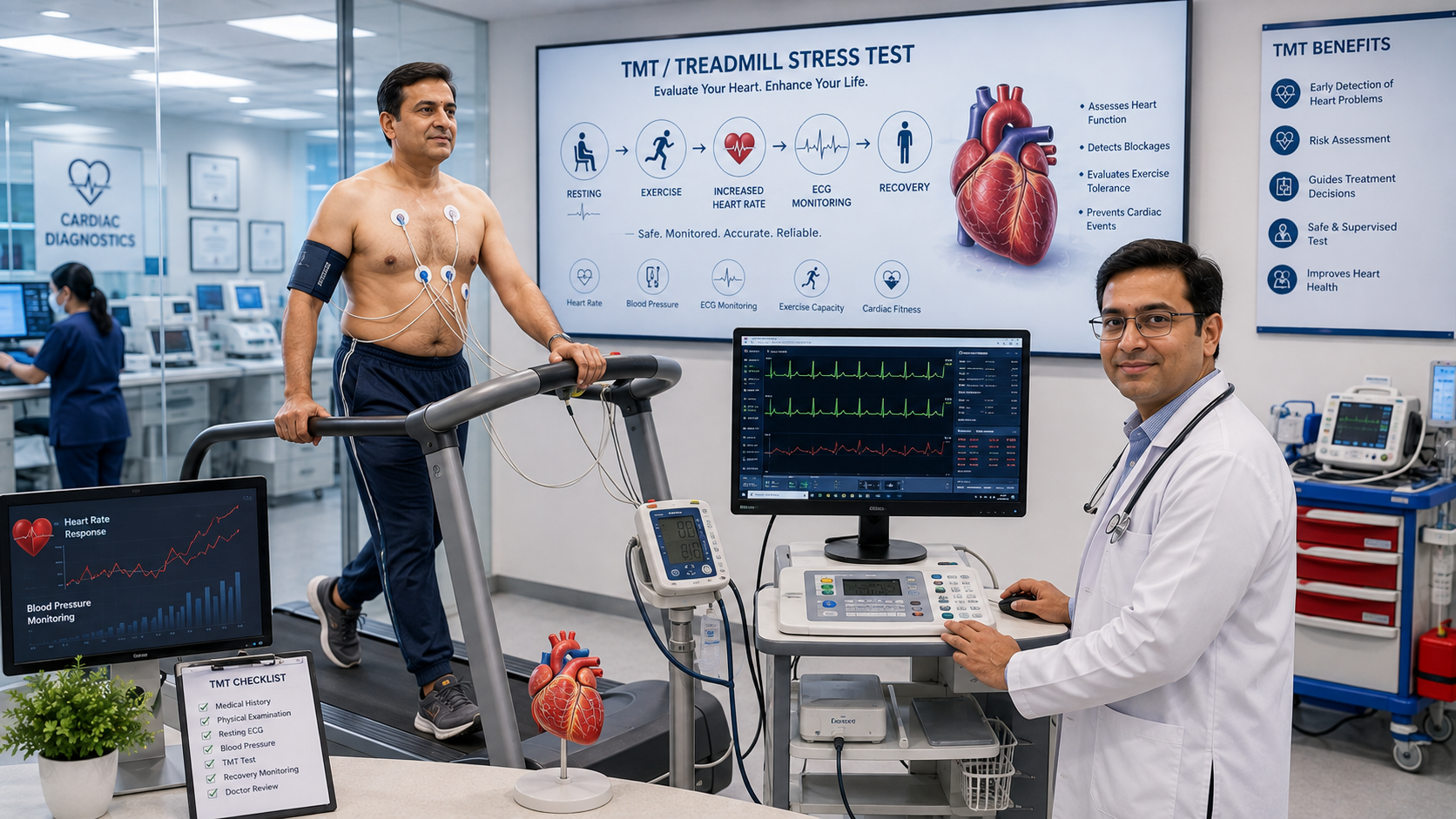
TMT / Treadmill Stress Test Cost and What It Detects
The TMT / Treadmill stress test cost in Bangalore depends on the diagnostic centre, the test setup, and whether it is booked alone or as part of a cardiac evaluation package. A TMT, or treadmill stress test, records your heart’s electrical activity while you exercise and can help assess how the heart responds to increasing physical workload.
For people with Bangalore heart-risk concerns, especially those experiencing chest pain on exertion, unexplained breathlessness, or reduced exercise tolerance, a TMT may be recommended by a doctor. Moreover, for people with an IT sedentary lifestyle, the test may become relevant when other cardiovascular risk factors are present.
However, a TMT is not simply a test to “find blocked arteries.” Instead, it looks for exercise-related changes that may suggest reduced blood supply to the heart and helps the healthcare provider decide whether further evaluation is required.
This Blog Includes:
- Article Title: TMT / Treadmill Stress Test Cost in Bangalore
- Publisher: Prima Diagnostics
- Type: Test Cost Guide Healthcare Blog
- Topics Covered: TMT, Treadmill Stress Test, Exercise Stress Test, TMT Cost in Bangalore, Cardiac Risk, Exercise-Induced ECG Changes, Myocardial Ischaemia, Chest Pain on Exertion, ECG, 2D Echo, Coronary Angiography, Cardiac Evaluation, Heart Health, IT Sedentary Lifestyle, and Patient Education.
- Services Covered: TMT / Treadmill Stress Test, ECG, 2D Echocardiography, Cardiac Diagnostic Services, Cardiac Risk Assessment, Preventive Health Testing, Home Sample Collection for Eligible Blood Tests, Digital Reports, and Laboratory Diagnostics.
- Test Covered: TMT / Treadmill Stress Test, including resting measurements, exercise ECG monitoring, heart rate monitoring, blood pressure monitoring, symptom assessment, and recovery monitoring.
- Comparison Covered: TMT vs Resting ECG, TMT vs 2D Echo, TMT vs Coronary Angiography, and the different purposes of functional and anatomical cardiac investigations.
- Preparation Guidance: Wear comfortable clothing and suitable footwear for treadmill exercise. Follow the specific preparation instructions provided by your healthcare provider. Fasting requirements and medication instructions may vary depending on the individual’s clinical situation and accompanying tests. Do not stop prescribed medicines without medical advice.
- FAQ Section: Included.

What Is a TMT?
Understanding the TMT / Treadmill Stress Test
A Treadmill Test (TMT), also called an exercise stress test, evaluates how your heart performs during gradually increasing physical activity.
During the test:
- ECG electrodes are attached to your chest.
- Your resting heart rate and ECG are recorded.
- You begin walking on a treadmill.
- The speed and incline gradually increase.
- Your ECG, heart rate and symptoms are monitored.
- The test ends according to the protocol and your clinical response.
- Recovery is monitored afterward.
Therefore, unlike a resting ECG, a TMT evaluates the heart while it is working harder.
Why Is a TMT Done?
A TMT may help evaluate:
- Chest discomfort during exertion
- Breathlessness with activity
- Exercise tolerance
- Possible myocardial ischaemia
- Certain abnormal ECG findings
- Response to treatment in selected patients
Consequently, it can provide information that a resting ECG alone may not reveal.
TMT / Treadmill Stress Test Cost in Bangalore
How Much Does a TMT TMT / Treadmill Stress Test Cost?
The TMT stress test cost in Bangalore varies between diagnostic centres and depends on the services included.
Pricing may differ because of:
- Equipment used
- Cardiologist supervision
- Facility location
- Reporting process
- Whether consultation is included
- Whether TMT is part of a cardiac package
Therefore, patients should confirm the current price with the diagnostic centre before booking.
At Prima Diagnostics, patients can enquire about TMT availability, pricing, preparation requirements and appointment slots before scheduling the test.
What Can a TMT Detect?
Can a TMT Detect Blocked Arteries?
A TMT can provide evidence that may suggest reduced blood flow to the heart during exercise.
When the heart works harder, it requires more oxygen. If blood supply cannot increase sufficiently, exercise-related ECG changes or symptoms may occur.
Therefore, an abnormal TMT can raise suspicion of myocardial ischaemia.
However, a TMT does not directly show the blockage itself.
This distinction is important.
A TMT is a functional test, whereas imaging tests such as coronary CT angiography or invasive coronary angiography can provide anatomical information about coronary arteries.
TMT and Chest Pain on Exertion
If you experience chest discomfort while:
- Walking quickly
- Climbing stairs
- Exercising
- Carrying heavy objects
Your doctor may consider an exercise-based cardiac evaluation depending on your symptoms and overall risk.
However, chest pain should never be self-diagnosed using a TMT.
If chest pain is sudden, severe, persistent, or associated with symptoms such as sweating, breathlessness, fainting or pain spreading to the arm or jaw, seek urgent medical attention rather than waiting for a routine test.
TMT vs 2D Echo vs Angiogram
These tests answer different questions.
TMT
A TMT primarily evaluates how the heart responds to exercise and whether exercise produces findings suggestive of myocardial ischaemia.
A 2D echocardiogram uses ultrasound to assess:
- Heart chambers
- Pumping function
- Heart valves
- Certain structural abnormalities
- Heart muscle movement
Therefore, a 2D echo focuses more on the heart’s structure and function.
Coronary Angiogram
Coronary angiography is an anatomical assessment of the coronary arteries and can identify narrowing or blockage directly.
Consequently, TMT, 2D echo, and angiography should not be considered interchangeable tests.
TMT vs ECG
A resting ECG records the heart’s electrical activity while you are generally at rest.
In contrast, a TMT records ECG changes while physical workload increases.
Therefore, a TMT can sometimes reveal exercise-related changes that may not be present on a resting ECG.
However, neither test should be interpreted independently when evaluating complex cardiac symptoms.
Who Should Consider a TMT?
A TMT may be recommended for selected individuals with:
- Suspected stable coronary artery disease
- Exertional chest discomfort
- Exercise-related breathlessness
- Certain cardiovascular risk factors
- Specific ECG abnormalities
- A need to assess exercise capacity
Your doctor may consider factors such as:
- Age
- Symptoms
- Diabetes
- Blood pressure
- Cholesterol
- Smoking history
- Family history
- Previous cardiac disease
- Baseline ECG
Therefore, a TMT should be performed when clinically appropriate rather than simply because of age or lifestyle.
Bangalore IT Lifestyle and Heart Risk
Long hours at a desk can reduce daily physical activity.
Furthermore, irregular meals, prolonged sitting, stress, inadequate sleep, and limited exercise can contribute to cardiovascular risk factors.
However, having an IT sedentary lifestyle does not automatically mean you need a TMT.
Instead, your overall risk profile and symptoms should guide testing decisions.
Regular physical activity, healthy food choices, adequate sleep, and appropriate preventive screening remain important components of cardiovascular health.
 TMT / Treadmill Stress Test Preparation
Do You Need to Fast?
Fasting requirements can vary depending on your healthcare provider’s instructions and whether other tests are being performed at the same appointment.
Therefore, confirm the preparation instructions before arriving.
What Should You Wear?
Wear comfortable clothing and footwear suitable for walking or exercising on a treadmill.
Avoid heavy meals immediately before the test unless specifically instructed otherwise.
Medicines Before a TMT
Some medicines can affect heart rate and exercise response.
Therefore, do not stop any medication on your own.
Your healthcare provider will tell you whether any medication needs to be adjusted or temporarily withheld before the test.
Follow any specific instructions given by your healthcare provider.
What Happens During the Test?
Before exercise begins, your resting measurements are recorded.
Then, as you walk on the treadmill, the workload gradually increases.
Meanwhile, the healthcare team monitors:
- ECG
- Heart rate
- Blood pressure
- Symptoms
- Exercise response
The test may be stopped if you develop significant symptoms or if the supervising medical team determines that stopping is appropriate.
Afterward, recovery measurements are recorded.
How Long Does a TMT / Treadmill Stress Test Take?
The exercise portion itself is usually relatively short, although the total appointment takes longer because of preparation, baseline measurements and recovery monitoring.
Therefore, allow enough time for the complete procedure rather than planning around only the treadmill exercise period.
What Does an Abnormal TMT Mean?
An abnormal TMT does not automatically prove that a coronary artery is blocked.
Instead, it may indicate that additional evaluation is needed.
Depending on your symptoms and risk profile, your doctor may recommend:
- 2D Echo
- Stress imaging
- Coronary CT angiography
- Other cardiac investigations
- Cardiology consultation
Consequently, the next step depends on the complete clinical picture.
How to Book a TMT / Treadmill Stress Test in Bangalore
Before booking, confirm:
- Current TMT price
- Appointment availability
- Preparation requirements
- Whether cardiologist supervision is included
- Reporting process
- Whether additional consultation is available
- Home collection availability for any accompanying blood tests
At Prima Diagnostics, patients can enquire about cardiac testing options and available appointments.
Frequently Asked Questions
What is the TMT / Treadmill Stress Test cost in Bangalore?
The cost varies by diagnostic centre and by what is included in the service. Contact the centre for the current TMT price and appointment details.
What does a TMT detect?
A TMT evaluates the heart’s response to exercise and can identify ECG or symptom patterns that may suggest reduced blood flow to the heart during exertion.
Can TMT show blocked arteries?
Not directly. TMT is primarily a functional test. It may suggest myocardial ischaemia, while coronary angiography or coronary CT angiography provides anatomical information about coronary arteries.
Is TMT / Treadmill Stress Test better than a 2D echo?
Neither is universally “better.” They assess different aspects of heart health. TMT evaluates exercise response, while 2D echo evaluates heart structure and function.
Is TMT the same as an ECG?
No. A resting ECG records electrical activity while you are generally at rest. A TMT records ECG changes during increasing exercise.
Who should undergo a TMT?
A TMT may be recommended for selected patients with symptoms or cardiovascular risk factors. Your doctor should determine whether it is appropriate for you.
Do I need to stop medicines before TMT?
Some medicines can influence heart rate and exercise response. However, never stop medication without medical instructions. Follow your healthcare provider’s specific preparation guidance.
Can IT professionals have a TMT for preventive screening?
A sedentary IT lifestyle can contribute to cardiovascular risk factors, but a TMT is not automatically required for every IT professional. Discuss your individual risk profile and symptoms with a healthcare provider.
Conclusion
The TMT / Treadmill Stress Test cost in Bangalore is only one factor to consider when choosing where to undergo the test. More importantly, patients should understand what the TMT actually evaluates and why it may be recommended.
A treadmill stress test assesses the heart during increasing physical workload and can identify findings that may suggest reduced blood supply during exercise. However, it does not directly visualize coronary blockages. Instead, it can help doctors decide whether further cardiac evaluation is appropriate.
For Bangalore heart-risk patients, particularly those experiencing chest pain on exertion, understanding the difference between TMT, ECG, 2D echo and angiography is therefore important. Likewise, people with sedentary IT lifestyles should focus on their complete cardiovascular risk profile rather than relying on one test.
Ultimately, the right cardiac test depends on your symptoms, medical history and doctor’s assessment. If a TMT is recommended, choosing a reliable diagnostic provider such as Prima Diagnostics can help make the testing process more convenient and organized.