
📍Your CentreSelect Centre

Why Do Your Reports Differ Between Two Labs? NABL Explained
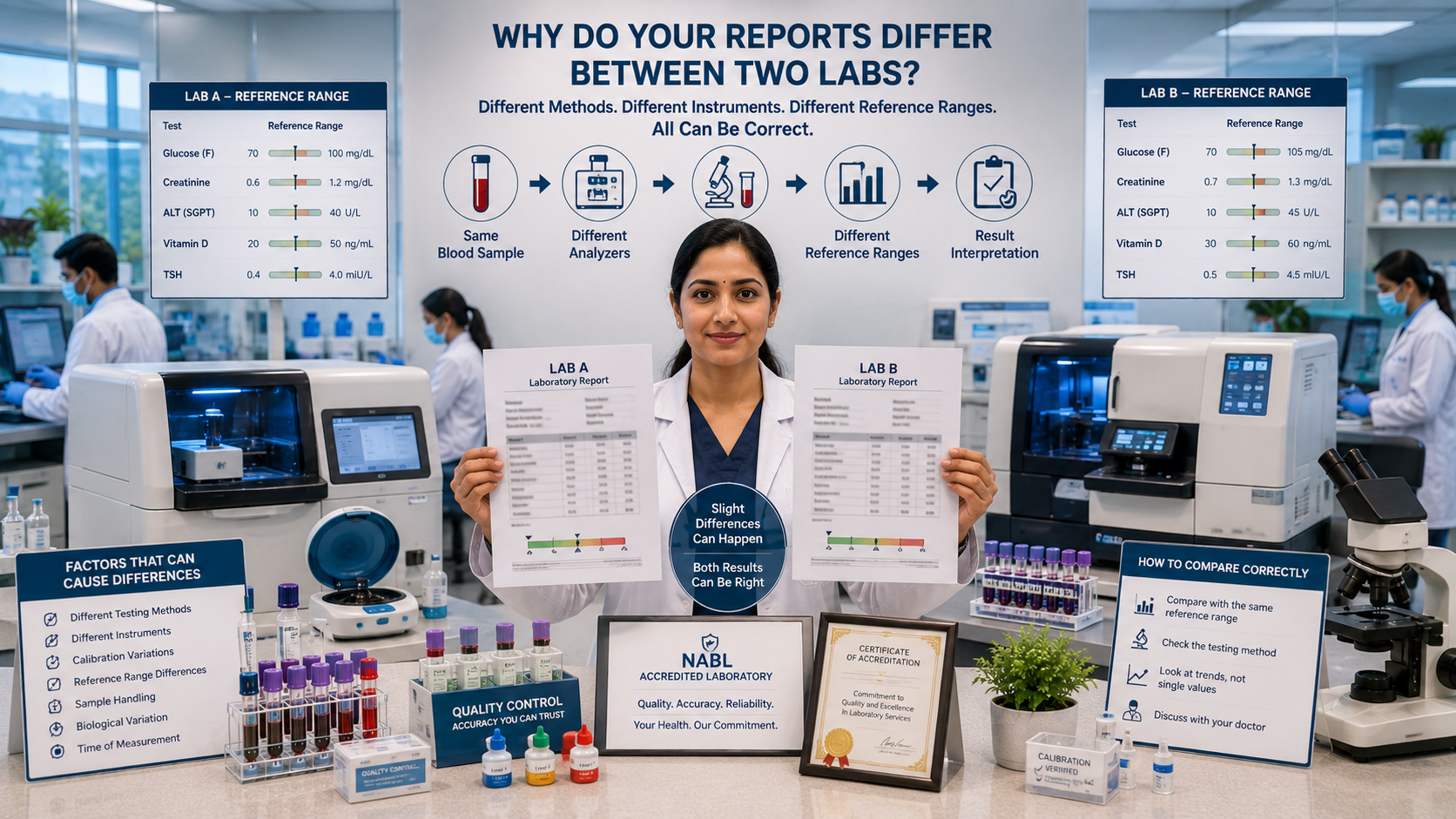
Why Blood Test Reports Differ Between Two Labs

Blood test results can differ between two laboratories because of differences in testing methods, instruments, calibration, sample handling, reference ranges, and laboratory procedures. A small variation does not necessarily mean that one report is wrong. Instead, results should be interpreted using the laboratory’s own reference range, the test method, clinical context, and previous results.

For Bangalore patients comparing labs, this can be particularly frustrating when a blood test performed at one laboratory produces a slightly different number from a test performed elsewhere. Furthermore, people seeking a second opinion may become concerned when two reports do not look identical.

However, understanding why blood test results differ between labs can make these differences much easier to interpret. More importantly, choosing a laboratory with robust quality systems and appropriate accreditation can improve confidence in your testing process.

This Blog Includes:

  • Article Title: Why Do Your Reports Differ Between Two Labs? NABL Explained
  • Publisher: Prima Diagnostics
  • Type: Myth / Decision Guide Healthcare Blog
  • Topics Covered: Differences Between Laboratory Results, Blood Test Result Variation, Laboratory Testing Methods, Analyzer Differences, Calibration, Reference Ranges, Sample Collection, Biological Variation, NABL Accreditation, Quality Control, External Quality Assessment, Second Opinions, Laboratory Comparison, Consistent Health Monitoring, and Patient Education.
  • Services Covered: Blood Tests, Biochemistry Testing, Haematology Testing, Hormone Testing, Immunoassays, Specialized Laboratory Testing, Preventive Health Screening, Home Sample Collection, Digital Reports, and Laboratory Diagnostics.
  • Laboratory Quality Topics Covered: Testing Methodology, Analyzer Performance, Calibration, Internal Quality Control, External Quality Assessment, Sample Handling, Laboratory Documentation, Staff Competency, and Quality Management Systems.
  • Educational Guidance: Explains why results can vary between laboratories, how biological and analytical variation affect results, why reference ranges may differ, how testing methods and instruments influence measurements, and how patients can correctly compare reports.
  • NABL Guidance: Explains the role of NABL accreditation in assessing laboratory competence and quality-management systems within an accredited scope. Clarifies that NABL accreditation does not guarantee identical numerical results across different laboratories.
  • Report Comparison Guidance: Patients should compare the exact test name, units, reference range, testing date, sample preparation, testing method where relevant, and clinical context before interpreting differences between reports.
  • Consistency Guidance: Using the same trusted laboratory for regular monitoring can make longitudinal trends easier to interpret, particularly for tests such as HbA1c, thyroid testing, lipid profile, liver enzymes, kidney function and vitamin levels.
  • Preparation Guidance: Follow the preparation instructions provided for each individual test. Fasting, exercise, hydration, medication timing and time of sample collection may influence certain laboratory results. Follow any specific instructions given by your healthcare provider.
  • Service Focus: Laboratory Quality Awareness, Reliable Diagnostic Testing, NABL Accreditation Awareness, Second-Opinion Guidance, Consistent Health Monitoring, Home Sample Collection, Digital Reporting, and Patient Education.
  • FAQ Section: Included.

Reports Differ Between Two Labs


The Frustrating Problem of Different Results

Imagine that you have a blood test at Lab A and receive a cholesterol result of one value. A few days later, you repeat the same test at Lab B and receive a slightly different number.

Naturally, you may wonder:

  • Which report is correct?
  • Did one laboratory make a mistake?
  • Has my health changed?
  • Should I repeat the test again?
  • Which number should I show my doctor?

First of all, a difference does not automatically indicate an error.

Laboratory testing involves several stages, and variation can occur at each stage.

Therefore, instead of comparing numbers alone, it is better to understand how the test was performed.

Why Do Numbers Vary in Reports Differ Between Two Labs?

Several factors can influence laboratory results.

Different Testing Methods

Laboratories may use different analytical methods or technologies for the same test.

For example, a particular biochemical test may be performed using different analytical principles or reagent systems.

Consequently, two laboratories can produce slightly different numerical results while both results remain analytically acceptable.

This is one reason why a laboratory report should always be interpreted according to the method and reference range used by that laboratory.

Differences in Machines and Instruments

Modern diagnostic laboratories use automated analyzers to perform many blood tests.

However, different laboratories may use different analyzer platforms.

Even when two instruments measure the same analyte, their analytical characteristics can vary slightly.

Therefore, a result of 100 on one analyzer should not automatically be expected to appear as exactly 100 on another analyzer.

This does not necessarily mean that either laboratory is incorrect.

Calibration Can Influence Results

Laboratory analyzers require calibration and quality-control procedures.

Calibration helps ensure that instruments produce measurements that are consistent with established standards.

Furthermore, laboratories regularly monitor analytical performance through internal quality-control systems and, where applicable, external quality-assessment programs.

Consequently, reliable laboratory testing depends not only on the machine itself but also on how the laboratory manages and monitors that equipment.

Sample Collection Can Change Results

Interestingly, differences can occur before the sample even reaches the analyzer.

For example:

  • Fasting status
  • Hydration
  • Exercise before testing
  • Time of sample collection
  • Tourniquet use
  • Sample transport
  • Time between collection and processing

can influence certain laboratory measurements.

Therefore, if you compare two tests performed on different days, the difference may reflect a combination of biological and analytical variation.

Your Body Changes Too

This is an important point that is sometimes overlooked.

Even if you use the same laboratory and the same machine, your result can naturally change from day to day.

For example, glucose, triglycerides, cortisol and several other measurements can be influenced by:

  • Food intake
  • Stress
  • Physical activity
  • Sleep
  • Medication
  • Hydration
  • Time of day
  • Recent illness

Consequently, a change between two reports does not necessarily mean that the laboratory methods are responsible.

Reference Range Differences

One of the most confusing aspects of comparing reports is the reference range.

A reference range represents the range expected in a defined reference population under specific laboratory conditions.

Therefore, the reference range printed on one report may not be identical to the range printed on another laboratory’s report.

For example, two laboratories might display slightly different upper limits for the same test.

Does That Mean One Is Wrong?

Not necessarily.

Reference intervals can vary because of:

  • Testing methodology
  • Analyzer system
  • Population used to establish the interval
  • Statistical approach
  • Laboratory-specific validation

Therefore, always read the result together with the reference range printed on that particular report.

Don’t Compare the Number Alone

Suppose one report says:

TSH: 4.5

and another says:

TSH: 4.8

It may be tempting to assume that the second result is significantly worse.

However, that conclusion cannot be made from the number alone.

You also need to consider:

  • Units
  • Reference range
  • Testing method
  • Date of testing
  • Symptoms
  • Medications
  • Clinical history

Therefore, a doctor should interpret the results rather than simply comparing the numerical values.

Machine and Method Differences

Different laboratories may use different platforms for:

  • Biochemistry
  • Immunoassays
  • Hormone testing
  • Haematology
  • Molecular testing

Some tests are particularly method-dependent.

For example, hormone assays and certain specialized tests may show meaningful analytical differences between platforms.

Consequently, when monitoring a condition over time, using the same laboratory and, where practical, the same testing method can make trends easier to interpret.

Why NABL Accreditation Matters

For Bangalore patients with trust concerns, laboratory accreditation can provide an additional level of confidence in the laboratory’s quality-management processes.

NABL stands for the National Accreditation Board for Testing and Calibration Laboratories.

NABL accreditation is based on established standards and assessment of laboratory competence and quality systems.

Importantly, accreditation is not simply about having a modern machine.

It involves broader aspects of laboratory operations, including areas such as:

  • Quality management
  • Technical competence
  • Testing procedures
  • Equipment management
  • Staff competency
  • Documentation
  • Quality control

Therefore, NABL accreditation can be an important factor when choosing a diagnostic laboratory.

Does NABL Mean Every Result Will Be Identical?

No.

This distinction is important.

NABL accreditation does not mean that every laboratory result will be numerically identical across all laboratories.

Instead, it indicates that the accredited laboratory has been assessed against applicable competence and quality requirements within its accredited scope.

Therefore, small differences between two acceptable laboratory results can still occur.

What Quality Control Means

Quality control is an ongoing part of laboratory testing.

Laboratories may use control materials to monitor whether an analyzer is performing within expected limits.

If a quality-control result falls outside acceptable limits, laboratory personnel can investigate before reporting patient results, according to the laboratory’s procedures.

Furthermore, laboratories may participate in external quality-assessment or proficiency-testing programs where applicable.

Consequently, quality is not determined by the analyzer alone.

How to Compare Two Reports Correctly

If you are comparing reports from two laboratories, use this checklist.

Step 1: Check the Test Name

Make sure both laboratories actually performed the same test.

A similar-looking test name does not always mean identical methodology.

Step 2: Check the Units

Units can differ between laboratories.

Therefore, never compare numbers until you confirm that the units are the same.

Step 3: Check the Reference Range

Look at the reference interval printed on each report.

Do not automatically apply Lab A’s reference range to Lab B’s result.

Step 4: Check the Testing Date

Results collected weeks or months apart may reflect genuine biological changes.

Therefore, timing matters.

Step 5: Check Your Preparation

Ask whether both tests were performed under similar conditions.

For example:

  • Were you fasting?
  • Did you exercise heavily?
  • Did you take your usual medicines?
  • Was the sample collected at a similar time?

Step 6: Check the Method When Important

For specialized tests, method and analyzer differences can be particularly relevant.

Therefore, ask the laboratory or your healthcare provider when a precise comparison is clinically important.

Stick to One Trusted Lab for Monitoring

When you are tracking a condition over time, consistency can be extremely helpful.

For example, if you are monitoring:

  • HbA1c
  • Thyroid levels
  • Lipid Profile
  • Liver enzymes
  • Kidney function
  • Vitamin levels

using the same trusted laboratory can make trends easier to assess.

This does not mean you should never use another laboratory.

Rather, when results are being compared over several months, consistency in laboratory, method and testing conditions can reduce unnecessary confusion.

What About Second Opinions?

Getting a second opinion is completely reasonable when a result is unexpected or does not match your clinical picture.

However, instead of immediately repeating every test at a different laboratory, discuss the result with your doctor first.

Your doctor may determine that you need:

  • A repeat test
  • A confirmatory test
  • A different method
  • Additional investigations
  • No repeat testing at all

Consequently, the best next step depends on the specific test and clinical situation.

When Should You Repeat a Test?

A repeat test may be considered when:

  • The result is unexpected
  • The result conflicts with symptoms
  • Sample quality was questionable
  • The value is close to an important clinical decision point
  • The healthcare provider wants confirmation
  • There was a significant preparation difference

However, repeating a test unnecessarily can create confusion and expense.

Therefore, repeat testing should ideally be guided by your healthcare provider.

How to Choose a Trusted Diagnostic Lab in Bangalore

When selecting a laboratory, consider more than price.

Look for:

Accreditation and Quality Systems

Check whether the laboratory has relevant accreditation for the tests you require.

Clear Reports

A useful report should clearly show:

  • Test name
  • Result
  • Units
  • Reference range
  • Relevant method information where applicable

Convenient Services

For busy Bangalore residents, home sample collection can also be useful.

Consistency

If you require repeated monitoring, using the same laboratory can make longitudinal comparison easier.

Why Prima Diagnostics Can Be a Practical Choice

Prima Diagnostics provides laboratory diagnostic services across Bangalore, including blood testing and home sample collection services at covered locations.

For patients who regularly monitor health parameters, maintaining reports from the same laboratory can make trend comparison more straightforward.

Additionally, patients can discuss unexpected results with their healthcare provider before deciding whether a repeat test or second opinion is necessary.

The goal is not simply to find the laboratory with the lowest price. Instead, it is to choose a diagnostic provider where quality, consistency, convenience, and trust are all considered.

Frequently Asked Questions

Why do blood test results report differ between two labs?

Results can vary because of differences in testing methods, analyzers, calibration, reference ranges, sample handling and normal biological variation. Therefore, a small difference does not automatically mean one report is incorrect.

Which lab result should I trust if two reports are different?

Neither result should be judged from the number alone. Compare the units, reference ranges, testing methods, collection conditions and dates. Your healthcare provider can determine which result is clinically relevant.

Does NABL accreditation guarantee identical results?

No. NABL accreditation supports laboratory competence and quality systems, but different laboratories can still produce slightly different results because of analytical methods, instruments and reference intervals.

Should I use the same lab for regular health monitoring?

Generally, using the same trusted laboratory can make trends easier to compare because the testing system and reference intervals are more consistent.

Can fasting affect blood test results?

Yes. Certain tests can be affected by food intake, while others may not require fasting. Therefore, follow the preparation instructions provided for the specific tests being performed.

Should I repeat an abnormal test at another lab?

Not automatically. First discuss the result with your healthcare provider. Depending on the test and clinical situation, they may recommend repeating it, using a confirmatory method, or performing another investigation.

Are two different reference ranges a sign that one lab is wrong?

No. Reference intervals can vary between laboratories because of differences in methodology, populations and laboratory-specific validation.

Can home collection affect laboratory results?

Sample collection and transport conditions can influence certain tests if appropriate procedures are not followed. Therefore, laboratories should follow proper sample-collection, handling and transport protocols.

Conclusion

Why do your reports differ between two labs? In most cases, the answer is more complicated than simply saying that one laboratory is right and the other is wrong. Differences in analytical methods, machines, calibration, reference ranges, sample handling, preparation and even normal biological variation can all influence results.

For Bangalore patients comparing labs, especially those seeking a second opinion, the best approach is to compare the test name, units, reference range, method, testing date and preparation conditions rather than focusing only on the final number.

Moreover, NABL accreditation can provide useful reassurance about a laboratory’s assessed quality and technical competence within its accredited scope. Nevertheless, accreditation does not mean every result will be identical across laboratories.

Ultimately, if you are monitoring a health condition over time, staying with one trusted laboratory such as Prima Diagnostics can make your reports easier to compare and your health trends easier for your doctor to interpret. When an unexpected result appears, discuss it with your healthcare provider before repeatedly testing at multiple laboratories.

Select Your Nearest Centre

This helps us show the right centre at checkout.