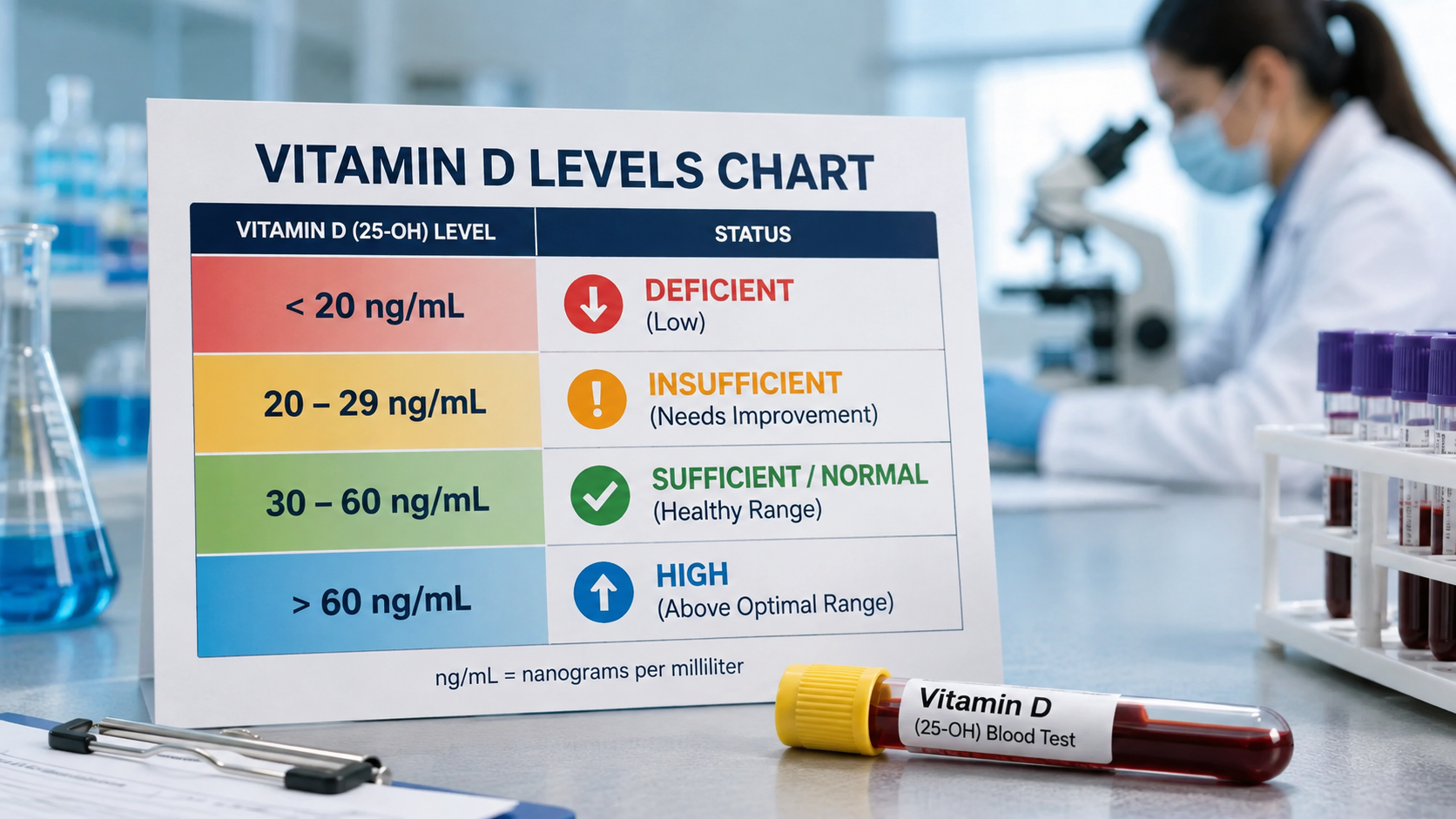
Vitamin D Levels Chart (ng/ml) - Deficient to Optimal
The vitamin D levels chart helps show whether your blood vitamin D level is low, insufficient, adequate, or potentially higher than needed. The commonly used 25-hydroxyvitamin D [25(OH)D] blood test is the standard test for assessing vitamin D status. However, laboratory reference ranges and clinical interpretation can vary, so your report should always be reviewed with the reference range provided by the laboratory and your healthcare provider.
| Vitamin D Level (ng/mL) |
General Interpretation |
| Below 12 |
Deficiency / very low |
| 12–19 |
Low / generally inadequate |
| 20–29 |
Often considered insufficient by some guidelines |
| 30–50 |
Generally adequate for many adults |
| Above 50 |
May be higher than needed; interpretation depends on context |
Importantly, there is no single cutoff that applies identically to every person. Therefore, the number should be interpreted alongside symptoms, health history, age, bone health, medications, and clinical risk factors.
This Blog Includes:
- Article Title: Vitamin D Levels Chart - Deficient, Insufficient, Normal (ng/ml)
- Publisher: Prima Diagnostics
- Type: Chart / Normal Range Healthcare Blog
- Topics Covered: Vitamin D Levels, 25-Hydroxyvitamin D, Vitamin D Deficiency, Vitamin D Insufficiency, Adequate Vitamin D Levels, Vitamin D Symptoms, Vitamin D Supplements, Sun Exposure, Dietary Vitamin D, Bone Health, Tiredness, Retesting After Supplementation, and Patient Education.
- Services Covered: Vitamin D Blood Test, Preventive Health Screening, Bone Health Testing, Routine Blood Tests, Home Sample Collection, Digital Reports, Laboratory Diagnostics, and Health Check-up Services.
- Test Covered: 25-Hydroxyvitamin D [25(OH)D] Blood Test for assessing vitamin D status.
- Vitamin D Level Guidance: Explains commonly used vitamin D categories in ng/mL, including very low levels below 12 ng/mL, low levels of 12–19 ng/mL, commonly classified insufficient levels of 20–29 ng/mL, and generally adequate levels around 30–50 ng/mL. Clarifies that reference ranges and clinical targets can vary.
- Interpretation Guidance: Vitamin D results should be interpreted using the laboratory's reference range together with symptoms, age, medical history, medications, bone health, and individual clinical circumstances.
- Supplementation Guidance: Explains that vitamin D supplementation depends on the severity of deficiency and individual health factors. High-dose vitamin D should not be taken without appropriate medical guidance.
- Preparation Guidance: Follow any specific instructions given by your healthcare provider. Testing and retesting schedules should be based on the individual's treatment plan and clinical requirements.
- Lifestyle Guidance: Covers sunlight exposure, indoor work, air-conditioned office environments, sunscreen use, dietary vitamin D sources, and lifestyle factors that may influence vitamin D status.
- FAQ Section: Included.
 How Vitamin D Levels Is Measured
The 25(OH)D Blood Test
How Vitamin D Levels Is Measured
The 25(OH)D Blood Test
Vitamin D status is usually assessed using a blood test called
25-hydroxyvitamin D, also written as 25(OH)D.
This test reflects vitamin D obtained from sunlight, food and supplements over time.
Consequently, it is different from measuring the active hormone form of vitamin D, which is usually reserved for specific medical situations.
Vitamin D Units
Vitamin D results are commonly reported in:
- ng/mL in many laboratories
- nmol/L in some laboratories
Therefore, always check the unit before comparing your result with an online vitamin D chart.
Vitamin D Levels Chart Explained
What Does Deficient Mean?
Very low vitamin D levels may indicate inadequate vitamin D stores.
In addition, people with significant deficiency may have increased risk of bone and muscle problems, particularly when the deficiency persists.
However, symptoms alone cannot confirm deficiency.
A blood test is needed for proper assessment.
What Does Insufficient Mean?
An insufficient result indicates that the level may not be ideal according to the reference system being used.
Nevertheless, the appropriate target can vary depending on the individual's health status.
For example, someone with osteoporosis or certain medical conditions may require a different management approach from a healthy adult.
What Is a Normal or Adequate Level?
A level around
30–50 ng/mL is commonly considered adequate for many adults.
However, "normal" should not be treated as a universal target.
Instead, your healthcare provider should interpret the result according to your circumstances and the laboratory's reference interval.
Symptoms at Different Vitamin D Levels
Symptoms of Low Vitamin D
Vitamin D deficiency can sometimes occur without obvious symptoms.
When symptoms do occur, they may include:
- Tiredness
- Muscle weakness
- Muscle or bone discomfort
- Frequent aches
- Reduced physical strength
- In some cases, bone pain
Furthermore, these symptoms are not specific to vitamin D deficiency.
For example, tiredness can also be associated with anaemia, thyroid problems, poor sleep, stress, nutritional deficiencies and many other conditions.
Therefore, testing is more reliable than guessing based on symptoms.
Why Are Bangaloreans Low Despite the Sun?
Bengaluru Has Plenty of Sunshine - So Why Vitamin D Deficiency?
At first glance, this seems surprising.
Bengaluru receives considerable sunlight throughout the year. Nevertheless, many urban residents may spend much of their day indoors.
This is particularly relevant for people working in
air-conditioned offices.
Indoor IT Work
For many IT professionals, the typical day may involve:
- Travelling to an office
- Spending several hours indoors
- Sitting at a desk
- Working in air-conditioned rooms
- Returning home after sunset
Consequently, total skin exposure to sunlight may be much lower than expected.
Bengaluru AC Offices and Vitamin D
Air conditioning itself does not directly cause vitamin D deficiency.
Instead, the lifestyle associated with indoor workplaces can reduce opportunities for sunlight exposure.
Therefore, an office worker who spends most of the day indoors may receive considerably less UVB exposure than someone who regularly spends time outdoors.
Does Sunscreen Cause Vitamin D Deficiency?
Sunscreen reduces UV radiation reaching the skin.
However, sunscreen should not simply be abandoned to increase vitamin D production.
Sun exposure must be balanced against the risk of sunburn, premature skin ageing and skin cancer.
Therefore, discuss appropriate sunlight exposure with your healthcare provider rather than deliberately seeking excessive UV exposure.
How Much Supplement Do You Need?
Vitamin D Supplements Depend on Your Level
The appropriate supplement dose depends on several factors, including:
- Your current vitamin D level
- Age
- Body weight
- Dietary intake
- Bone health
- Medical conditions
- Medications
- Previous vitamin D treatment
Therefore, there is
no single supplement dose for every level on the chart.
Mildly Low Levels
For mildly low levels, a healthcare provider may recommend a vitamin D supplement and dietary or lifestyle changes.
The exact dose and duration should follow professional advice.
Significant Deficiency
For substantial deficiency, healthcare providers may prescribe higher-dose replacement for a defined period, followed by maintenance supplementation.
However, high-dose vitamin D should not be taken indefinitely without medical supervision.
Why Too Much Vitamin D Can Be Harmful
More vitamin D is not always better.
Excessive supplementation can increase calcium levels and potentially cause problems such as nausea, weakness, excessive thirst and kidney-related complications.
Therefore, avoid self-prescribing large doses simply because your result is low.
Foods That Provide Vitamin D
Dietary Sources
Food can contribute to vitamin D intake, although diet alone may not always provide enough vitamin D.
Sources can include:
- Fatty fish
- Egg yolks
- Fortified milk
- Cereals
- Certain mushrooms
- Fortified dairy or plant-based products
Therefore, a balanced diet can complement sunlight exposure and supplementation when required.
Sun Exposure and Vitamin D
Sunlight helps the body produce vitamin D through UVB exposure.
However, vitamin D production depends on several factors, including:
- Time of day
- Season
- Skin pigmentation
- Clothing
- Age
- Location
- Amount of exposed skin
- Sunscreen use
Consequently, simply being outdoors does not guarantee adequate vitamin D production.
Avoid prolonged exposure that causes sunburn.
When Should You Test Vitamin D?
Who May Benefit From Testing?
Vitamin D testing may be considered when clinically appropriate, particularly in people with risk factors such as:
- Bone health concerns
- Osteoporosis or osteopenia
- Recurrent fractures
- Certain malabsorption conditions
- Limited sun exposure
- Certain medications affecting vitamin D metabolism
- Symptoms that prompt clinical evaluation
However, routine testing is not necessarily required for every healthy person.
When to Retest After Supplements
How Soon Should Vitamin D Be Rechecked?
The timing of repeat testing depends on the severity of deficiency, treatment plan and clinical circumstances.
Generally, vitamin D levels are
not checked again after only a few days, because the body needs time to respond to supplementation.
A healthcare provider may recommend reassessment after a period of treatment, often after several weeks or months depending on the situation.
Therefore, follow the retesting schedule provided by your doctor rather than repeatedly testing too soon.
Vitamin D and Bone Health
Vitamin D plays an important role in calcium absorption and bone health.
Consequently, persistent deficiency can contribute to poor bone mineralization and, in difficult situations, bone-related disorders.
For people with osteoporosis, fractures or other bone-health concerns, vitamin D may be assessed alongside other investigations.
A vitamin D result should therefore be considered as part of the wider picture rather than in isolation.
Vitamin D and Tiredness
Can Low Vitamin D Cause Fatigue?
Low vitamin D can be associated with tiredness in some people.
However, fatigue has many possible causes.
For example, persistent tiredness may also be linked to:
- Anaemia
- Thyroid disorders
- Diabetes
- Poor sleep
- Nutritional deficiencies
- Stress
- Infections
- Other medical conditions
Therefore, if tiredness persists, a healthcare provider may recommend broader evaluation rather than assuming vitamin D is the only cause.
Vitamin D Test in Bengaluru
If you have symptoms, risk factors or a healthcare recommendation for testing, a
25-hydroxyvitamin D blood test can help assess your vitamin D status.
At
Prima Diagnostics, patients can enquire about vitamin D testing, available collection options and related health investigations.
For busy Bengaluru professionals, home sample collection may also make routine testing more convenient where available.
Frequently Asked Questions
What is the normal vitamin D level in ng/mL?
A level around
30–50 ng/mL is commonly considered adequate for many adults. However, interpretation varies by guideline, laboratory and individual health circumstances.
What vitamin D level is considered deficient?
Very low levels, particularly
below 12 ng/mL, are generally considered deficient. Results between 12 and 19 ng/mL are also generally considered inadequate. Your healthcare provider should interpret the result in context.
Is 20 ng/mL vitamin D low?
A level of 20 ng/mL is at the lower end of commonly used ranges. Some guidelines consider 20 ng/mL adequate for many people, while others classify levels below 30 ng/mL as insufficient. Therefore, the laboratory reference range and clinical context matter.
Is 30 ng/mL a good vitamin D level?
Around 30 ng/mL is generally considered adequate by many clinical approaches. However, the appropriate target depends on the individual and the reason for testing.
Why is vitamin D low in Bengaluru despite plenty of sunlight?
Many Bengaluru residents spend much of their day indoors, particularly in air-conditioned offices. IT desk work, commuting, clothing and limited outdoor exposure can therefore reduce opportunities for UVB exposure.
Does sunscreen reduce vitamin D production?
Sunscreen can reduce UVB exposure and therefore may reduce vitamin D production through the skin. Nevertheless, sunscreen remains important for protecting against excessive UV exposure and skin damage.
Should I take vitamin D supplements if my level is low?
You may need supplementation, but the appropriate dose depends on your result and health circumstances. Follow your healthcare provider's recommendation rather than taking high-dose supplements without supervision.
When should I repeat a vitamin D test?
The appropriate retesting interval depends on your starting level and treatment plan. Vitamin D is generally not retested immediately after beginning supplements because levels need time to change.
Conclusion
The
vitamin D levels chart is a useful starting point for understanding whether a 25(OH)D result is low, insufficient, or adequate. Nevertheless, the numbers should never be interpreted in isolation.
For Bengaluru residents, especially people spending long hours in
AC offices and indoor IT workplaces, limited sunlight exposure can contribute to low vitamin D despite living in a sunny city. At the same time, sunscreen use, clothing, lifestyle, and individual factors can influence vitamin D production.
Therefore, if your vitamin D level is low, the right approach is not simply to take the largest possible supplement dose. Instead, discuss the result with your healthcare provider, consider appropriate diet and lifestyle measures, and follow a suitable supplementation and retesting plan.
If persistent tiredness, muscle discomfort, or bone-health concerns are present, vitamin D testing may be one part of a broader evaluation.
Prima Diagnostics can provide vitamin D testing and other relevant laboratory investigations, with available collection options depending on location and service coverage.