Seeing
WBC marked “high” or “low” on a blood report can immediately raise questions. Is it an infection? Is it dengue? Or could it simply be a temporary change? Fortunately, a WBC result needs to be interpreted in context. The
WBC count normal range can vary with age, pregnancy, health status, medications and the laboratory's reference range.
Therefore, one abnormal result does not automatically mean something serious.
Moreover, during Bengaluru's viral fever and dengue seasons, WBC and platelet checks are commonly included in medical evaluation. So, understanding what your report means can help you discuss the next step with your doctor.
This Blog includes:
- Article Title: WBC Count Normal Range Chart - High or Low White Blood Cells Explained
- Publisher: Prima Diagnostics
- Type: Health Information / Normal Range Chart / Test Explainer
- Target Keyword: WBC Count Normal Range
- Topics Covered: WBC Count, White Blood Cells, Normal WBC Range, High WBC, Low WBC, WBC Differential, Dengue and Viral Fever
- Test Included: CBC (Complete Blood Count)
- Reference Information: Adult WBC range, age-related differences, pregnancy-related changes and laboratory-specific reference ranges
- Preparation Guidance: Follow any specific instructions given by your healthcare provider; fasting is generally not required for a CBC unless other prescribed tests require it.
- Service Focus: CBC Testing, Blood Testing and Home Sample Collection
- Healthcare Service: Pathology / Diagnostic Blood Testing
- Local SEO Focus: Bengaluru, Bengaluru viral fever season, dengue season, CBC testing and home sample collection across Bengaluru
- FAQ Section: Included
 What Is WBC in a Blood Test?
WBC stands for white blood cells
What Is WBC in a Blood Test?
WBC stands for white blood cells, which are an important part of the immune system.
In simple terms, white blood cells help the body identify and respond to infections, inflammation and other immune-related challenges.
Therefore, the WBC count tells you approximately how many white blood cells are present in a given volume of blood.
What WBC Means in Simple Words
Think of WBCs as part of your body's
defense team.
When the body responds to an infection or inflammation, the number and types of white blood cells can change. Consequently, doctors may look at the WBC count when someone has a fever, weakness, recurrent infections, or other symptoms.
However, WBC is only one piece of the picture. Your doctor may also consider the
differential WBC count, haemoglobin, platelets, symptoms, and medical history.
What Is the WBC Count Normal Range?
For many healthy adults, a commonly used
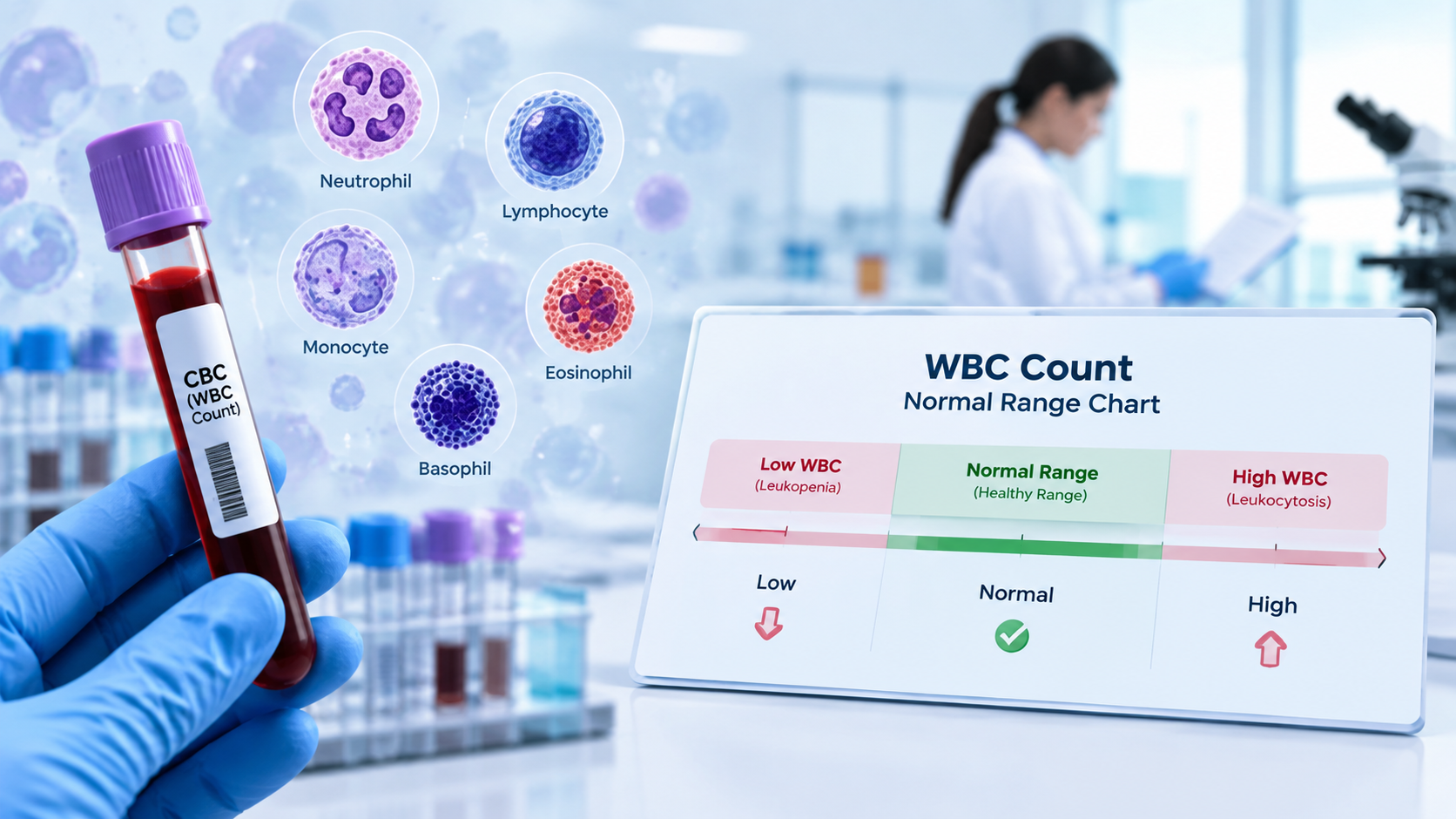
WBC count normal range is approximately 4,000–11,000 cells/µL (4.0–11.0 × 10⁹/L).
However, the exact reference range can differ between laboratories, age groups, and clinical situations. Therefore, always compare your result with the reference interval printed on your own laboratory report.
WBC Count Normal Range Chart
| Group |
Common WBC Reference Range* |
| Adults |
Approximately 4,000–11,000 cells/µL |
| Children |
Usually higher and varies significantly with age |
| Newborns |
Often considerably higher than adult values |
| Pregnancy |
WBC can be physiologically higher, particularly later in pregnancy |
*These are general reference ranges, not personal diagnostic cut-offs. Laboratory-specific ranges should be used when interpreting an individual report.
Why Do Children's WBC Count Normal Range Differ?
Children do not necessarily have the same WBC reference range as adults.
In fact, normal values can change considerably from newborn age through infancy, childhood, and adolescence. Therefore, a child's result should be compared with the
age-specific reference range provided by the laboratory or pediatrician.
What About WBC During Pregnancy?
Pregnancy can naturally increase the WBC count.
Consequently, a pregnant person's WBC result should not automatically be interpreted using an adult non-pregnancy range. Instead, the result should be considered alongside the pregnancy stage, symptoms, and the laboratory's reference interval.
High WBC Count – What Does It Mean?
A
high WBC count, medically called leukocytosis, means the number of white blood cells is above the laboratory's expected range.
However, a high WBC does not automatically mean a bacterial infection.
There are several possible reasons.
High WBC Due to Infection
One of the most common reasons for an elevated WBC is an infection.
For example, bacterial infections can increase certain types of white blood cells. Viral infections can also cause changes in WBC count and differential counts.
Therefore, doctors usually look at the complete blood picture rather than WBC alone.
High WBC During Inflammation
Inflammation can also affect WBC levels.
Consequently, conditions involving inflammation, tissue injury or immune responses may sometimes be associated with an increased WBC count.
Stress, Exercise and Other Temporary Causes
Interestingly, WBC levels can temporarily rise because of physical stress, strenuous exercise, certain medications and other short-term factors.
Therefore, a mildly elevated WBC result does not necessarily indicate a serious disease.
When Is High WBC More Important?
A persistently elevated WBC, particularly when accompanied by symptoms or other abnormal blood counts, deserves medical evaluation.
Your doctor may consider repeating the CBC or ordering additional tests depending on the overall picture.
Low WBC Count – What Does It Mean?
A
low WBC count, commonly referred to as leukopenia, means that the WBC level is below the laboratory's reference range.
Again, however, one low result does not automatically indicate a dangerous condition.
Low WBC During Viral Infections
Some viral infections can temporarily reduce WBC counts.
This is particularly relevant during periods of increased viral fever in Bengaluru. Therefore, doctors may recommend a CBC during or after a febrile illness when clinically appropriate.
Low WBC and Dengue
Dengue can be associated with changes in blood counts, including a reduction in WBC in some patients.
However,
WBC alone cannot diagnose dengue.
Because dengue can also affect platelets and other clinical parameters, your doctor may recommend appropriate dengue testing and repeat blood counts depending on symptoms and the stage of illness.
Medicines and Other Causes
Certain medicines, nutritional deficiencies, immune-related conditions and disorders affecting blood-cell production can also contribute to low WBC.
Therefore, persistent or significantly low results should be evaluated rather than interpreted in isolation.
WBC and Platelets: Why Doctors May Check Both
During fever, particularly when dengue is being considered, doctors may monitor both
WBC and platelet counts.
The reason is simple: these are different blood parameters and can provide different pieces of information.
For example, a platelet count may change during dengue, while WBC changes can also occur. Nevertheless, neither result should be used alone to diagnose or rule out dengue.
WBC Differential: More Than Just a Total Count
A CBC usually provides more information than the total WBC number.
The
differential count breaks white blood cells into different types, such as:
- Neutrophils
- Lymphocytes
- Monocytes
- Eosinophils
- Basophils
Consequently, the differential can sometimes provide additional clues about the body's immune response.
For instance, doctors may pay attention to the neutrophil and lymphocyte pattern along with symptoms and other test results.
When Should You See a Doctor?
If your WBC is slightly above or below the reference range and you feel well, your doctor may simply recommend monitoring or repeating the test.
However, medical review becomes particularly important when an abnormal WBC result occurs with:
- Persistent or high fever
- Recurrent infections
- Unusual tiredness or weakness
- Unexplained weight loss
- Persistent swollen lymph nodes
- Unusual bruising or bleeding
- Repeated abnormal CBC results
Moreover, if you are experiencing significant symptoms during a suspected infection, do not delay medical evaluation simply because one blood-count value appears normal.
Which Test Should You Repeat?
The most common follow-up is a
CBC (Complete Blood Count).
A repeat CBC can help determine whether the WBC abnormality was temporary or persistent.
Depending on the situation, your doctor may also consider:
CBC With Differential
This provides additional information about the different types of WBCs.
Platelet Count
This may be monitored when clinically indicated, especially during certain febrile illnesses.
Dengue Testing
If dengue is suspected based on symptoms, exposure, and clinical assessment, an appropriate dengue test may be recommended.
Other Tests
Depending on your symptoms, your doctor may recommend additional investigations rather than repeatedly checking WBC alone.
Therefore, the right follow-up test depends on
why the WBC is abnormal in the first place.
How Bengaluru's Viral Fever Season Affects WBC Testing
Bengaluru experiences periods when viral fever and mosquito-borne illnesses become more common.
Consequently, people visiting doctors with fever may be asked to undergo CBC testing. During suspected dengue, doctors may monitor CBC and platelet counts over time.
However, it is important to remember that
a WBC count cannot independently confirm dengue, viral fever, or any specific infection.
Instead, diagnosis is based on symptoms, examination, exposure history, and appropriate laboratory testing.
Can You Get a WBC Test at Home in Bengaluru?
Yes. A CBC requires a blood sample, so it can often be performed through home sample collection services.
For people who are unwell, elderly, busy with work or unable to travel comfortably, home collection can be particularly convenient.
Prima Diagnostics provides diagnostic testing and home sample collection services across Bengaluru, subject to availability.
How to Read a WBC Result Correctly
When you receive your report, do not look only at whether the WBC is marked
H (high) or
L (low).
Instead, check:
- Your actual WBC value
- The laboratory's reference range
- Your differential WBC counts
- Haemoglobin and RBC-related parameters
- Platelet count
- Your symptoms
- Any medicines you are taking
Furthermore, compare the result with previous CBC reports when available.
A trend can sometimes be more useful than a single isolated number.
Frequently Asked Questions About WBC Count Normal Range
What is the WBC count normal range?
For many adults, the commonly used WBC count normal range is approximately
4,000–11,000 cells/µL. However, the reference range can vary by laboratory, age, and clinical circumstances.
Is a WBC count of 12,000 high?
A WBC count of 12,000 cells/µL is above many commonly used adult reference ranges. Nevertheless, the significance depends on symptoms, differential counts, medications, and the reason the CBC was performed.
Is a low WBC dangerous?
Not necessarily. A low WBC can occur temporarily, including during some viral infections. However, persistent or significantly low WBC levels should be evaluated by a healthcare professional.
Does dengue cause low WBC?
Dengue can be associated with a low WBC count in some patients. However, WBC alone cannot diagnose dengue, so appropriate clinical assessment and dengue testing may be needed.
Does dengue always cause low platelets?
No. Platelet levels can change during dengue, but the pattern varies according to the illness stage and individual patient. Therefore, platelet results should be interpreted with symptoms and medical assessment.
Can pregnancy increase WBC count?
Yes. WBC counts can physiologically increase during pregnancy. Therefore, pregnancy-specific clinical context and laboratory reference ranges are important.
Should I repeat my CBC if WBC is high?
Your doctor may recommend repeating a CBC when appropriate, particularly if the WBC abnormality is unexplained, persistent or associated with symptoms.
Can I get a CBC test at home in Bengaluru?
Yes. Home sample collection can make CBC testing more convenient for eligible locations across Bengaluru. Availability should be confirmed while booking.
Conclusion
Ultimately, the
WBC count normal range is a useful starting point, but it is not the entire story. A high or low WBC count can occur for many different reasons, ranging from temporary infections and physical stress to conditions that require further evaluation.
Therefore, rather than worrying about a single number, look at the complete CBC report, your symptoms and the laboratory's reference range. Moreover, if your doctor has recommended a repeat CBC, following that advice can help determine whether the change is temporary or persistent.
During Bengaluru's viral fever and dengue season, CBC and platelet monitoring may become especially common. Nevertheless, these results should always be interpreted alongside appropriate clinical assessment and, when required, specific infection testing.