
Noticing a swelling in the neck can understandably make you concerned. However, a lump in the front or side of the neck does not automatically mean something serious. In fact, neck swelling can have several causes, including an enlarged thyroid, thyroid nodule, swollen lymph node, cyst, infection, or other conditions.
Therefore, the first step is not to panic but to understand what the swelling could represent. Depending on its location, size, movement, duration, and associated symptoms, a doctor may recommend blood tests and imaging.
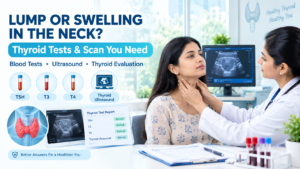
In particular, TSH, T3, T4, Anti-TPO and thyroid ultrasound may be used when a thyroid-related cause is suspected. Moreover, if an ultrasound identifies a nodule with features that require further evaluation, a doctor may recommend a fine-needle aspiration biopsy (FNAC).
This Blog Includes:
- Article Title: Lump or Swelling in the Neck? Thyroid Tests and Scan You Need
- Publisher: Prima Diagnostics
- Target Keyword: Swelling in the Neck
- Search Intent: Understanding which tests and scans may be needed after noticing a swelling or lump in the neck
- Topics Covered: Thyroid swelling, goitre, thyroid nodules, swollen lymph nodes, neck lumps and thyroid evaluation
- Tests Included: TSH, T3, T4 and Anti-TPO
- Imaging Covered: Thyroid ultrasound
- Procedure Covered: Fine-Needle Aspiration Cytology (FNAC)
- Preparation Guidance: Follow the specific instructions provided by your healthcare provider or diagnostic centre
- Local SEO Focus: Prima Diagnostics centres in Bangalore, thyroid testing, ultrasound availability and same-week appointment enquiries
- FAQ Section: Included
What Can Cause Swelling in the Neck?
A neck lump can come from different structures. Consequently, its exact location can provide an important clue.
Common possibilities include:
- Enlarged thyroid or goitre
- Thyroid nodule
- Swollen lymph node
- Thyroid inflammation
- Infection
- Cyst
- Salivary gland swelling
- Less commonly, other growths or conditions
Importantly, you should not try to identify the cause simply by looking at the swelling yourself. A clinical examination is often needed before deciding which tests are appropriate.
Thyroid Swelling (Goitre) vs Lymph Node vs Other
- Thyroid swelling or goitre
A goitre is an enlargement of the thyroid gland, which sits at the lower front of the neck. It may appear as a swelling that becomes more noticeable when swallowing. Goitres can be associated with normal, overactive, or underactive thyroid function.
Additionally, a thyroid gland may contain one or more nodules. These can be felt as a lump or may be discovered during an ultrasound.
Lymph nodes are small structures located throughout the neck. They can become enlarged when the body responds to infections such as a throat infection, cold, dental infection, or other inflammatory conditions.
For this reason, a tender lump following an infection may have a different cause from a painless swelling that has been present for a longer period.
- Other neck lumps
Not every neck swelling comes from the thyroid or lymph nodes. Cysts, salivary gland problems and other conditions can also produce a lump.
Therefore, if a swelling persists, grows, becomes painful, or is associated with other symptoms, it is sensible to have it examined.
Which Test Is Done for Swelling in the Neck?
The appropriate test depends on what your doctor finds during the examination.
When a thyroid problem is suspected, the initial evaluation may include thyroid blood tests and thyroid ultrasound. TSH is commonly used to assess thyroid function, while T3 and T4 provide additional information about thyroid hormone levels.
If autoimmune thyroid disease is suspected, an Anti-TPO antibody test may also be requested.
For a suspected thyroid nodule, ultrasound is particularly important because it can show the size, structure and appearance of the nodule and can also assess nearby lymph nodes.
Thyroid Blood Tests: TSH, T3 and T4
TSH test
TSH, or thyroid-stimulating hormone, helps assess how actively the thyroid is functioning.
An abnormal TSH result may indicate that additional thyroid testing is required. However, TSH alone cannot determine whether a neck lump is benign or cancerous.
T3 test
T3, or triiodothyronine, is one of the thyroid hormones. It may be useful when evaluating suspected thyroid overactivity, depending on the clinical situation.
T4 test
T4, or thyroxine, is another major thyroid hormone. Doctors may evaluate T4 along with TSH to understand thyroid function more clearly.
Consequently, thyroid blood tests answer an important question: Is the thyroid functioning normally?
However, they do not necessarily explain the physical characteristics of a lump.
What Is the Anti-TPO Test?
The Anti-TPO test checks for antibodies against thyroid peroxidase, an enzyme involved in thyroid hormone production.
Therefore, this test can be useful when autoimmune thyroid disease is suspected.
For example, your doctor may consider Anti-TPO testing when thyroid function abnormalities occur alongside symptoms or clinical findings suggestive of autoimmune thyroid disease.
It is important to remember, however, that Anti-TPO is not a test that determines whether a thyroid lump is cancerous.
Why Is Thyroid Ultrasound Important?
When a thyroid nodule or thyroid swelling is suspected, thyroid ultrasound is one of the key imaging tests.
Unlike a blood test, ultrasound provides a picture of the thyroid itself. It can help determine:
- Whether a nodule is present
- The size of the nodule
- Whether it is solid or cystic
- Its location within the thyroid
- Whether there are multiple nodules
- Whether nearby lymph nodes appear suspicious
Furthermore, ultrasound findings can help doctors decide whether a nodule needs monitoring or further investigation.
Does Every Thyroid Lump Need a Biopsy?
No. Not every thyroid nodule requires FNAC.
This is an important point because discovering a thyroid nodule can immediately create anxiety.
Instead, doctors generally consider the nodule’s ultrasound appearance, size, clinical features and other relevant factors before recommending a biopsy. Ultrasound-based risk assessment systems are used to help identify nodules that need further evaluation.
Thus, an ultrasound is often an important step before deciding whether FNAC is appropriate.
When Is a Biopsy (FNAC) Needed?
FNAC, or fine-needle aspiration cytology, involves using a thin needle to collect cells from a thyroid nodule for examination.
When required, it is commonly performed with ultrasound guidance so that the needle can be accurately directed into the nodule.
A doctor may recommend FNAC when the ultrasound shows features that make the nodule worthy of further investigation.
Importantly, FNAC is not automatically required just because a lump exists.
The decision depends on the complete clinical and ultrasound assessment.
Do Not Panic — Most Thyroid Nodules Are Harmless
Finding a lump can naturally make you think about the worst-case scenario. Nevertheless, most thyroid nodules are benign.
The American Thyroid Association notes that the vast majority of thyroid nodules are non-cancerous.
Therefore, the better approach is to investigate the swelling systematically rather than assuming what it means.
First, get the neck examined. Next, complete the recommended thyroid blood tests. Then, if appropriate, undergo an ultrasound. Finally, follow the doctor’s advice about monitoring or FNAC.
This step-by-step approach can provide much more clarity.
When Should You Get a Neck Swelling Checked?
Consider medical evaluation if the swelling:
- Persists or continues to grow
- Becomes noticeable or progressively larger
- Is associated with difficulty swallowing
- Causes breathing difficulty
- Is accompanied by persistent hoarseness or voice changes
- Is associated with unexplained symptoms
- Appears without an obvious recent infection
A large thyroid swelling can sometimes cause pressure symptoms such as difficulty swallowing or breathing.
Consequently, persistent or concerning symptoms should not simply be ignored.
Thyroid Testing in Bangalore
If you have noticed swelling in the neck and your doctor has recommended thyroid testing, you can arrange the required investigations through Prima Diagnostics.
Prima Diagnostics offers thyroid testing and diagnostic services through its Bangalore centres. Additionally, depending on availability and the clinical requirement, patients can enquire about ultrasound services and appointment scheduling.
For people who are working or managing busy schedules, same-week appointments can make the testing process more convenient.
Before booking, however, confirm the specific test or scan advised by your doctor and the availability of the required service at the selected centre.
What Happens After the Tests?
The next step depends on the results.
For example:
Normal thyroid blood tests + no concerning ultrasound findings:
Your doctor may recommend observation or follow-up.
Abnormal thyroid blood tests:
Further thyroid evaluation or treatment may be considered.
Thyroid nodule on ultrasound:
The ultrasound characteristics and size help determine whether monitoring or additional evaluation is appropriate.
Suspicious ultrasound findings:
Your doctor may recommend FNAC or another investigation.
Therefore, the test result should always be interpreted together with your symptoms, examination and imaging findings.
Do You Need to Fast for Thyroid Tests?
Routine thyroid blood tests such as TSH, T3 and T4 generally do not automatically require fasting.
Nevertheless, preparation can vary depending on whether other blood tests are being performed at the same time. Therefore, follow the instructions provided by your healthcare provider or diagnostic centre.
FAQs About Swelling in the Neck
Which test is done for swelling in the neck?
When thyroid swelling is suspected, doctors may recommend thyroid blood tests such as TSH, T3 and T4, along with a thyroid ultrasound. Anti-TPO may be added when autoimmune thyroid disease is suspected. The exact tests depend on the clinical examination.
Can a blood test detect a thyroid lump?
Blood tests can show how the thyroid is functioning, but they generally cannot determine the physical characteristics of a lump. Therefore, ultrasound is commonly used when a thyroid nodule is suspected.
Is every neck swelling a thyroid problem?
No. A neck swelling can also arise from lymph nodes, infections, cysts, salivary glands and other causes. Consequently, the location and clinical examination are important.
Is a thyroid ultrasound painful?
Thyroid ultrasound is generally a non-invasive imaging test using sound waves. It can provide detailed information about the thyroid and any nodules present.
Does every thyroid nodule need FNAC?
No. FNAC is recommended only for nodules that meet relevant clinical and ultrasound criteria. Many nodules can instead be monitored.
When should I worry about a neck lump?
A persistent, enlarging or symptomatic neck lump should be evaluated by a healthcare professional. In particular, difficulty swallowing, breathing problems or persistent voice changes deserve medical attention.
Conclusion
A swelling in the neck can have many causes, and therefore it should not immediately be assumed to be a thyroid problem or something serious.
Instead, start with a proper clinical evaluation. If a thyroid cause is suspected, TSH, T3, T4 and, when appropriate, Anti-TPO can help assess thyroid function. Meanwhile, a thyroid ultrasound can show whether a nodule or enlargement is present and provide important information about its appearance.
Furthermore, FNAC is not required for every thyroid lump. It is generally considered when clinical and ultrasound findings indicate that further investigation is necessary.
So, rather than worrying about the lump before knowing what it represents, take it step by step. With appropriate testing and medical guidance, the cause of many neck swellings can be clarified.