
How to Read Your Vitamin D and B12 Report
Getting a Vitamin D or Vitamin B12 blood test is only the first step. Understanding what the numbers mean is equally important. However, report interpretation can sometimes feel confusing because laboratories may use different units, reference ranges, and reporting formats.
For Bangalore’s vegetarians, indoor workers and deficiency-prone readers, these tests can be particularly relevant when symptoms such as tiredness, weakness or numbness are present. Nevertheless, one abnormal value does not automatically explain every symptom.
So, how do you read your report correctly? First, check the test name and unit. Next, compare the result with the laboratory’s reference range. Then, consider whether the value is deficient, borderline, or adequate. Finally, discuss supplementation and follow-up with a healthcare professional.
This Blog Includes:
- Article Title: How to Read Your Vitamin D and B12 Report
- Publisher: Prima Diagnostics
- Type: Report Guide / Healthcare Education Blog
- Topics Covered: Vitamin D Report Interpretation, Vitamin B12 Report Interpretation, Vitamin D Deficiency, Vitamin D Insufficiency, Vitamin B12 Deficiency, Borderline B12, Nutritional Deficiencies, Supplementation, Retesting, Vegetarian Nutrition, Indoor Lifestyle, Preventive Health and Patient Education.
- Target Keyword: How to read vitamin D B12 report
- Services Covered: Vitamin D Test, 25-OH Vitamin D Test, Vitamin B12 Test, Nutritional Deficiency Testing, CBC, Iron-Related Testing, Thyroid Testing when indicated, Home Sample Collection, Digital Reports and Laboratory Diagnostics.
- Tests Included: 25-Hydroxy Vitamin D [25(OH)D], Vitamin B12, Complete Blood Count (CBC), Haemoglobin, Iron Studies when indicated, Thyroid Function Tests when indicated, and Additional Nutritional Investigations as Recommended by Healthcare Providers.
- Vitamin D Interpretation: Explains commonly used Vitamin D categories, including deficiency below 20 ng/mL, insufficiency around 20–29 ng/mL and generally adequate levels around 30 ng/mL or above, while emphasizing that laboratory reference ranges and clinical recommendations may vary.
- Vitamin B12 Interpretation: Explains how B12 values should be compared with the laboratory reference range, including the possibility of borderline results near the lower end of the range and the importance of clinical correlation.
- Deficiency Guidance: Explains possible risk factors for Vitamin D and B12 deficiency, including limited sunlight exposure, indoor work, restricted diets, vegetarian diets, certain medical conditions and selected medications.
- Supplementation Guidance: Explains that supplementation should be based on the individual’s deficiency status, clinical circumstances and healthcare-provider recommendations, and that high-dose supplementation should not be taken without appropriate medical guidance.
- Retesting Guidance: Explains that Vitamin D and B12 should generally be retested after an appropriate treatment interval when clinically indicated, rather than immediately after starting supplementation.
- FAQ Section: Included.
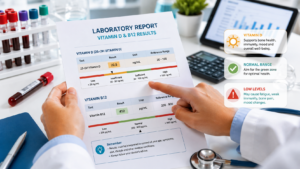
How to Read Vitamin D and B12 Report
To read a Vitamin D and B12 report, first identify the reported value and unit, then compare it with the reference range printed by your laboratory. Vitamin D is commonly reported as ng/mL, while Vitamin B12 is commonly reported as pg/mL. Low results may indicate deficiency, whereas borderline results require interpretation alongside symptoms, medical history and other tests.
Importantly, reference ranges can differ between laboratories. Therefore, the range printed on your own report should be considered when interpreting the result.
What These Reports Show
Why Are Vitamin D and B12 Tested?
Although both nutrients are important, they perform different functions.
Vitamin D is particularly important for:
- Bone health
- Calcium absorption
- Muscle function
- Normal physiological processes
Meanwhile, Vitamin B12 is important for:
- Red blood cell formation
- Normal neurological function
- DNA synthesis
- Healthy nerve function
Consequently, deficiency in either nutrient can produce symptoms, although symptoms can overlap with many other conditions.
Understanding Your Vitamin D Report
Which Vitamin D Test Is Usually Reported?
The commonly measured test is 25-hydroxy Vitamin D, also written as 25-OH Vitamin D or 25(OH)D.
It is generally reported in ng/mL.
Therefore, when reading your report, first confirm that you are looking at the 25-OH Vitamin D result rather than another Vitamin D measurement.
Vitamin D Value Bands
Vitamin D Levels Chart
A commonly used interpretation is:
| Vitamin D Level | General Interpretation |
| Below 20 ng/mL | Deficient |
| 20–29 ng/mL | Insufficient / borderline |
| 30 ng/mL or above | Generally considered adequate by many commonly used criteria |
However, these categories are not universal. Laboratory reference ranges and clinical guidelines can differ, and your healthcare provider may interpret the result in the context of your age, health status and risk factors.
Therefore, do not treat a single number as a diagnosis without considering the complete picture.
For a more detailed explanation, see the Vitamin D Chart.
What Does Low Vitamin D Mean?
A low Vitamin D result may indicate inadequate Vitamin D status.
Possible contributing factors include:
- Limited sun exposure
- Indoor lifestyle
- Dietary insufficiency
- Certain digestive conditions
- Obesity
- Certain medications
- Other medical conditions
For Bangalore’s indoor workers, spending most of the day inside offices can reduce regular sunlight exposure.
Furthermore, sunscreen use, clothing and lifestyle can influence effective sun exposure.
Understanding Your Vitamin B12 Report
What Does the B12 Test Measure?
Vitamin B12 is generally reported in pg/mL, although units can vary between laboratories.
Therefore, always check the unit and reference range printed on your report before interpreting the number.
B12 deficiency can sometimes affect the blood and nervous system.
Possible symptoms include:
- Fatigue
- Weakness
- Tingling or numbness
- Difficulty concentrating
- Pale appearance
- Balance problems in more significant deficiency
However, these symptoms are not specific to B12 deficiency.
Vitamin B12 Value Bands
B12 Deficient, Borderline or Normal?
Unlike some simplified online charts, B12 interpretation does not have one universal set of cutoffs that applies to every laboratory.
A commonly used practical approach is:
| B12 Result | General Interpretation |
| Below the laboratory’s lower limit | Possible deficiency |
| Near the lower end of the range | Borderline / requires clinical correlation |
| Within the laboratory reference range | Generally adequate |
Some laboratories use approximately 200 pg/mL as a lower threshold, while values around 200–300 pg/mL may sometimes be considered borderline depending on the clinical context.
Therefore, always use the reference interval printed on your report rather than applying an internet cutoff blindly.
Deficient vs Borderline vs Normal
Why the Difference Matters
A deficient result is different from a borderline result.
For example, a clearly low B12 level combined with neurological symptoms may require more urgent attention than a result that is simply near the lower end of the reference range.
Similarly, a Vitamin D value just below an adequacy threshold may be managed differently from a severe deficiency.
Consequently, the treatment decision should consider:
- Your actual result
- Symptoms
- Age
- Diet
- Medical history
- Other laboratory results
- Current supplements
- Medications
What to Do With a Low Vitamin D Result
Step 1: Discuss the Result
If Vitamin D is low, discuss the result with your healthcare provider.
Depending on the severity, your doctor may recommend dietary changes, sunlight exposure and an appropriate Vitamin D supplement.
However, do not take very high-dose Vitamin D supplements without medical advice.
Step 2: Review Lifestyle
If your routine involves long hours indoors, consider discussing safe and appropriate sunlight exposure with your healthcare provider.
Additionally, dietary sources of Vitamin D and overall nutrition can be reviewed.
Most importantly, treatment should be individualized.
What to Do With a Low B12 Result
Vegetarians May Need Particular Attention
Vitamin B12 is naturally concentrated in animal-derived foods, although fortified foods and supplements can provide B12.
Therefore, vegetarians and vegans may have a higher risk of inadequate B12 intake, particularly when dietary sources are limited.
However, diet is not the only possible cause.
B12 deficiency can also occur because of absorption problems, certain medications, and gastrointestinal conditions.
Consequently, identifying the cause is important, especially when deficiency is significant or recurrent.
What If Your B12 Is Borderline?
Don’t Ignore a Borderline Result
A borderline B12 result does not necessarily mean that you have a clinically significant deficiency.
Nevertheless, it should not always be dismissed.
If symptoms are present, your healthcare provider may consider additional assessment. Depending on the situation, tests such as methylmalonic acid (MMA) or homocysteine may sometimes help clarify B12 status.
Therefore, interpretation should be based on the complete clinical picture.
Can Vitamin D and B12 Be Low Together?
Yes, They Can
It is possible for an individual to have both Vitamin D and B12 deficiency.
This may be particularly relevant when diet, limited outdoor exposure or other risk factors overlap.
For example, a person who works indoors, eats a restricted diet and has limited exposure to fortified foods may have multiple nutritional gaps.
Consequently, when both results are low, it is useful to look at overall nutrition rather than focusing on only one number.
What Happens After Starting Supplements?
When Should You Retest?
There is no single retesting date that applies to everyone.
The appropriate timing depends on:
- How low the original result was
- The treatment prescribed
- The supplement dose
- Whether symptoms are improving
- Underlying medical conditions
- Your healthcare provider’s plan
Generally, retesting is performed after enough time has passed for the treatment to produce a meaningful change.
Therefore, testing again after only a few days is usually unlikely to provide useful information about long-term correction.
When to Retest Vitamin D
Follow the Treatment Plan
After starting Vitamin D supplementation, your healthcare provider may recommend a repeat test after an appropriate interval.
The timing can vary depending on the degree of deficiency and treatment regimen.
Additionally, taking a supplement consistently is important before judging whether the treatment has worked.
When to Retest Vitamin B12
Check Response When Appropriate
Similarly, B12 may be rechecked after treatment when clinically indicated.
If neurological symptoms were present, your healthcare provider may focus not only on the laboratory number but also on whether symptoms are improving.
Therefore, a better number is useful, but clinical improvement also matters.
Bangalore’s Indoor Lifestyle and Vitamin Deficiency
Why Indoor Workers Should Pay Attention
Bangalore’s technology and corporate workforce often involves long hours at desks.
Consequently, some workers may spend most daylight hours inside:
- Offices
- Co-working spaces
- Homes
- Cars
- Public transport
At the same time, irregular meals and limited dietary variety can contribute to nutritional gaps.
Therefore, if you have persistent fatigue or other symptoms, discuss whether nutritional testing is appropriate rather than assuming that work stress is the only explanation.
When Should You Consider Testing?
Vitamin D or B12 testing may be considered when clinically appropriate, particularly in people with:
- Persistent unexplained fatigue
- Muscle weakness
- Tingling or numbness
- Restricted diets
- Limited sunlight exposure
- Certain digestive conditions
- Previous deficiency
- Long-term use of certain medications
- Other risk factors identified by a healthcare provider
However, testing decisions should be individualized.
Don’t Interpret One Number in Isolation
Look at the Complete Report
A laboratory report contains more than one number.
For example, someone with fatigue may need evaluation of:
- CBC
- Haemoglobin
- Vitamin B12
- Vitamin D
- Thyroid function
- Blood glucose
- Iron status
Therefore, if your Vitamin D and B12 results are normal but fatigue continues, other causes should be considered.
Frequently Asked Questions
How do I read my Vitamin D and B12 report?
Check the test name, result, unit and laboratory reference range. Then determine whether the result is below, within or above the stated range. Finally, interpret it alongside symptoms, diet and medical history.
What Vitamin D level is considered deficient?
A commonly used classification considers below 20 ng/mL deficient and 20–29 ng/mL insufficient. However, reference ranges and clinical recommendations can vary.
What Vitamin D level is normal?
Many commonly used criteria consider 30 ng/mL or above adequate. However, use the reference range printed on your laboratory report and discuss the result with your healthcare provider.
What B12 level is considered low?
A B12 value below the laboratory’s lower reference limit may indicate deficiency. Values around 200–300 pg/mL can sometimes be considered borderline, depending on the laboratory and clinical context.
Are vegetarians more likely to have B12 deficiency?
They can be, particularly when the diet contains few reliable B12 sources. However, absorption problems and certain medications can also contribute to deficiency.
Can low Vitamin D cause tiredness?
Low Vitamin D can be associated with various symptoms, but tiredness has many possible causes. Therefore, fatigue should not automatically be attributed to Vitamin D deficiency.
When should I repeat my Vitamin D test after supplements?
The timing depends on the severity of deficiency and your treatment plan. Your healthcare provider can recommend an appropriate interval rather than testing too soon.
Can I take Vitamin D and B12 supplements without testing?
Some people may require supplements based on diet or medical circumstances. However, high-dose supplementation should not be started without appropriate professional guidance.
Conclusion
Learning how to read your Vitamin D and B12 report can help you understand whether your results are deficient, borderline or within the laboratory’s reference range. However, the numbers should always be interpreted carefully.
For Vitamin D, a result below 20 ng/mL is commonly considered deficient, while values between 20 and 29 ng/mL are often described as insufficient. Meanwhile, B12 interpretation depends more heavily on the laboratory reference range and clinical context, particularly when results are close to the lower limit.
For Bangalore’s vegetarians, indoor workers and deficiency-prone readers, lifestyle and diet can contribute to nutritional inadequacy. Nevertheless, symptoms such as tiredness or weakness can have many causes.
Therefore, don’t self-diagnose based on one result. Instead, discuss abnormal or borderline findings with a healthcare professional, follow the recommended supplementation plan and retest when appropriate.