
Cholesterol Patients on Statins - Monitoring Tests in Bengaluru
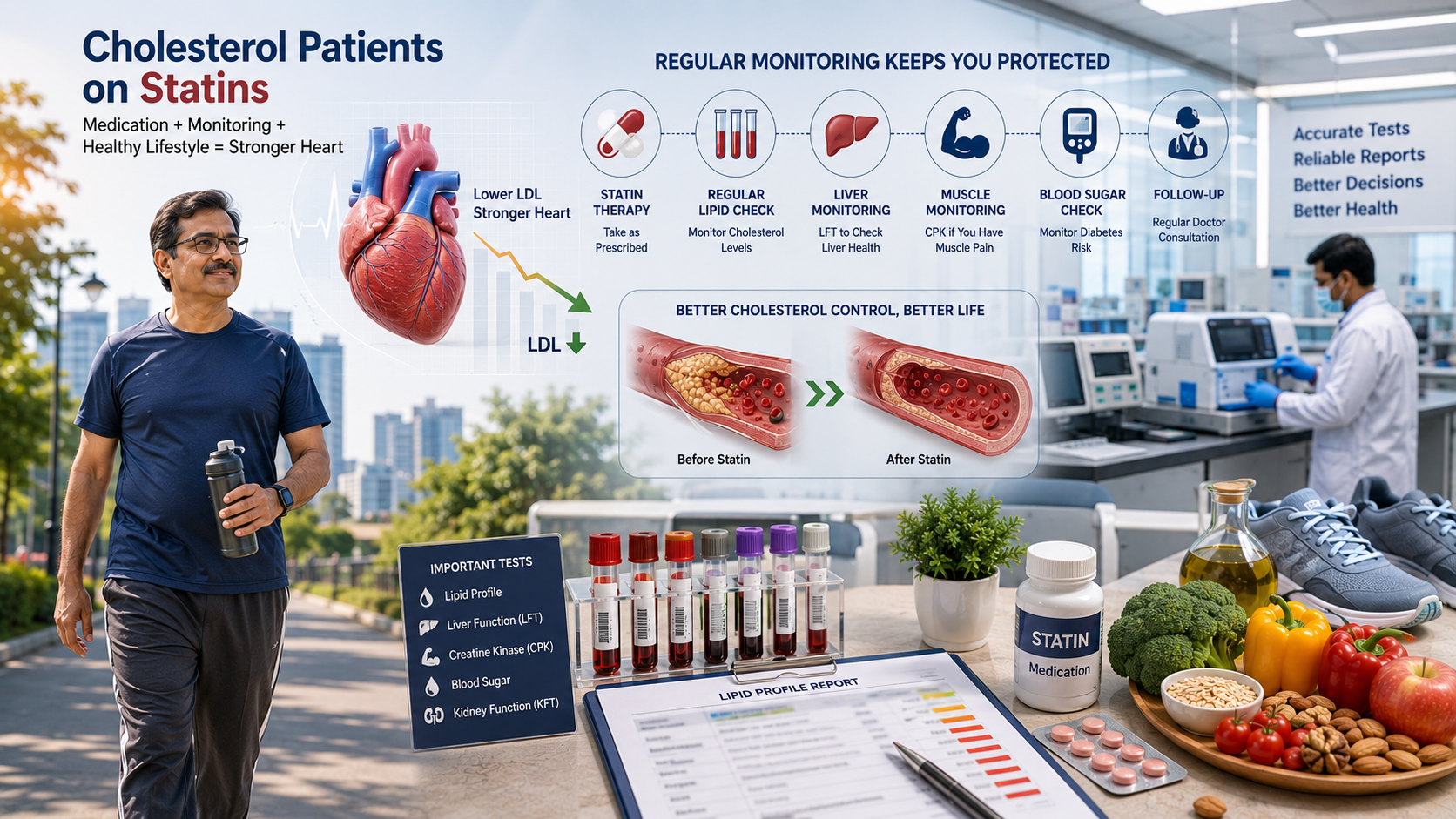
If you have been prescribed a statin for high cholesterol, taking the medicine regularly is only one part of long-term heart-risk management. Cholesterol patients on statins may also need periodic monitoring to assess cholesterol response, liver health and, when symptoms or risk factors are present, other laboratory parameters.
For Bengaluru heart patients, however, follow-up can sometimes become difficult because of busy work schedules, commuting and family responsibilities. Fortunately, planned laboratory monitoring and convenient home sample collection can make follow-up easier.
Most importantly, monitoring does not mean that every statin user needs every test at every visit. Instead, the appropriate tests and timing depend on the medicine, dose, medical history, treatment response and symptoms.
This Blog Includes:
 Monitoring Tests for Cholesterol Patients on Statins
Monitoring tests for Cholesterol patients on statins commonly include a lipid profile to assess cholesterol response. Liver function testing may be considered when clinically indicated, while creatine kinase (CPK/CK) is generally checked when significant muscle symptoms occur. Blood glucose or HbA1c may also be monitored when appropriate.
Therefore, the purpose of follow-up testing is not simply to collect numbers. Rather, it is to help your healthcare provider determine whether your treatment is working appropriately and whether anything needs further attention.
Why Statin Patients Need Monitoring
Statins Do More Than Lower Cholesterol
Statins reduce the liver's production of cholesterol and help lower LDL cholesterol.
Consequently, they can play an important role in reducing cardiovascular risk in people who need lipid-lowering treatment.
However, treatment should still be reviewed periodically.
During follow-up, your healthcare provider may consider:
Monitoring Tests for Cholesterol Patients on Statins
Monitoring tests for Cholesterol patients on statins commonly include a lipid profile to assess cholesterol response. Liver function testing may be considered when clinically indicated, while creatine kinase (CPK/CK) is generally checked when significant muscle symptoms occur. Blood glucose or HbA1c may also be monitored when appropriate.
Therefore, the purpose of follow-up testing is not simply to collect numbers. Rather, it is to help your healthcare provider determine whether your treatment is working appropriately and whether anything needs further attention.
Why Statin Patients Need Monitoring
Statins Do More Than Lower Cholesterol
Statins reduce the liver's production of cholesterol and help lower LDL cholesterol.
Consequently, they can play an important role in reducing cardiovascular risk in people who need lipid-lowering treatment.
However, treatment should still be reviewed periodically.
During follow-up, your healthcare provider may consider:
- Article Title: Cholesterol Patients on Statins - Monitoring Tests in Bengaluru
- Publisher: Prima Diagnostics
- Type: Condition Management Healthcare Blog
- Topics Covered: Statin Monitoring, Cholesterol Management, Lipid Profile, LDL Cholesterol, HDL Cholesterol, Triglycerides, Liver Function Tests, ALT/SGPT, AST/SGOT, Muscle Symptoms, CPK/CK Testing, Blood Sugar, HbA1c, Heart Health, Cardiovascular Risk, Follow-Up Testing, Home Sample Collection and Patient Education.
- Services Covered: Lipid Profile Testing, Liver Function Test (LFT), Blood Glucose, HbA1c, Creatine Kinase/CPK Testing when indicated, Preventive Heart Health Testing, Home Sample Collection, Digital Reports and Laboratory Diagnostics.
- Tests Included: Lipid Profile, Total Cholesterol, LDL Cholesterol, HDL Cholesterol, Triglycerides, Liver Function Test (LFT), ALT/SGPT, AST/SGOT, Bilirubin, Blood Glucose, HbA1c and Creatine Kinase (CK/CPK) when recommended by a healthcare provider.
- Monitoring Guidance: Explains why statin users may require periodic assessment of cholesterol response and why additional tests should be selected according to symptoms, treatment stage, cardiovascular risk and healthcare-provider recommendations.
- Lipid Monitoring Guidance: Explains the role of lipid profiles in assessing response to statin therapy and emphasizes that LDL targets vary according to individual cardiovascular risk.
- Liver Monitoring Guidance: Explains the role of liver function tests and clarifies that routine repeated LFT testing is not necessarily required for every statin user.
- Muscle Monitoring Guidance: Explains that CK/CPK testing may be considered when significant muscle pain, weakness or other concerning symptoms occur and is not necessarily required routinely for every statin user.
- Blood Sugar Guidance: Explains why glucose and HbA1c may be monitored in patients with diabetes, prediabetes or other metabolic risk factors.
- Medication Guidance: Advises patients not to start, stop or change prescribed statin treatment solely because of an individual laboratory result and to discuss medication decisions with their healthcare provider.
- Preparation Guidance: Preparation depends on the tests ordered. Fasting may be required for certain investigations. Follow any specific instructions given by your healthcare provider before sample collection.
- FAQ Section: Included.
Monitoring Tests for Cholesterol Patients on Statins
Monitoring tests for Cholesterol patients on statins commonly include a lipid profile to assess cholesterol response. Liver function testing may be considered when clinically indicated, while creatine kinase (CPK/CK) is generally checked when significant muscle symptoms occur. Blood glucose or HbA1c may also be monitored when appropriate.
Therefore, the purpose of follow-up testing is not simply to collect numbers. Rather, it is to help your healthcare provider determine whether your treatment is working appropriately and whether anything needs further attention.
Why Statin Patients Need Monitoring
Statins Do More Than Lower Cholesterol
Statins reduce the liver's production of cholesterol and help lower LDL cholesterol.
Consequently, they can play an important role in reducing cardiovascular risk in people who need lipid-lowering treatment.
However, treatment should still be reviewed periodically.
During follow-up, your healthcare provider may consider:
- Your LDL cholesterol response
- Overall cardiovascular risk
- Statin dose
- Treatment adherence
- Other medicines
- Liver-related concerns
- Muscle symptoms
- Blood sugar or diabetes risk
- Total cholesterol
- LDL cholesterol
- HDL cholesterol
- Triglycerides
- Medication adherence
- Diet and exercise
- Statin dose
- Drug interactions
- Other causes of elevated cholesterol
- Whether additional lipid-lowering treatment is appropriate
- ALT/SGPT
- AST/SGOT
- Bilirubin
- Alkaline phosphatase
- Other liver-related parameters
- Muscle aches
- Muscle tenderness
- Weakness
- Unusual muscle discomfort
- Prediabetes
- Diabetes
- Overweight or obesity
- A family history of diabetes
- Other metabolic risk factors
- Blood pressure
- Blood glucose
- HbA1c
- Kidney function when appropriate
- Weight and waist circumference
- Lifestyle factors
- Lipid profile
- Liver-related tests
- Diabetes risk
- Medical history
- Current medications
- Regular physical activity
- A balanced diet
- Adequate sleep
- Healthy body weight
- Avoidance of tobacco
- Appropriate alcohol habits
- Regular medical follow-up
- Bengaluru heart patients
- Statin users requiring periodic lipid testing
- Older adults
- Working professionals
- Patients managing multiple follow-up appointments
- Tests included
- Whether fasting is required
- Available appointment slots
- Serviceable location
- Report delivery options
- Any specific preparation instructions
- Lipid profile
- LFT when indicated
- Blood glucose
- HbA1c when appropriate
- CK/CPK when clinically indicated
- Additional tests recommended by your healthcare provider