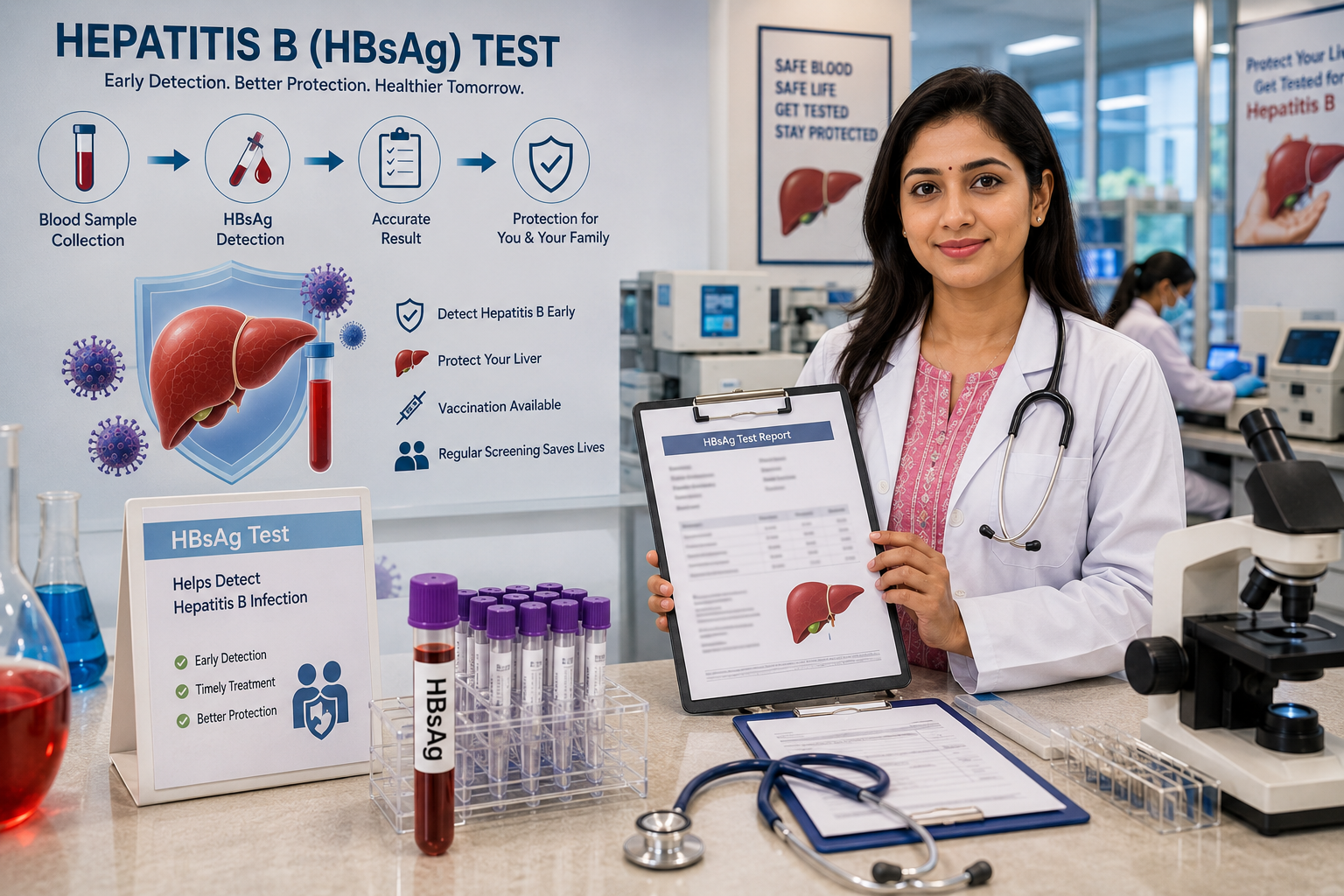
Hepatitis B (HBsAg) Test - What Positive and Negative Mean
Looking for a Hepatitis B (HBsAg) Test in Bengaluru and wondering what the result means? The
Hepatitis B surface antigen (HBsAg) test is a blood test used to detect evidence of a current Hepatitis B virus (HBV) infection. In simple terms, a
positive HBsAg result generally indicates that Hepatitis B infection is present and requires medical evaluation, while a
negative result means HBsAg was not detected at the time of testing. However, a negative result does not always exclude very recent infection because testing during the early
window period may be negative.
Therefore, understanding the HBsAg test is especially important for people undergoing premarital screening, healthcare workers, individuals with possible exposure, and anyone recommended for Hepatitis B testing by a healthcare provider. Moreover, because Hepatitis B can cause no symptoms for years, testing can identify infection even when a person feels completely healthy.
This Blog Includes:
- Article Title: Hepatitis B (HBsAg) Test in Bengaluru – Cost and What It Means
- Publisher: Prima Diagnostics
- Type: Test Explainer Healthcare Blog
- Topics Covered: Hepatitis B, HBsAg Test, Hepatitis B Surface Antigen, HBsAg Positive Meaning, HBsAg Negative Meaning, Hepatitis B Transmission, Hepatitis B Symptoms, Hepatitis B Vaccination, Anti-HBs, Hepatitis B Screening, Premarital Screening, Healthcare Worker Screening, Hepatitis B Window Period, and Patient Education.
- Services Covered: HBsAg Testing, Hepatitis B Screening, Anti-HBs Testing, Hepatitis B Antibody Testing, Liver Function Testing, Infection Screening, Home Sample Collection, Digital Reports, Laboratory Diagnostics, and Preventive Health Screening.
- Tests Included: HBsAg, Anti-HBs, Anti-HBc, IgM Anti-HBc, HBeAg, Anti-HBe, HBV DNA, Liver Function Test (LFT), ALT / SGPT, AST / SGOT, Bilirubin, and Additional Hepatitis Investigations as Recommended by Healthcare Providers.
- Educational Guidance: Explains what HBsAg detects, how Hepatitis B spreads, why symptoms may be absent, what positive and negative HBsAg results generally mean, the role of Anti-HBs in assessing immunity, the importance of testing after potential exposure, and when additional Hepatitis B investigations may be required.
- Preparation Guidance: Fasting is generally not required for an HBsAg blood test. However, preparation may differ if additional investigations are performed at the same time. Follow any specific instructions given by your healthcare provider. Inform the laboratory about relevant medications and recent medical exposures, and prepare a comfortable area if booking home sample collection.
- Service Focus: Infectious Disease Screening, Hepatitis B Detection, Preventive Health Screening, Premarital Health Screening, Occupational Health Screening, Home Sample Collection, Laboratory Diagnostics, Digital Reporting, and Patient Education.
- FAQ Section: Included.
 What Does the Hepatitis B (HBsAg) Test Detect?
HBsAg
What Does the Hepatitis B (HBsAg) Test Detect?
HBsAg stands for
Hepatitis B surface antigen.
It is a protein found on the surface of the Hepatitis B virus. When HBsAg is detected in blood, it indicates that HBV is present in the body.
The test is therefore commonly used to:
- Screen for Hepatitis B infection
- Investigate possible exposure
- Screen pregnant women as recommended
- Support premarital health screening
- Screen healthcare workers
- Evaluate people with liver abnormalities
- Monitor individuals known to have Hepatitis B
However, HBsAg is only one part of Hepatitis B testing. Depending on the situation, doctors may recommend additional markers to understand whether an infection is recent, ongoing, resolved, or whether immunity is present.
Why Is Hepatitis B Testing Important?
Hepatitis B can affect the liver and, in some people, can become a chronic infection.
Furthermore, chronic Hepatitis B may increase the risk of:
- Liver inflammation
- Fibrosis
- Cirrhosis
- Liver failure
- Liver cancer
Importantly, many infected people may have
few or no symptoms, particularly during the early stages.
Consequently, testing is often more reliable than waiting for symptoms to appear.
How Does Hepatitis B Spread?
Hepatitis B is transmitted when infected blood or certain body fluids enter another person's body.
Common routes include:
Blood Exposure
Sharing contaminated needles or exposure to infected blood can transmit HBV.
Sexual Contact
Unprotected sexual contact with an infected person can result in transmission.
Mother-to-Child Transmission
Hepatitis B can pass from an infected mother to her baby around the time of childbirth.
Contaminated Instruments
Unsafe tattooing, piercing, or medical procedures can pose a risk when proper sterilization is not followed.
Occupational Exposure
Healthcare workers may have occupational exposure to infected blood or body fluids.
What Hepatitis B Does Not Spread Through
It is equally important to understand what does
not typically transmit Hepatitis B.
HBV is not generally spread through:
- Hugging
- Handshakes
- Sharing food casually
- Coughing
- Sneezing
- Sitting next to an infected person
Therefore, people living with Hepatitis B should not be unnecessarily isolated or stigmatized.
Symptoms Are Often Absent
One of the most important facts about Hepatitis B is that
many people may not experience obvious symptoms.
When symptoms do occur, they may include:
- Fatigue
- Loss of appetite
- Nausea
- Abdominal discomfort
- Dark urine
- Pale stools
- Fever
- Joint pain
- Yellowing of the skin or eyes
However, these symptoms are not specific to Hepatitis B.
As a result, laboratory testing is essential when infection is suspected.
HBsAg Positive vs Negative Meaning
Understanding the report correctly is extremely important.
What Does HBsAg Positive Mean?
A
positive HBsAg result generally indicates current Hepatitis B infection.
However, the test alone cannot determine exactly how long the infection has been present or whether it will become chronic.
Therefore, your healthcare provider may recommend additional tests such as:
These tests help provide a more complete picture.
What Does HBsAg Negative Mean?
A
negative HBsAg result means the antigen was not detected in the sample.
However, it does not necessarily tell you whether you are immune.
For example, a person may be:
- Vaccinated and immune
- Previously infected and recovered
- Susceptible because they have neither infection nor immunity
- Tested too early after a recent exposure
Therefore, additional Hepatitis B markers may be required.
What Is the Hepatitis B Window Period?
After a recent exposure, there may be a period when infection has occurred but HBsAg is not yet detectable.
This is one reason why the timing of testing matters.
If you have had a recent potential exposure, do not assume that one negative HBsAg test completely rules out infection.
Instead, speak with a healthcare provider about:
- When the exposure occurred
- Which tests are appropriate
- Whether repeat testing is required
- Whether vaccination or post-exposure measures are appropriate
Vaccination Check: Anti-HBs
The
Anti-HBs (Hepatitis B surface antibody) test is different from HBsAg.
While HBsAg looks for evidence of current infection,
Anti-HBs helps assess immunity.
Anti-HBs may be present after:
- Successful Hepatitis B vaccination
- Recovery from a previous Hepatitis B infection
Therefore, someone can be HBsAg negative while also being Anti-HBs positive because they are immune.
HBsAg vs Anti-HBs
| Test |
What It Generally Indicates |
| HBsAg |
Evidence of current HBV infection |
| Anti-HBs |
Immunity against Hepatitis B |
| Anti-HBc |
Previous or current exposure to HBV |
Because interpretation can be complex, healthcare providers often consider multiple markers together.
Hepatitis B and Premarital Screening in Bengaluru
Bengaluru premarital screening commonly includes tests intended to identify important infections and health conditions before marriage.
Hepatitis B testing can be included when recommended or requested.
This is particularly useful because someone may carry HBV without symptoms.
Early identification allows appropriate medical evaluation and helps couples discuss preventive measures, vaccination, and follow-up with healthcare professionals.
Hepatitis A vs Hepatitis B During Monsoon
The monsoon season often increases public concern about hepatitis.
However,
Hepatitis A and Hepatitis B are different infections with different transmission routes.
Hepatitis A is commonly associated with contaminated food and water, whereas Hepatitis B is primarily transmitted through infected blood and certain body fluids.
Therefore, monsoon-related Hepatitis A concerns should not be confused with Hepatitis B transmission.
If you have symptoms of hepatitis, the appropriate testing depends on your exposure history and clinical evaluation.
Healthcare Workers and Hepatitis B Screening
Healthcare workers may have an increased occupational risk of exposure to blood and certain body fluids.
Therefore, Hepatitis B vaccination and appropriate occupational safety practices are particularly important.
Healthcare professionals may also require testing based on workplace protocols, vaccination history, or a potential exposure.
If an accidental needle-stick or blood exposure occurs, seek medical advice promptly rather than waiting for symptoms.
Hepatitis B (HBsAg) Test Cost in Bengaluru
The
Hepatitis B (HBsAg) Test cost in Bengaluru varies depending on the diagnostic laboratory, testing method, location, and whether the test is booked individually or as part of a larger health screening package.
Before booking, consider:
- Laboratory quality standards
- Testing methodology
- Report turnaround time
- Digital report availability
- Home sample collection
- Whether additional Hepatitis markers are required
Therefore, the cheapest test is not necessarily the most suitable choice. Reliable laboratory processing and appropriate interpretation are equally important.
Who Should Consider a Hepatitis B (HBsAg) Test?
Your healthcare provider may recommend Hepatitis B testing if you:
- Have had a possible exposure to infected blood
- Have a partner with Hepatitis B
- Are undergoing premarital screening
- Are pregnant
- Work in healthcare
- Have abnormal liver enzymes
- Are with a history of multiple sexual partners
- Have undergone procedures involving potentially unsafe instruments
- Come from or have lived in areas where HBV is more common
- Are being evaluated for unexplained liver disease
Additionally, anyone concerned about a possible exposure can discuss testing with a healthcare professional.
Can You Prevent Hepatitis B?
Yes.
Hepatitis B vaccination is one of the most effective ways to prevent HBV infection.
Prevention also includes:
- Avoiding shared needles
- Using sterile equipment for tattoos and piercings
- Practicing safer sex
- Following standard precautions in healthcare settings
- Avoiding contact with another person's blood
- Completing recommended vaccination schedules
Healthcare workers should follow occupational safety protocols carefully.
How to Book a Hepatitis B (HBsAg) Test at Prima Diagnostics
Booking a
Hepatitis B (HBsAg) Test can be straightforward.
You can choose:
- Laboratory visit
- Home sample collection, where available
- Individual HBsAg testing
- Broader infection screening packages
Before collection, follow any specific instructions provided by the laboratory or healthcare provider.
For most HBsAg blood tests,
fasting is generally not required.
Frequently Asked Questions
What is the Hepatitis B (HBsAg) test?
The HBsAg test is a blood test that detects Hepatitis B surface antigen, which generally indicates current Hepatitis B infection when detected.
What does a positive HBsAg result mean?
A positive result generally indicates current HBV infection. Additional testing is usually required to determine the stage and characteristics of the infection.
What does a negative HBsAg result mean?
It means HBsAg was not detected in the blood sample. However, it does not establish immunity and may not exclude a very recent infection.
Does HBsAg testing require fasting?
Usually,
fasting is not required for an HBsAg blood test unless other tests being performed at the same time require fasting.
Can a vaccinated person have a positive Hepatitis B (HBsAg) test?
Vaccination is not expected to cause a persistent positive HBsAg result. A positive result should be evaluated by a healthcare professional.
Is Hepatitis B included in premarital screening?
It may be included depending on the screening package or healthcare provider's recommendations. Couples can discuss appropriate screening with their healthcare professionals.
Can Hepatitis B be detected without symptoms?
Yes. Many people with Hepatitis B may have no obvious symptoms, which is why screening can be important for individuals with risk factors.
Conclusion
The
Hepatitis B (HBsAg) Test is an important blood test for detecting evidence of current Hepatitis B infection. Most importantly, a
positive HBsAg result generally indicates current infection, while a negative result means HBsAg was not detected at the time of testing. Nevertheless, interpreting Hepatitis B status often requires additional markers such as Anti-HBs and Anti-HBc, particularly after recent exposure or when vaccination status needs to be established.
For
Bengaluru premarital screening, healthcare workers, people with possible exposure, and individuals undergoing liver evaluation, timely testing can provide valuable information. Moreover, vaccination, safe practices, and appropriate medical follow-up remain central to Hepatitis B prevention and management. Prima Diagnostics provides laboratory testing and convenient diagnostic services to support informed healthcare decisions.