
AMH Levels by Age Chart - What Is a Good AMH for Pregnancy?
If you are planning pregnancy, trying to conceive, or considering IVF, you may have come across the term AMH. In particular, searches for AMH levels by age are common among women who want to understand their ovarian reserve and fertility options.
However, AMH is only one part of a fertility assessment. It can provide information about the number of eggs remaining in the ovaries, but it does not directly measure egg quality or guarantee whether pregnancy will occur.
Therefore, an AMH result is most useful when it is interpreted alongside age, menstrual history, ultrasound findings, and other fertility factors.
What Do AMH levels by age Tell You?
AMH stands for Anti-Müllerian Hormone. It is produced by small developing follicles in the ovaries.
Consequently, AMH is commonly used as a marker of ovarian reserve, meaning an estimate of the remaining egg supply.
AMH Is About Egg Quantity, Not Egg Quality
This distinction is especially important.
As women get older, both the number and quality of eggs generally decline. However, AMH mainly provides information related to ovarian reserve and does not directly tell you whether your eggs are genetically normal.
Therefore, a woman with a relatively good AMH can still experience age-related fertility challenges.
Can AMH Predict Natural Pregnancy?
Not by itself.
AMH can help doctors understand ovarian reserve and may be particularly useful when planning fertility treatment. Nevertheless, natural conception depends on many factors, including ovulation, fallopian-tube function, sperm health, age, and other reproductive factors.
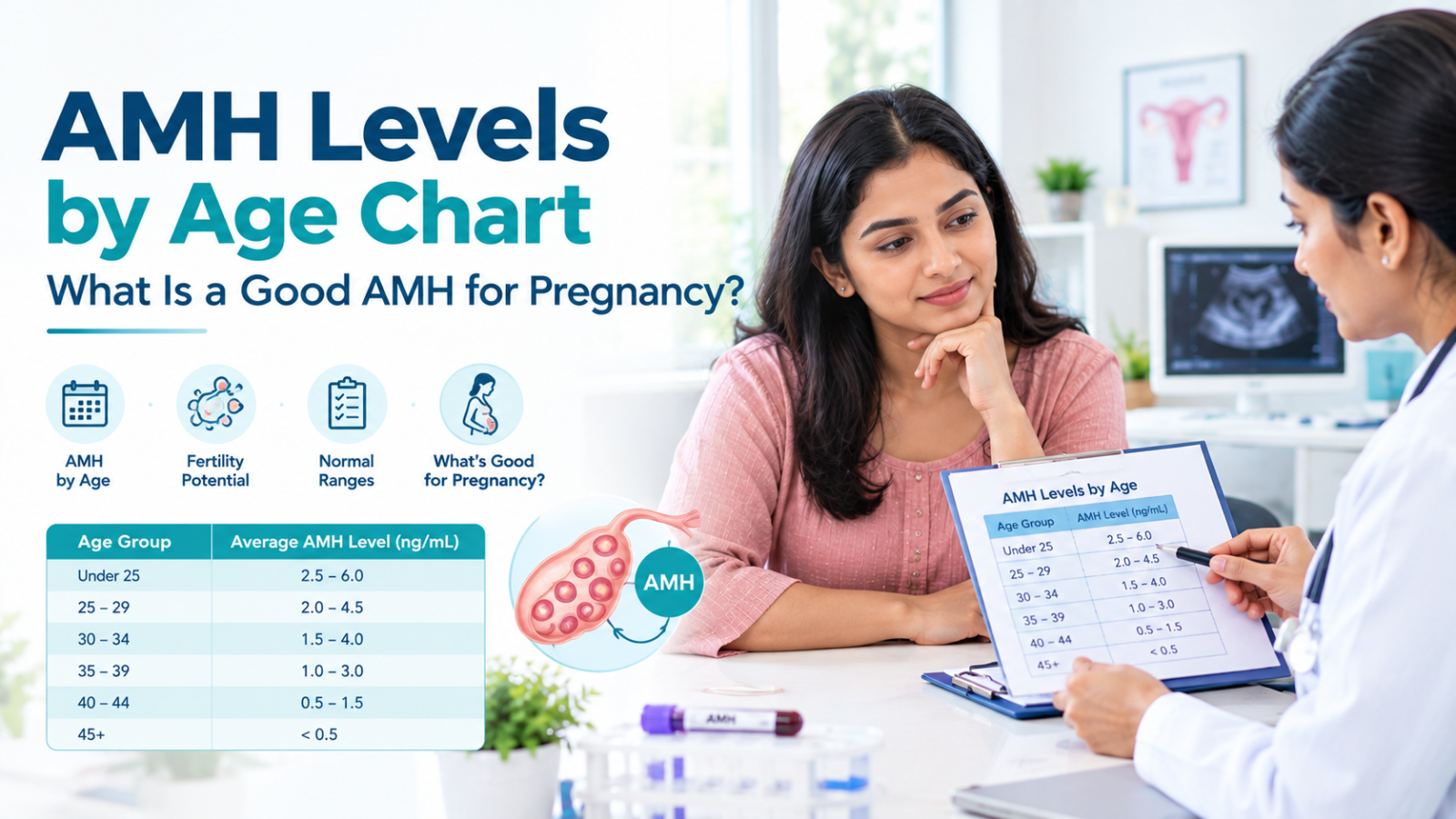
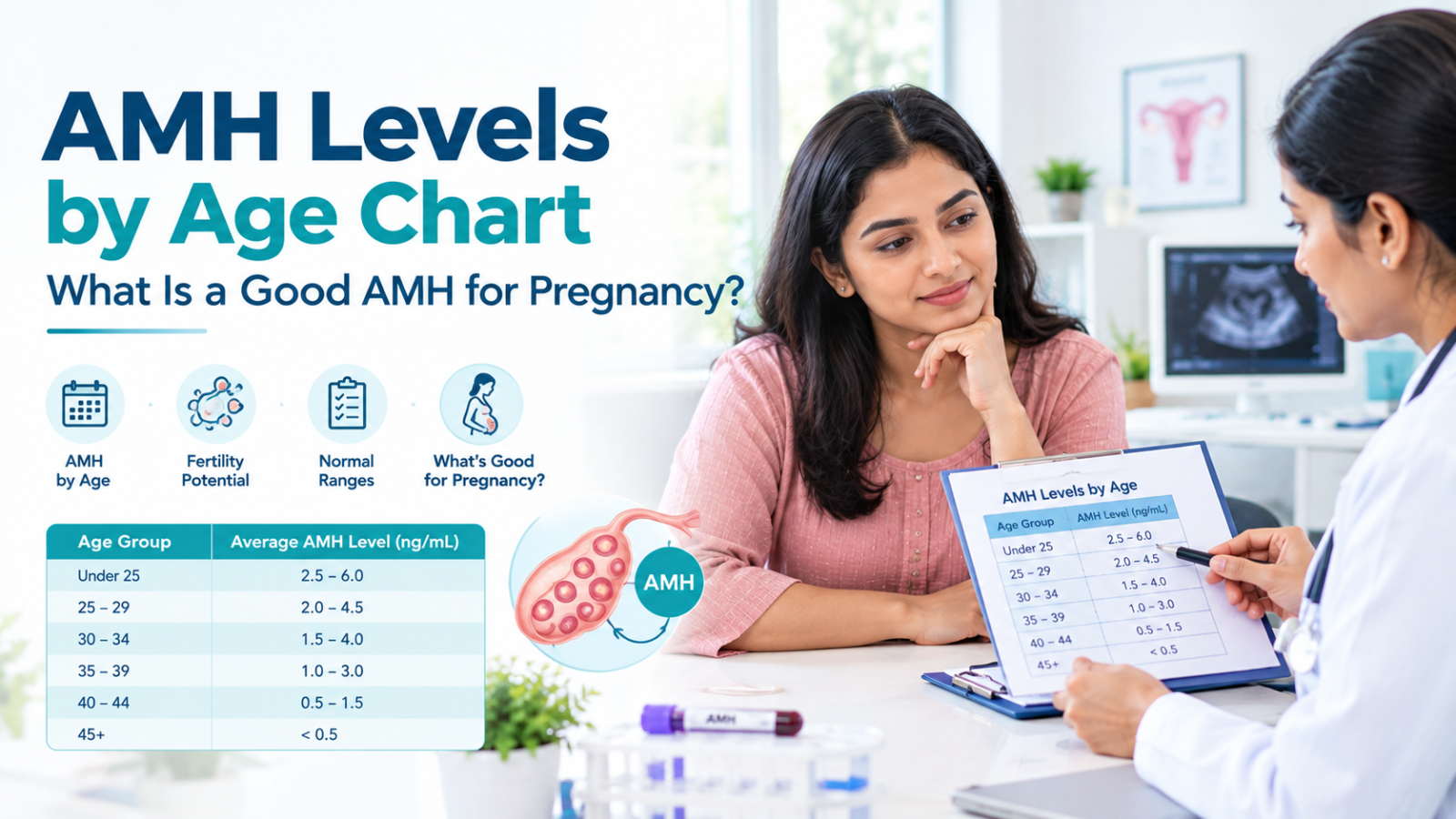
What Is a Normal AMH Level by Age?
There is no single AMH number that is considered “good” for every woman.
AMH levels naturally vary between individuals and generally decline with age. In addition, different laboratories may use different assays and reference ranges.
The following chart is therefore a general educational guide rather than a diagnostic reference range:
Age group |
General AMH pattern |
|
20–24 years |
Often higher ovarian reserve, but individual values vary |
|
25–29 years |
Generally higher than later reproductive years, with substantial variation |
|
30–34 years |
AMH commonly begins showing an age-related decline |
|
35–39 years |
Greater variation; declining ovarian reserve becomes more relevant |
|
40–44 years |
AMH is often considerably lower, although individual results vary |
|
45+ years |
AMH is frequently very low as menopause approaches |
AMH Levels by Age: Why Age Still Matters
When interpreting AMH levels by age, age itself remains an important fertility factor.
For example, two women can have similar AMH results but different fertility prospects because egg quality is strongly related to age.
Therefore, AMH should not be used as a stand-alone “fertility score.”
What Does Low AMH Mean?
A low AMH can indicate a lower ovarian reserve than expected for age.
However, low AMH does not mean that pregnancy is impossible.
Low AMH Does Not Equal No Eggs
Even when AMH is low, ovulation may still occur, and pregnancy can still happen.
Nevertheless, a lower ovarian reserve may become particularly important when planning IVF or other fertility treatment because ovarian response to stimulation can be reduced.
Why Might AMH Be Low?
AMH can naturally decline with age. Additionally, ovarian surgery, certain medical treatments, and some ovarian conditions can affect ovarian reserve.
Therefore, the result should be discussed with a fertility specialist rather than interpreted in isolation.
What Does High AMH Mean?
A higher AMH level generally indicates a larger pool of small ovarian follicles.
However, higher is not automatically better.
High AMH and PCOS
Women with polycystic ovary syndrome (PCOS) may have elevated AMH because of the increased number of small follicles commonly seen with the condition.
Consequently, a high AMH may sometimes be one clue supporting a PCOS evaluation, although AMH alone does not diagnose PCOS.
Can High AMH Affect IVF?
High AMH can indicate a stronger response to ovarian stimulation. Therefore, fertility specialists may take it into account when planning IVF medication doses and monitoring.
The goal is not simply to achieve the highest possible AMH. Instead, treatment planning focuses on achieving an appropriate ovarian response while managing potential risks.
When Should You Test AMH levels by age?
AMH can generally be measured at various points in the menstrual cycle because it has less cycle-to-cycle variation than some other reproductive hormones.
However, your fertility specialist may recommend AMH alongside other tests depending on your situation.
If You Are Planning Pregnancy
If you are concerned about fertility because of age, previous ovarian surgery, family history, or other factors, discussing ovarian-reserve testing may be useful.
If You Are Considering IVF
AMH is particularly relevant when doctors are estimating how the ovaries may respond to stimulation.
If You Have PCOS Symptoms
If irregular periods, excess hair growth, acne, or other PCOS-related symptoms are present, AMH may be considered as part of a broader evaluation.
What Other Tests May Be Done With AMH?
AMH is rarely the only fertility investigation.
Depending on the situation, your doctor may consider:
- Antral follicle count through ultrasound
- FSH and other reproductive hormones
- Pelvic ultrasound
- Ovulation assessment
- Tubal evaluation
- Semen analysis for the male partner
Therefore, a fertility evaluation is usually more informative when several relevant factors are considered together.
AMH and Late Marriage in Bangalore
For many Bangalore women who are planning pregnancy later in their reproductive years, AMH levels by age can become a frequently searched fertility topic.
However, AMH should not be viewed as a test that determines whether you can or cannot become pregnant.
Instead, it can provide useful information about ovarian reserve, particularly when pregnancy planning is being delayed or fertility treatment is being considered.
Prima Fertility Panel
If you are looking for an AMH test in Bangalore, Prima Diagnostics can help with fertility-related laboratory testing.
Depending on your healthcare provider's recommendation, an evaluation may include AMH along with other reproductive or preconception tests.
Most importantly, discuss the result with your gynaecologist or fertility specialist, particularly if you are planning IVF or have been trying to conceive.
How to Prepare for an AMH Test
AMH testing generally does not require complicated preparation.
However, preparation requirements can depend on whether AMH is being performed alone or as part of a larger fertility panel.
Therefore, follow the instructions provided by your diagnostic centre or healthcare provider.
FAQs About AMH Levels by Age
What is a normal AMH levels by age?
There is no universal AMH value that is normal for every age group. AMH varies considerably between individuals and laboratories and generally declines with age. Your result should therefore be interpreted using the laboratory's reference range and your clinical situation.
What is a good AMH level for pregnancy?
There is no single AMH level that guarantees pregnancy. AMH mainly provides information about ovarian reserve, while age, egg quality, ovulation, sperm health, tubes, and other factors also affect fertility.
Is low AMH a sign of infertility?
Not necessarily. Low AMH suggests reduced ovarian reserve, but it does not mean pregnancy is impossible. It can, however, be relevant when planning fertility treatment.
Is high AMH always good?
No. A high AMH can reflect a larger number of small follicles and may occur in PCOS. In IVF planning, a higher AMH may also indicate a stronger response to ovarian stimulation.
Should I test AMH if I am planning pregnancy?
It depends on your individual circumstances. AMH may be useful when there are concerns about ovarian reserve, delayed pregnancy planning, previous ovarian surgery, or fertility treatment. However, it is not routinely required for every woman trying to conceive.
Does AMH decrease with age?
Generally, yes. AMH tends to decline as ovarian reserve decreases with age. However, the rate of decline varies substantially between individuals.
Final Takeaway
AMH levels by age can provide useful information about ovarian reserve, particularly for women planning pregnancy or considering IVF. Nevertheless, AMH is not a pregnancy predictor and should not be treated as a stand-alone measure of fertility.
A low AMH may indicate reduced ovarian reserve, while a high AMH can sometimes be associated with PCOS or a stronger response to fertility medication. Therefore, both results need context.
For women in Bangalore who are planning pregnancy later, discussing AMH and other preconception tests with a gynaecologist or fertility specialist can help put the result into perspective.