
Vitamin B12 plays an important role in red blood cell formation, nerve function and DNA synthesis. Therefore, when B12 levels fall, symptoms can range from tiredness and weakness to tingling, numbness and difficulty concentrating.
For people searching for a vitamin B12 normal range chart, however, one important point comes first: the “normal” range can vary slightly between laboratories. Consequently, your laboratory’s reference interval should always be considered when interpreting your report.
This guide explains B12 levels in simple terms, including normal, borderline and deficient levels, common symptoms, why vegetarian diets can sometimes contribute to low B12, and when supplementation or further evaluation may be considered.
This Blog Includes:
- Article Title: Vitamin B12 Normal Range Chart and Deficiency Levels
- Publisher: Prima Diagnostics
- Type: Chart / Normal Range Healthcare Blog
- Topics Covered: Vitamin B12, B12 Normal Range, B12 Deficiency, Borderline B12, B12 Levels in pg/mL, B12 Deficiency Symptoms, Vegetarian B12 Deficiency, South Indian Diet, Brain Fog, Tiredness, B12 Supplements, B12 Injections, B12 Retesting and Patient Education.
- Services Covered: Vitamin B12 Testing, Blood Testing, Nutritional Assessment, Preventive Health Testing, Digital Reports and Laboratory Diagnostics.
- B12 Measurement Guidance: Explains that Vitamin B12 is commonly measured in pg/mL and that laboratory-specific reference ranges should be used when interpreting results.
- Normal Range Guidance: Provides a general educational range of approximately 200–900 pg/mL while emphasizing that individual laboratory reference intervals may differ.
- Deficiency Guidance: Explains that levels below approximately 200 pg/mL are commonly considered low, while approximately 200–300 pg/mL may be considered borderline depending on the clinical context.
- Symptom Guidance: Covers tiredness, weakness, difficulty concentrating, tingling, numbness, balance problems, muscle weakness and other symptoms that may occur with B12 deficiency.
- Dietary Guidance: Explains why people following vegetarian or vegan diets may have a higher risk of inadequate B12 intake while clarifying that vegetarianism does not automatically indicate deficiency.
- Treatment Guidance: Explains oral B12 supplementation and situations in which B12 injections may be considered, while emphasizing that treatment should be guided by a healthcare professional.
- Additional Testing: Covers CBC, folate, homocysteine and methylmalonic acid as possible additional investigations when clinically appropriate.
- Retesting Guidance: Explains that follow-up timing depends on the initial result, symptoms, treatment, underlying cause and individual clinical circumstances.
- Preparation Guidance: Patients should follow any specific instructions given by their healthcare provider or laboratory before testing.
- Service Focus: Vitamin B12 Testing, Laboratory Diagnostics, Preventive Health Screening, Nutritional Assessment and Patient Education.
- FAQ Section: Included.
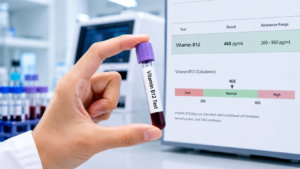
Vitamin B12 Normal Range Chart and Deficiency Levels
Vitamin B12 is commonly reported in pg/mL. A typical laboratory reference range may be approximately 200–900 pg/mL, although ranges differ between laboratories. Levels below about 200 pg/mL are often considered low, while approximately 200–300 pg/mL may be considered borderline in many clinical settings. However, the number alone does not establish a diagnosis.
| Vitamin B12 Level | General Interpretation | What It May Mean |
| Below 200 pg/mL | Low / deficient | B12 deficiency may be present |
| 200–300 pg/mL | Borderline | Further assessment may be appropriate |
| Above 300 pg/mL | Generally adequate | Usually less suggestive of deficiency |
| Laboratory-specific range | Follow report | Reference intervals can vary |
Important: These are general educational ranges, not a substitute for your laboratory’s reference range or medical evaluation.
How Vitamin B12 Is Measured
What Does pg/mL Mean?
A Vitamin B12 blood test measures the amount of circulating B12 in your blood.
The result is commonly reported as pg/mL (picograms per millilitre).
However, interpreting B12 is not always as simple as looking at one number.
For example, someone with a borderline result may have symptoms that warrant additional testing. Therefore, healthcare providers may consider the complete clinical picture rather than relying exclusively on the B12 value.
Why Your Laboratory Range Matters
Different laboratories may use different:
- Testing platforms
- Reagents
- Analytical methods
- Reference populations
As a result, the reference interval printed on your report may not exactly match another laboratory’s range.
Therefore, when reading your report, look for the reference range shown beside your result.
Vitamin B12 Normal Range Chart
What Is a Normal B12 Level?
In many laboratories, a B12 result somewhere around 200–900 pg/mL may fall within the stated reference range.
Nevertheless, “within range” does not always mean that no further evaluation is needed.
For instance, a person with neurological symptoms and a borderline B12 result may require additional assessment.
Thus, the result should be interpreted together with symptoms, diet, medications, medical history and other laboratory findings.
Borderline vs Deficient B12 Levels
What Does a Borderline Result Mean?
A borderline B12 result means the level is not clearly deficient but may not completely rule out inadequate B12 status.
Generally, results around 200–300 pg/mL are often considered borderline, although this varies.
Consequently, your doctor may recommend additional evaluation if you have symptoms.
What Does a Deficient Result Mean?
A result below approximately 200 pg/mL is commonly considered low.
However, the exact threshold depends on the laboratory and clinical context.
If deficiency is suspected, your healthcare provider may consider additional tests such as:
- Methylmalonic acid (MMA)
- Homocysteine
- Complete Blood Count (CBC)
- Folate
Therefore, a low B12 result should be interpreted rather than simply treated as an isolated number.
Why Vegetarians Can Run Low on B12
B12 and the Vegetarian Diet
Vitamin B12 occurs naturally mainly in animal-derived foods.
Therefore, people following vegetarian or vegan diets may have a higher risk of inadequate B12 intake, particularly when fortified foods or supplements are not included regularly.
This can be especially relevant for people following traditional South Indian vegetarian diets, depending on their individual food choices.
Vegetarian Does Not Automatically Mean B12 Deficient
At the same time, being vegetarian does not automatically mean you have a B12 deficiency.
Some vegetarian foods may be fortified with B12, and supplements can also provide B12.
Consequently, dietary pattern, absorption and individual health factors all matter.
Symptoms of Low B12 by Level
Mild or Early Deficiency
Early or mild deficiency may produce nonspecific symptoms such as:
- Tiredness
- Weakness
- Reduced energy
- Difficulty concentrating
- Feeling mentally sluggish
Because these symptoms have many possible causes, B12 testing can sometimes help when deficiency is suspected.
More Significant Deficiency
As deficiency becomes more pronounced or persists, symptoms may include:
- Tingling
- Numbness
- Burning sensations
- Balance difficulties
- Muscle weakness
- Pale appearance
- Sore or smooth tongue
Importantly, neurological symptoms deserve medical attention because prolonged B12 deficiency can affect nerves.
B12 and IT Brain Fog
Could B12 Deficiency Contribute to Brain Fog?
B12 is important for normal nervous-system function. Therefore, inadequate B12 may contribute to symptoms such as difficulty concentrating or cognitive changes in some people.
For Bangalore’s IT workforce, however, “brain fog” can have numerous causes, including:
- Poor sleep
- Stress
- Long screen hours
- Inadequate nutrition
- Sedentary lifestyle
- Other vitamin deficiencies
- Medical conditions
Consequently, B12 should not automatically be blamed for every episode of mental fatigue.
For more information, see our Brain Fog Blog and Tiredness Blog.
Oral B12 vs B12 Injections
When Are B12 Tablets Used?
Oral B12 supplementation may be appropriate for many people, particularly when dietary intake is the main concern or when the deficiency is not associated with significant absorption problems.
The dose and duration should be determined according to individual circumstances.
When Might Injections Be Considered?
B12 injections may be considered in situations such as:
- Significant deficiency
- Certain absorption disorders
- Some gastrointestinal conditions
- Neurological symptoms
- Situations where rapid replacement is clinically appropriate
However, B12 injections are not automatically better than tablets for everyone.
Therefore, treatment should be selected by a healthcare professional based on the cause and severity of deficiency.
What Happens After Starting B12 Treatment?
When Should You Retest?
The timing of repeat testing depends on:
- Initial B12 level
- Symptoms
- Treatment type
- Cause of deficiency
- Other laboratory findings
Some people may need follow-up after a few months, while others may require earlier clinical review.
Therefore, there is no single retesting schedule that applies to everyone.
Don’t Retest Too Early Without a Reason
After supplementation begins, B12 levels can change.
However, a numerical improvement does not necessarily tell the entire story.
Consequently, healthcare providers may also assess symptom improvement, blood counts and, when necessary, additional markers.
Tests That May Be Considered Alongside B12
Complete Blood Count
A CBC can help identify anemia and changes in blood-cell measurements.
However, B12 deficiency can sometimes occur even without obvious anemia.
Folate and B12 are both involved in red blood cell formation.
Therefore, when deficiency is suspected, healthcare providers may evaluate both depending on the clinical situation.
Homocysteine and MMA
When B12 status is unclear, additional biomarkers such as homocysteine or methylmalonic acid may sometimes provide useful information.
These tests are not necessary for everyone, however.
When Should You Get a B12 Test?
Consider Testing When Deficiency Is Suspected
Testing may be considered when there is:
- Persistent unexplained tiredness
- Tingling or numbness
- Unexplained anemia
- Vegetarian or vegan dietary pattern with risk of inadequate intake
- Certain gastrointestinal conditions
- Long-term use of some medications that can affect B12 status
- Previous B12 deficiency
- Neurological symptoms
Ultimately, the decision should be based on your individual circumstances.
B12 Testing for Bangalore Residents
Vegetarian Bangalore and South Indian Diets
For Bangalore residents following vegetarian diets, especially those with limited B12-fortified foods, checking B12 can be a useful part of nutritional evaluation when clinically appropriate.
Furthermore, people with demanding work schedules may overlook dietary deficiencies for months.
Therefore, preventive testing can sometimes help identify an issue before symptoms become more noticeable.
Frequently Asked Questions
What is the normal Vitamin B12 range?
A commonly used general range is around 200–900 pg/mL, but laboratory reference ranges vary. Always use the reference interval printed on your report.
Is 200 pg/mL Vitamin B12 low?
A result around 200 pg/mL is generally considered low or borderline depending on the laboratory. Your symptoms and other test results should also be considered.
Is 300 pg/mL B12 normal?
It may fall within the laboratory’s normal range, but it can still be considered borderline by some clinical approaches. If symptoms are present, your healthcare provider may recommend further evaluation.
Do vegetarians need a B12 test?
Not necessarily, but people following vegetarian or vegan diets can have a higher risk of inadequate B12 intake. Testing may be useful when symptoms or dietary risk factors are present.
Are B12 injections better than tablets?
Not always. Oral B12 works well for many people, whereas injections may be preferred in certain situations, particularly when deficiency is significant or absorption is impaired.
How long does it take for B12 levels to improve?
The response depends on the severity and cause of deficiency and the treatment used. Your healthcare provider can recommend an appropriate follow-up schedule.
Can low B12 cause brain fog?
B12 deficiency can be associated with neurological and cognitive symptoms. However, brain fog has many possible causes, so a low B12 level should be confirmed rather than assumed.
Should I take B12 supplements before testing?
If you are planning a B12 test because deficiency is suspected, discuss supplementation with your healthcare provider first. Starting supplements can affect subsequent test results.
Conclusion
Understanding a vitamin B12 normal range chart is useful, but the number on the report is only one part of the picture.
In general, B12 levels below approximately 200 pg/mL are often considered deficient, while 200–300 pg/mL may be viewed as borderline. Nevertheless, laboratory reference ranges differ, and symptoms and additional testing can change how a result is interpreted.
For vegetarian Bangalore residents, people following South Indian diets, and IT professionals experiencing persistent tiredness or brain fog, B12 testing may be worth discussing with a healthcare professional when deficiency is suspected.
Most importantly, don’t decide between tablets and injections based solely on the B12 number. Instead, identify the underlying cause, choose appropriate treatment and retest according to medical advice.