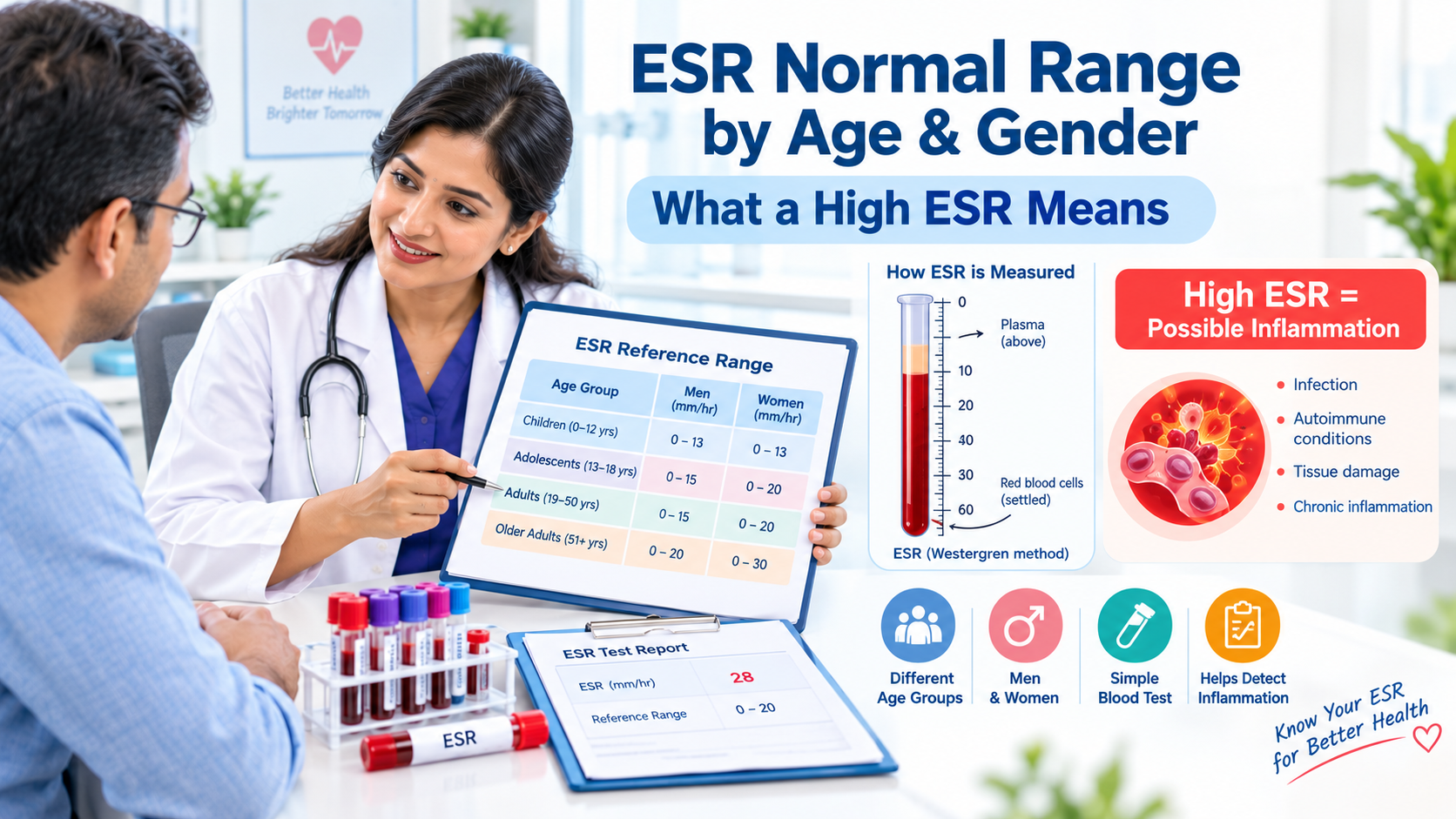
If your blood report shows a
high ESR, it is understandable to feel concerned. However, an elevated ESR does not automatically mean that you have a serious disease. Instead, ESR is a
non-specific marker of inflammation, so doctors interpret it together with your symptoms, medical history and other test results. So,
what is the ESR normal range? The expected ESR normal range varies according to
age, gender,laboratory method and health status.
Generally, women tend to have slightly higher ESR values than men, and ESR can naturally increase with age.
Therefore, rather than looking at one number in isolation, it is important to understand what your ESR result means in context.
This Blog Includes:
- Article Title: ESR Normal Range by Age and Gender - What a High ESR Means
- Publisher: Prima Diagnostics
- Type: Normal Range Chart / Medical Test Explainer Blog
- Topics Covered: ESR Normal Range, Erythrocyte Sedimentation Rate, ESR by Age, ESR by Gender, High ESR, ESR in Men, ESR in Women, ESR in Older Adults, Inflammation, Infection, Arthritis, Tuberculosis, ESR vs CRP, CRP Testing, Blood Test Interpretation, and Preventive Healthcare
- Services Covered: ESR Testing, CRP Testing, CBC Testing, Blood Tests, Inflammation Screening, Preventive Health Check-ups, Laboratory Diagnostics, Home Sample Collection, Wellness Packages, and Digital Reports
- Tests Included: ESR Test, C-Reactive Protein (CRP), Complete Blood Count (CBC), Haemoglobin, and Other Doctor-Recommended Inflammation and Blood Tests
- Conditions Covered: Inflammation, Infections, Tuberculosis (TB), Rheumatoid Arthritis, Inflammatory Joint Conditions, Anaemia, Autoimmune Conditions, Chronic Diseases, and Other Conditions Associated With Elevated ESR
- Service Focus: ESR Normal Range Awareness, High ESR Interpretation, Inflammation Screening, Infection Evaluation, Joint Health Assessment, TB-Related Evaluation, ESR and CRP Testing, Preventive Healthcare, and Laboratory Diagnostics
- Healthcare Service: ESR Testing, CRP Testing, CBC Testing, Blood Testing, Pathology Services, Preventive Health Check-ups, Laboratory Diagnostics, Home Sample Collection, Wellness Packages, and Digital Reports
- Locations Covered: Bengaluru and Home Sample Collection Across Bengaluru
- FAQ Section: Included.
 What Is ESR in Simple Words?
ESR stands for Erythrocyte Sedimentation Rate.
What Is ESR in Simple Words?
ESR stands for Erythrocyte Sedimentation Rate. It is a blood test that measures how quickly red blood cells settle at the bottom of a test tube over a specified period.
When inflammation is present, certain proteins in the blood can cause red blood cells to settle faster. Consequently, the ESR may increase.
However, ESR cannot identify the exact cause of inflammation. That is why doctors often combine it with other investigations.
What Is the ESR Normal Range?
A commonly used general reference range is:
- Men: approximately 0–15 mm/hour
- Women: approximately 0–20 mm/hour
Nevertheless, reference ranges can vary between laboratories. Moreover, ESR tends to increase naturally with age.
Therefore, always compare your result with the
reference range printed on your own laboratory report.
ESR Normal Range Chart by Age and Gender
The following values are general clinical reference guidelines rather than universal cut-offs.
| Age / Group |
General ESR Reference Range |
| Men under 50 years |
0–15 mm/hour |
| Women under 50 years |
0–20 mm/hour |
| Men over 50 years |
0–20 mm/hour |
| Women over 50 years |
0–30 mm/hour |
| Older adults |
May naturally be higher |
Because different laboratories use different methods and reference intervals, your doctor's interpretation remains more important than comparing your result with an internet chart.
ESR in Men
Men generally have a lower ESR reference range than women. However, age can influence the expected value.
Therefore, a mildly elevated ESR in an older man may have a different significance from the same result in a younger man.
ESR in Women
Women can naturally have somewhat higher ESR values. Furthermore, factors such as pregnancy, menstruation and anaemia can influence ESR.
Consequently, an elevated result does not necessarily indicate infection or another disease.
ESR in Older Adults
ESR can gradually increase with age. Thus, an ESR value that appears high compared with a younger adult's range may not have the same significance in an older person.
Why Does ESR Go High?
An elevated ESR indicates that
something may be associated with inflammation or another factor affecting the test, but it does not identify the cause.
Infection
First, infections can increase ESR. Both acute and chronic infections may influence the result.
Therefore, someone with fever, persistent cough or other infection-related symptoms may be advised to undergo ESR testing as part of a broader evaluation.
Arthritis and Joint Inflammation
Inflammatory joint conditions can also cause ESR to rise.
For example, doctors may use ESR when evaluating conditions such as rheumatoid arthritis or other inflammatory disorders.
However, ESR alone cannot diagnose arthritis.
Tuberculosis (TB)
Tuberculosis can be associated with an elevated ESR, particularly in some cases of active or chronic disease.
Because TB remains an important health concern in India, doctors may include ESR among several investigations when symptoms such as prolonged cough, fever, night sweats or unexplained weight loss require evaluation.
Importantly, ESR cannot confirm or rule out TB by itself.
Other Reasons for a High ESR
In addition to infection and inflammation, several other factors can affect ESR.
Anaemia
Anaemia can increase ESR in some people. Consequently, a high ESR may sometimes occur alongside a low haemoglobin level.
Autoimmune Conditions
Conditions involving abnormal immune-system activity can cause inflammation and therefore raise ESR.
Kidney or Other Chronic Conditions
Some chronic medical conditions may also influence ESR.
Pregnancy and Other Physiological Factors
Pregnancy can increase ESR naturally. Similarly, age and other physiological factors can affect the result.
Therefore, an elevated ESR should always be interpreted in context.
Is a High ESR Dangerous?
Not necessarily.
ESR is a marker rather than a diagnosis. A mildly elevated result may occur because of a temporary infection, anaemia, age-related changes, or other relatively common factors.
On the other hand, a persistently or significantly elevated ESR combined with concerning symptoms may require further investigation.
Therefore, the number alone should not be used to determine whether a condition is serious.
ESR vs CRP: What's the Difference?
Both
ESR and CRP (C-reactive protein) can help doctors assess inflammation. However, they behave differently.
| ESR |
CRP |
| Measures the rate at which red blood cells settle |
Measures C-reactive protein in blood |
| Non-specific inflammation marker |
Non-specific inflammation marker |
| Can be influenced by age and anaemia |
Generally responds more rapidly to changes in inflammation |
| May remain elevated for longer |
Often changes more quickly with inflammation |
Consequently, doctors may use
ESR and CRP together when monitoring certain inflammatory conditions.
ESR vs CRP: Which Is Better?
There is no single answer.
Instead, the appropriate test depends on what your doctor is trying to investigate. For some situations, CRP may provide a faster indication of current inflammation, while ESR can provide additional information.
Therefore, do not replace one test with the other without medical advice.
What Should You Do if Your ESR Is High?
If your report shows a high ESR,
don't panic and don't self-diagnose.
Step 1: Check the Reference Range
First, look at the laboratory's reference interval. A result is meaningful only when interpreted against the appropriate range.
Step 2: Consider Your Symptoms
Next, consider whether you have symptoms such as fever, joint pain, prolonged cough, unexplained weight loss or persistent fatigue.
Step 3: Review Other Blood Results
Then, your doctor may review other results such as CBC, CRP and other relevant investigations.
Step 4: Follow Up With Your Doctor
Finally, your doctor can decide whether you need repeat ESR testing or additional investigations.
Should You Repeat an ESR Test?
Sometimes, yes. However, the timing depends on why the ESR was initially ordered.
If the elevation occurred during a temporary infection, the value may decrease as you recover. Conversely, persistent elevation may prompt additional evaluation.
Therefore,
do not repeat ESR simply to chase a normal number without understanding why it was elevated.
When Should You See a Doctor?
Speak with your doctor if your ESR is significantly elevated, remains high, or occurs alongside concerning symptoms.
Seek medical evaluation particularly if you have:
- Persistent fever
- Unexplained weight loss
- Prolonged cough
- Persistent joint swelling or pain
- Severe or ongoing fatigue
- Night sweats
- Other unexplained symptoms
Moreover, if you already have a diagnosed inflammatory condition, your doctor may use ESR and CRP to monitor your condition over time.
Can ESR Diagnose TB or Arthritis?
No. ESR cannot diagnose TB, arthritis, or any specific disease by itself.
Instead, it provides a general indication that inflammation or another influencing factor may be present.
Because
TB and joint problems are among the reasons doctors may order ESR in India, additional tests are often required when these conditions are suspected.
FAQs About ESR Normal Range
What is the ESR normal Range?
A commonly used general range is
0–15 mm/hour for men and 0–20 mm/hour for women, although ranges vary by laboratory, age, and clinical circumstances.
Is ESR 30 high?
An ESR of 30 mm/hour may be above the usual range for some adults. However, its significance depends on age, sex, symptoms and the laboratory's reference range.
What does a high ESR mean?
A high ESR may indicate inflammation or another factor affecting the test. Infection, inflammatory conditions, anaemia and several other situations can raise ESR.
Does high ESR mean TB?
No. Although TB can cause an elevated ESR,
ESR alone cannot diagnose TB. Additional clinical evaluation and appropriate tests are required.
Can arthritis cause high ESR?
Yes. Inflammatory arthritis can increase ESR. Nevertheless, ESR cannot confirm arthritis by itself.
Should I be worried about a high ESR?
Not necessarily. A mildly elevated ESR can have many causes. However, persistent or significantly elevated ESR, especially with symptoms, should be discussed with a doctor.
Where can I get an ESR test in Bengaluru?
You can enquire about ESR testing at
Prima Diagnostics and its diagnostic centres across Bengaluru. Home sample collection may also be available depending on your location and appointment availability.
Conclusion
A
high ESR does not automatically mean that you have a serious illness. Instead, it is a broad inflammation marker that needs to be interpreted alongside your symptoms, medical history and other test results.
Although infections, inflammatory arthritis and TB can increase ESR, several other factors—including age, anaemia and pregnancy—can also affect the result. Therefore, avoid drawing conclusions from the ESR number alone.
If your report shows an elevated ESR, discuss the result with your healthcare provider. Depending on your symptoms, your doctor may consider
CRP, CBC, or other investigations to understand the underlying cause more clearly.