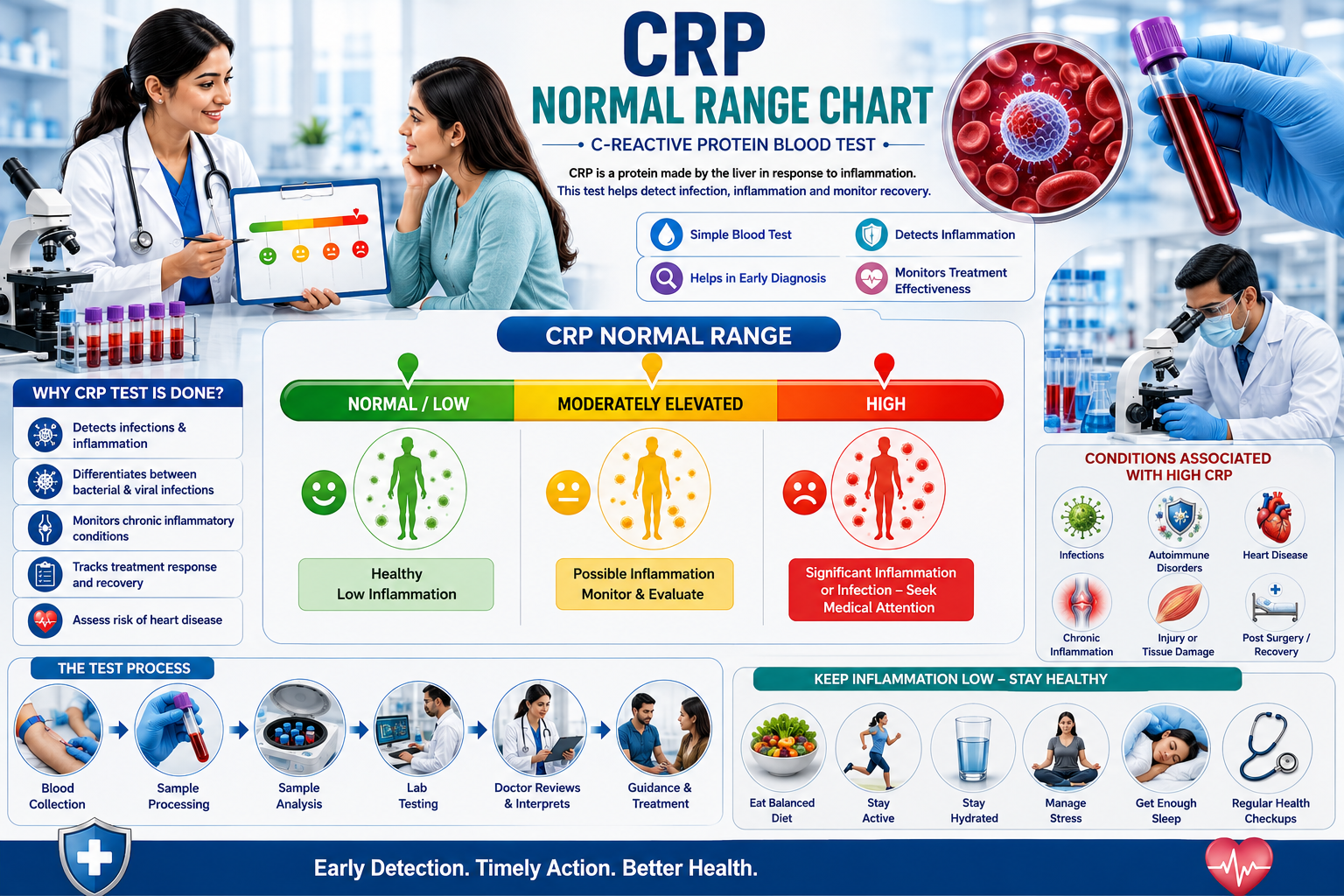
If your doctor has recommended a
CRP test, you may naturally wonder what the result means. In particular, understanding the
CRP normal range can help you interpret whether your result is within the laboratory's reference interval or whether it may indicate inflammation.
CRP stands for
C-reactive protein, a protein produced mainly by the liver in response to inflammation. Therefore, CRP can rise when the body is responding to infection, inflammation, tissue injury or certain other conditions.
However, a high CRP result does
not identify the exact cause by itself. Instead, it needs to be interpreted along with your symptoms, medical history and other investigations.
For people in Bengaluru experiencing
frequent infections, monsoon fevers or lingering symptoms after a viral illness, CRP may sometimes be included as part of a broader clinical evaluation.
This Blog Includes:
- Article Title: CRP Normal Range Chart - What a High CRP Means
- Publisher: Prima Diagnostics
- Topics Covered: C-Reactive Protein, CRP Normal Range, CRP Levels, High CRP, Mild CRP Elevation, Moderate CRP Elevation, Inflammation, Infection, Viral Infection, Bacterial Infection, hs-CRP, CBC, ESR, Fever Testing, Monsoon Fever, Post-Viral Checks and Patient Education.
- Services Covered: CRP Testing, Blood Testing, Inflammation Marker Testing, Fever-Related Laboratory Testing, Preventive Health Testing, Home Sample Collection and Laboratory Diagnostics.
- Preparation Guidance: Explains that standard CRP testing often does not require fasting, while emphasizing that preparation requirements may depend on other tests being performed at the same time.
- Buying Guidance: Advises patients to confirm the test type, current price, preparation requirements and home collection availability before booking.
- Home Collection Guidance: Explains that CRP blood testing may be available through home sample collection for eligible Bengaluru locations, subject to appointment and service availability.
- Service Focus: CRP Testing, Laboratory Diagnostics, Blood Testing, Inflammation Assessment, Fever-Related Testing, Preventive Health Screening and Home Sample Collection.
- FAQ Section: Included.
 CRP normal range chart and what high CRP means
A commonly used CRP reference range for standard CRP is
less than 10 mg/L, although laboratory reference ranges can differ. Mild, moderate or markedly elevated CRP levels may indicate inflammation, but CRP alone cannot determine whether the cause is bacterial infection, viral infection or another inflammatory condition. Always interpret the result using the reference range printed on your laboratory report.
What CRP Measures
What Is C-Reactive Protein?
C-reactive protein (CRP) is an inflammatory marker.
When inflammation occurs, the liver can produce more CRP. Consequently, blood CRP levels may increase during infections, inflammatory disorders, tissue injury, and several other conditions.
Therefore, CRP is primarily useful as a
marker of inflammation, rather than as a disease-specific test.
Why Do Doctors Order a CRP Test?
A healthcare professional may recommend CRP testing when evaluating symptoms such as:
- Fever
- Chills
- Unexplained weakness
- Body aches
- Persistent inflammation
- Symptoms suggesting infection
- Certain inflammatory or autoimmune conditions
- Monitoring of an already identified inflammatory condition
However, the reason for ordering the test matters.
Therefore, the same CRP value can have different significance depending on the clinical situation.
CRP Normal Range Chart
Standard CRP Reference Range
| CRP level |
General interpretation* |
| <10 mg/L |
Commonly within the standard reference range |
| 10–40 mg/L |
Mild to moderate elevation may be seen |
| 40–200 mg/L |
Significant elevation may occur |
| >200 mg/L |
Marked elevation; requires clinical correlation |
*These are
general educational ranges, not universal diagnostic cut-offs. Reference ranges and interpretation can vary by laboratory, method and clinical context.
Consequently, always compare your result with the
reference range printed on your own laboratory report.
What Does a Low or Normal CRP Mean?
Is a Normal CRP Always Good?
Generally, a CRP within the laboratory's reference range suggests that there is no substantial systemic inflammatory response detectable at the time of testing.
However, a normal CRP does not rule out every infection or inflammatory condition.
For example, inflammation may be localized, early in its course, or insufficient to cause a significant CRP increase.
Therefore, doctors interpret CRP alongside symptoms and examination findings.
What Mild, Moderate and High CRP Means
Mildly Elevated CRP
A mild elevation can occur for several reasons.
For example, it may accompany a minor infection, inflammation, recent illness or other temporary condition.
Therefore, a mildly elevated result should not automatically be interpreted as evidence of a serious disease.
Moderately Elevated CRP
A moderate increase can occur with more active inflammation or infection.
Nevertheless, CRP does not reveal the cause on its own.
Consequently, your doctor may consider your symptoms, examination, and other blood tests before deciding what further evaluation is necessary.
High CRP
A substantially elevated CRP indicates that
significant inflammation may be present, but it does not specify where the inflammation is occurring or what caused it.
Possible causes can include infections, inflammatory diseases, tissue injury, and other medical conditions.
Therefore, a high CRP should be interpreted in context rather than used as a standalone diagnosis.
Does High CRP Always Mean Infection?
Infection Is Only One Possible Cause
CRP commonly rises during infections. However, infection is not the only reason for an elevated result.
CRP can also increase with:
- Inflammatory disorders
- Autoimmune conditions
- Tissue injury
- Certain chronic diseases
- Other inflammatory processes
Consequently,
high CRP does not automatically mean bacterial infection.
Infection vs Inflammation
Can CRP Tell Whether an Infection Is Bacterial or Viral?
Not reliably by itself.
Both bacterial and viral infections can affect CRP levels. The degree of elevation may provide useful clinical information, but it cannot independently establish whether an infection is bacterial or viral.
Therefore, doctors may consider:
- Symptoms
- Duration of illness
- Physical examination
- CBC
- CRP
- Other infection-specific tests
- Imaging when necessary
As a result, CRP is best viewed as one part of the overall assessment.
CRP vs hs-CRP
Are CRP and hs-CRP the Same Test?
They measure the same protein but are used for different clinical purposes.
Standard CRP
Standard CRP is generally used to evaluate
inflammation and infection.
It is commonly reported in
mg/L.
High-Sensitivity CRP
hs-CRP is designed to detect much smaller differences in CRP levels.
It is commonly used in particular cardiovascular risk-assessment settings rather than as a general infection test.
Therefore, you should not automatically substitute an hs-CRP test for a standard CRP test.
CRP Units Explained
What Does mg/L Mean?
CRP is commonly reported in
milligrams per litre (mg/L).
For example, a report may show:
CRP: 25 mg/L
The next step is to compare this number with the laboratory's stated reference range.
However, the number alone does not explain the cause of inflammation.
CRP During Bengaluru Monsoon Fevers
Why CRP Can Be Useful During Fever Evaluation
Bengaluru's monsoon season can bring an increase in various infections and fever-related illnesses.
Consequently, people may undergo blood testing when fever, body aches, weakness or other symptoms persist.
CRP may sometimes be included in a broader fever evaluation.
Nevertheless, it should not be considered a standalone fever diagnosis.
Post-Viral CRP Testing
After a viral illness, some people continue to experience fatigue, weakness or other symptoms.
In certain situations, a healthcare professional may recommend repeat testing to assess whether inflammation is resolving.
However, the timing and need for repeat CRP testing depend on the illness and clinical situation.
Tests to Pair With CRP
CRP and CBC
A
Complete Blood Count (CBC) evaluates red blood cells, white blood cells, haemoglobin and platelets.
Because white blood-cell patterns can provide additional information during infection evaluation, CBC and CRP may sometimes be ordered together.
However, neither test alone can identify every cause of fever or inflammation.
CRP and ESR
ESR (erythrocyte sedimentation rate) is another inflammation marker.
Although both CRP and ESR can reflect inflammation, they behave differently and have different clinical uses.
Therefore, your doctor may request one or both depending on the clinical question.
Other Tests May Be Needed
Depending on your symptoms, additional investigations may include:
- Urine testing
- Liver function tests
- Kidney function tests
- Blood cultures
- Fever-specific tests
- Imaging
- Other infection or inflammation markers
Consequently, the appropriate test combination depends on the suspected cause.
When Should You Test CRP?
During Unexplained Fever
If fever persists or is accompanied by other concerning symptoms, a healthcare professional may recommend CRP testing as part of the evaluation.
When Symptoms Persist After an Infection
If symptoms continue after an infection, your doctor may consider additional testing depending on your recovery pattern.
However, routine CRP testing is not necessary for every person recovering from a viral illness.
For Monitoring Certain Conditions
CRP may also be used to monitor inflammatory conditions or response to treatment when medically appropriate.
Therefore, repeat testing should generally follow the schedule recommended by your healthcare provider.
Should You Repeat CRP After a High Result?
One Result May Not Tell the Whole Story
CRP changes over time.
Consequently, a single elevated result may not provide the same information as a trend.
Depending on the clinical situation, a doctor may recommend repeating CRP to determine whether inflammation is increasing, decreasing or resolving.
However, do not repeat the test unnecessarily without medical guidance.
How to Prepare for a CRP Test
Is Fasting Required?
Standard CRP testing generally does not require special fasting in many situations.
Nevertheless, preparation requirements can depend on whether other tests are being performed at the same time.
Therefore:
- Confirm the preparation requirements before collection.
- Follow any specific instructions given by your healthcare provider.
- Inform the healthcare professional about relevant medicines or supplements.
- Stay adequately hydrated unless you have been instructed otherwise.
When Is a High CRP an Emergency?
CRP Alone Does Not Define an Emergency
A high CRP number by itself does not determine whether someone needs emergency care.
Instead,
symptoms and overall clinical condition are more important.
Seek urgent medical attention for symptoms such as:
- Severe difficulty breathing
- Chest pain
- Confusion or altered consciousness
- Fainting
- Severe weakness
- Persistent high fever with significant deterioration
- Signs of severe dehydration
- Other rapidly worsening symptoms
Therefore, do not wait for a CRP result if you are experiencing potentially serious symptoms.
CRP Testing in Bengaluru
Convenient Blood Testing
If your healthcare provider has recommended a CRP test, you can arrange testing at a diagnostic laboratory or explore available home sample collection services.
For Bengaluru residents, home collection can be particularly convenient when fever or weakness makes travelling difficult.
However, availability depends on the location and appointment schedule.
Frequently Asked Questions
What is the normal CRP range?
A commonly used reference range for standard CRP is
less than 10 mg/L, but laboratory reference intervals can differ. Always use the range printed on your report for interpretation.
What does a CRP of 10 mg/L mean?
A CRP of 10 mg/L may represent a mild elevation depending on the laboratory reference range. It can occur with several inflammatory or infectious conditions and should be interpreted alongside symptoms and other findings.
What does a high CRP mean?
A high CRP generally indicates that inflammation is occurring somewhere in the body. However, it does not identify the cause by itself.
Does high CRP mean bacterial infection?
No. Both bacterial and viral infections can be associated with elevated CRP. Other clinical information and, when appropriate, additional tests are needed to determine the likely cause.
What is the difference between CRP and hs-CRP?
Standard CRP is commonly used to assess inflammation, whereas hs-CRP detects smaller CRP concentrations and is used in particular cardiovascular risk-assessment settings.
Can CRP be high after a viral infection?
Yes. CRP can be elevated during or around an infection, and the result may change as inflammation resolves. The significance depends on the illness and timing.
Should CRP be tested during Bengaluru monsoon fever?
It may be recommended when clinically appropriate, particularly when a healthcare professional is evaluating persistent fever or inflammation. However, CRP alone cannot identify the cause of a fever.
Can CRP and CBC be done together?
Yes. CBC and CRP may provide complementary information when evaluating infection or inflammation, depending on the clinical situation.
Can I book a CRP blood test in Bengaluru?
Yes. CRP testing can be arranged through diagnostic laboratories, and home collection may be available in eligible locations.
Conclusion
Understanding your
CRP normal range can make a laboratory report easier to read. However, the most important point is that
CRP is an inflammation marker, not a diagnosis.
A result within the usual reference range is generally reassuring, whereas an elevated CRP may indicate inflammation from infection, tissue injury, inflammatory disease or another cause.
Furthermore, the degree of elevation should always be considered alongside your symptoms and other investigations. Therefore, CBC, ESR and condition-specific tests may sometimes be used alongside CRP.
For people experiencing
frequent infections, Bengaluru monsoon fevers or persistent symptoms after a viral illness, appropriate testing can help support a more informed clinical evaluation.