If your
LFT report shows bilirubin as high or low, it is natural to wonder what the number means. Moreover, because bilirubin is reported as total, direct, and sometimes indirect bilirubin, the results can initially look confusing. Fortunately, understanding the
bilirubin normal range becomes easier when you know what each type represents and how doctors interpret the results alongside other liver tests.
Bilirubin is a yellow pigment produced when old red blood cells are broken down. Normally, the liver processes bilirubin and helps remove it from the body. However, problems involving red blood cell breakdown, the liver, or bile flow can cause bilirubin to rise.
This Blog Includes:
- Article Title: Bilirubin Normal Range Chart - Total, Direct and Indirect Explained
- Publisher: Prima Diagnostics
- Topics Covered: Bilirubin Normal Range, Total Bilirubin, Direct Bilirubin, Indirect Bilirubin, High Bilirubin, Low Bilirubin, Jaundice, Liver Function Tests, Newborn Bilirubin, Newborn Jaundice, and Follow-Up Testing.
- Services Covered: Bilirubin Testing, Liver Function Testing, Routine Blood Testing, Newborn Testing, and Diagnostic Laboratory Services.
- Tests Included: Total Bilirubin, Direct Bilirubin, Indirect Bilirubin, LFT, CBC, and additional investigations that may be recommended based on the bilirubin pattern.
- Preparation Guidance: Follow the specific preparation instructions provided for the selected test or LFT panel and follow any specific instructions given by your healthcare provider.
- Normal Range Guidance: Adult total bilirubin is commonly around 0.3–1.2 mg/dL and direct bilirubin below 0.3 mg/dL; laboratory reference ranges may vary. Newborn bilirubin requires age-in-hours and risk-based interpretation.
- Service Focus: Accurate Laboratory Testing, LFT Evaluation, Bilirubin Testing, Newborn Jaundice Checks, Preventive Diagnostics, and Follow-Up Testing.
- Location Focus: Bengaluru, with local relevance for Jayanagar, Whitefield, and other areas served by Prima Diagnostics.
- FAQ Section: Included.
 What Is the Bilirubin Normal Range?
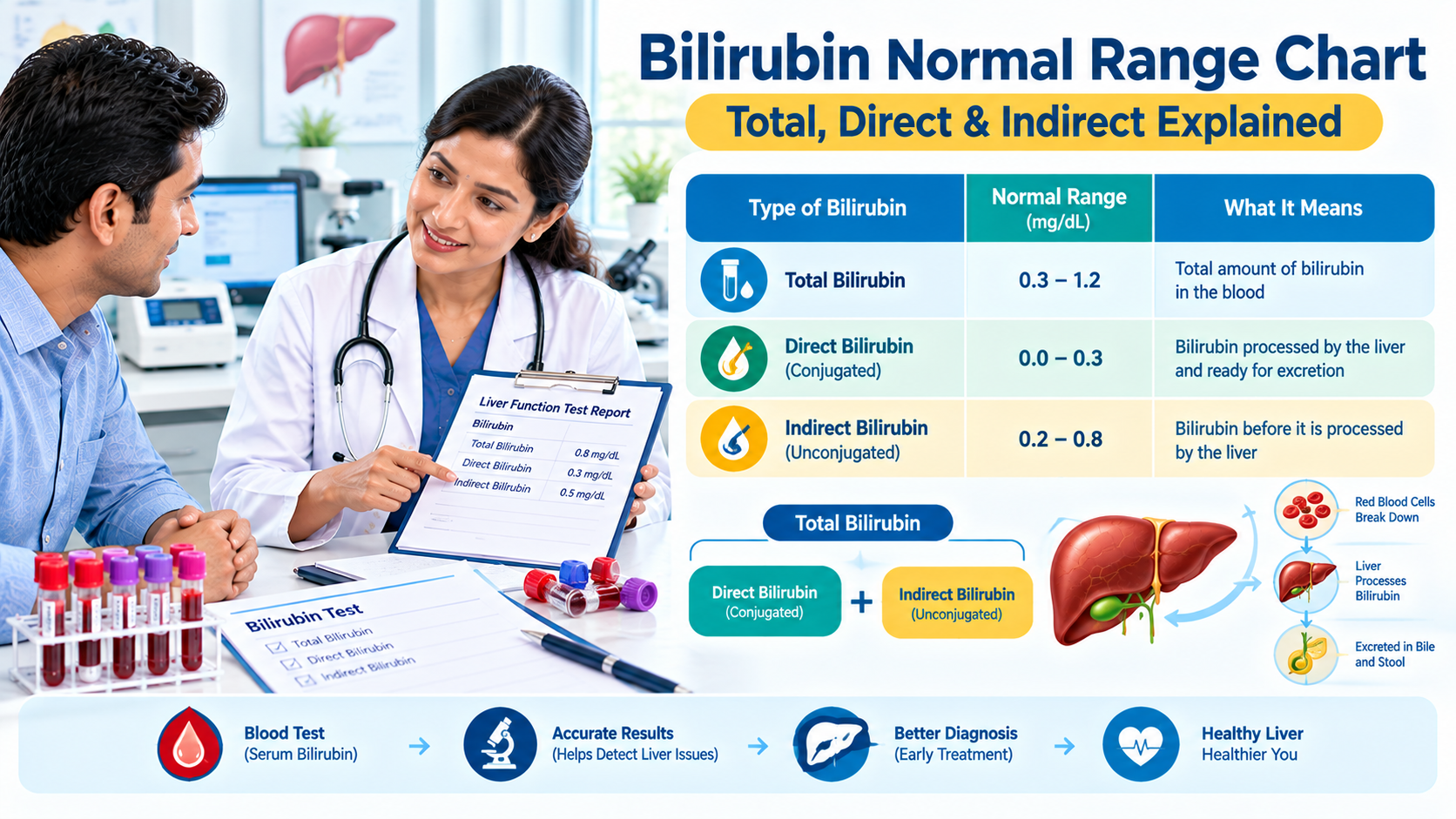
For most adults, a commonly used reference range is:
- Total bilirubin: 0.3–1.2 mg/dL
- Direct bilirubin: Less than 0.3 mg/dL
- Indirect bilirubin: Often calculated from total bilirubin minus direct bilirubin; the expected value may be around 0.2–0.9 mg/dL depending on the laboratory.
However,
reference ranges can vary between laboratories. Therefore, always compare your result with the range printed on your own laboratory report.
What Is Bilirubin?
Bilirubin is produced naturally when the body breaks down ageing red blood cells.
Initially, bilirubin is in an
unconjugated or indirect form. It then reaches the liver, where it is processed into a
conjugated or direct form.
Afterwards, the processed bilirubin is passed into bile and eventually eliminated through the digestive system.
Therefore, measuring different bilirubin fractions can help doctors understand whether an abnormal result may be associated with increased bilirubin production, liver processing, or bile flow.
Total Bilirubin
Total bilirubin represents the overall amount of bilirubin measured in the blood.
Importantly, total bilirubin is commonly included in an LFT panel because an elevated level can be associated with jaundice and several liver, gallbladder, or blood-related conditions.
Direct Bilirubin
Direct bilirubin, also called conjugated bilirubin, is bilirubin that has been processed by the liver.
Consequently, an increase in direct bilirubin may point toward problems involving bile flow or the liver's ability to excrete processed bilirubin.
Indirect Bilirubin
Indirect bilirubin, also called unconjugated bilirubin, is generally derived from the total and direct bilirubin values.
An increase in indirect bilirubin can occur when bilirubin production increases or when the liver's processing of bilirubin is affected.
Bilirubin Normal Range Chart
| Bilirubin Type |
Common Adult Reference Range |
What It Represents |
| Total Bilirubin |
0.3–1.2 mg/dL |
Total amount of bilirubin in blood |
| Direct Bilirubin |
Less than 0.3 mg/dL |
Conjugated/processed bilirubin |
| Indirect Bilirubin |
Approximately 0.2–0.9 mg/dL* |
Unconjugated bilirubin |
| Jaundice may become clinically visible |
Around 2 mg/dL or higher |
Yellowing may become noticeable |
*Indirect bilirubin is commonly calculated from total minus direct bilirubin, so its reference interval can vary by laboratory.
These values are general adult reference ranges rather than a diagnosis. For example, MedlinePlus lists total bilirubin of 0.1–1.2 mg/dL and direct bilirubin below 0.3 mg/dL as normal values, while also noting that laboratories can have slightly different ranges.
Why Can Bilirubin Be High?
An elevated bilirubin result does not automatically mean that you have liver disease.
Instead, there can be several possible reasons.
Liver-Related Causes
Bilirubin may increase when the liver is inflamed or damaged. For example, conditions affecting liver cells can interfere with normal bilirubin processing.
Therefore, doctors may look at bilirubin together with:
- ALT
- AST
- ALP
- GGT
- Albumin
- Total protein
Bile Flow Problems
Sometimes bilirubin rises because bile cannot flow normally from the liver or gallbladder.
For instance, gallstones or other bile duct problems can produce a rise in direct bilirubin.
Increased Red Blood Cell Breakdown
When red blood cells are broken down faster than usual, more bilirubin is produced.
As a result, indirect bilirubin may become elevated.
Gilbert Syndrome
Gilbert syndrome is a common inherited condition that can cause mild, intermittent increases in indirect bilirubin.
Usually, it is not associated with serious liver damage. Nevertheless, an unexplained elevated bilirubin should still be evaluated appropriately.
What Does High Bilirubin Mean in an LFT Report?
If your LFT report flags bilirubin, do not look at that number in isolation.
Instead, consider the pattern.
High Total + High Direct Bilirubin
This pattern may occur with conditions affecting bile flow or liver processing.
High Total + Predominantly High Indirect Bilirubin
This may be associated with increased red blood cell breakdown or certain conditions affecting bilirubin processing.
High Bilirubin + Abnormal ALT/AST
This combination may indicate that the liver needs further evaluation.
However, these patterns are only a starting point. Your doctor will consider symptoms, medical history, medications, examination findings, and other laboratory results.
Newborn Bilirubin Normal Range Is Different
Newborn babies need a separate approach.
Unlike adults, newborn bilirubin levels naturally change during the first days after birth. Therefore, there is
no single fixed newborn bilirubin normal range that can be applied to every baby.
Instead, bilirubin is interpreted according to:
- Baby's age in hours
- Gestational age
- Total serum bilirubin level
- Rate at which bilirubin is rising
- Feeding and clinical condition
- Other risk factors
Why Is Newborn Jaundice Common?
Many newborns develop some degree of jaundice because bilirubin production and liver processing are still adapting after birth.
Nevertheless, some babies develop bilirubin levels that require closer monitoring or treatment.
Therefore, visible yellowing in a newborn should not simply be dismissed as “normal.”
When Is Newborn Bilirubin Concerning?
The significance of a newborn's bilirubin level depends on the baby's age in hours and other risk factors.
For example, the AAP notes that treatment decisions are based on the
hour-specific total serum bilirubin, gestational age, and neurotoxicity risk factors.
Consequently, parents should follow the pediatrician's advice regarding repeat bilirubin testing and follow-up.
Newborn Jaundice Checks in Bengaluru
Newborn jaundice checks are common at diagnostic centres such as
Prima Diagnostics Jayanagar and Whitefield, especially when pediatricians recommend follow-up bilirubin testing.
What Does Low Bilirubin Mean?
Low bilirubin is generally much less concerning than significantly elevated bilirubin.
In many cases, a slightly low value does not indicate a specific disease.
Nevertheless, the result should still be interpreted using the laboratory's reference range and alongside the rest of the LFT.
Therefore, if your bilirubin is flagged low but your other results are normal, and you have no concerning symptoms, your doctor may simply interpret it in context rather than treating the number itself.
What Tests May Be Needed Next?
If bilirubin is elevated, the next investigation depends on the pattern and suspected cause.
Your doctor may consider:
Repeat Bilirubin Test
A repeat total and direct bilirubin test may be recommended to see whether the level is persistent or changing.
Complete LFT
ALT, AST, ALP, GGT, albumin, and other liver markers can provide additional information.
CBC and Related Tests
If increased red blood cell breakdown is suspected, a CBC and other blood investigations may be considered.
Ultrasound
If bile obstruction or gallbladder disease is suspected, abdominal imaging such as an ultrasound may be recommended.
Additional Tests
Depending on symptoms and medical history, doctors may also consider tests for viral hepatitis, hemolysis, or inherited conditions.
Therefore, the right next test depends on
why the bilirubin is elevated, rather than simply how high the number is.
When Should You Seek Medical Attention?
Yellowing of the eyes or skin should be medically evaluated, particularly when bilirubin is clearly elevated.
Furthermore, seek prompt medical attention if jaundice occurs with symptoms such as:
- Severe abdominal pain
- Persistent vomiting
- Confusion or unusual drowsiness
- Fever
- Very dark urine
- Pale or clay-coloured stools
- Significant weakness
- Rapidly worsening yellowing
For newborns, worsening jaundice, poor feeding, unusual sleepiness, or other concerning symptoms should be discussed promptly with a pediatrician.
Bilirubin Testing in Bengaluru
For people in Bengaluru, bilirubin testing is commonly performed as part of an LFT or as an individual investigation when clinically required.
Moreover, convenient diagnostic access can be useful when a doctor recommends repeat testing to monitor a changing bilirubin level.
FAQs About Bilirubin Normal Range
What is the bilirubin normal range in adults?
A commonly used adult reference range for total bilirubin is about
0.1–1.2 mg/dL, while direct bilirubin is generally less than
0.3 mg/dL. However, the laboratory's own reference range should be used for interpretation.
Is bilirubin 1.5 mg/dL high?
A total bilirubin of 1.5 mg/dL may be above the reference range used by some laboratories. However, its significance depends on whether the elevation is mainly direct or indirect and what the other LFT results show.
What bilirubin level causes jaundice?
Visible jaundice can become noticeable at around
2 mg/dL, although the appearance can vary between individuals.
Is high bilirubin always a sign of liver disease?
No. High bilirubin can have several causes, including increased red blood cell breakdown, inherited conditions, liver problems, or impaired bile flow.
What is the bilirubin normal range for newborns?
Newborn bilirubin should not be judged against one fixed normal range. Instead, the level must be interpreted according to the baby's age in hours, gestational age, and other risk factors.
Where can I get a bilirubin Normal range test in Bengaluru?
Bilirubin testing is available through diagnostic laboratories across Bengaluru. Prima Diagnostics provides laboratory testing and diagnostic services, with centres including locations such as Jayanagar and Whitefield.
Conclusion
Overall, understanding the
bilirubin normal range becomes much easier when total, direct, and indirect bilirubin are considered separately.
However, a flagged bilirubin value should never be interpreted in isolation. Instead, doctors usually compare it with the rest of the LFT, symptoms, medical history, and, when necessary, additional investigations.
Furthermore, newborn bilirubin requires a different approach because the acceptable level changes with the baby's age in hours and clinical risk factors.
Therefore, if your LFT report shows high bilirubin, focus not only on the number but also on the pattern and the next recommended step. With appropriate follow-up, the underlying reason for the abnormal result can be investigated more clearly.