
Blood clotting is a natural and essential process that helps stop bleeding after an injury. However, when blood clots form inside blood vessels without an injury, they can become dangerous and, in some cases, life-threatening. Conditions such as Deep Vein Thrombosis (DVT) and Pulmonary Embolism (PE) require prompt medical attention because they can interfere with normal blood flow and damage vital organs. One of the most commonly used blood tests for evaluating suspected blood clots is the D-dimer test. Although this test does not directly diagnose a clot, it helps doctors determine whether further imaging tests or emergency evaluation may be necessary.
The D-dimer test gained widespread attention during the COVID-19 pandemic because doctors frequently used it to assess clotting complications in hospitalized patients. Even today, it remains an important investigation for people with symptoms suggestive of abnormal blood clot formation.
If you are searching for information about the D-dimer test, this guide explains what the test measures, why it became important after COVID-19, when doctors recommend it, what a high result may indicate, normal reference ranges, related tests, and the approximate cost of testing in Bangalore.
This Blog Includes:
- Article Title: D-Dimer Test – When and Why It Matters (Clot Risk)
- Publisher: Prima Diagnostics
- Topics Covered: D-Dimer Test, Blood Clots, Deep Vein Thrombosis (DVT), Pulmonary Embolism (PE), Post-COVID Clot Awareness, Blood Clot Risk, Normal D-Dimer Range, Coagulation Disorders, Clot Evaluation, and Patient Education.
- Services Covered: D-Dimer Test, Complete Blood Count (CBC), C-Reactive Protein (CRP) Test, Coagulation Profile, PT, INR, aPTT, Preventive Health Checkups, Home Sample Collection, Digital Reports, and Laboratory Diagnostics.
- Tests Included: D-Dimer Test, CBC, CRP, PT, INR, aPTT, Kidney Function Test (KFT), Liver Function Test (LFT), Doppler Ultrasound (when clinically indicated), CT Pulmonary Angiography (when clinically indicated), and Additional Clotting Investigations as Recommended by Healthcare Providers.
- Preparation Guidance: Fasting is generally not required for a D-Dimer test unless additional fasting tests are ordered. Follow healthcare provider instructions, inform the laboratory about medications, recent surgery, pregnancy, or ongoing medical conditions, and prepare appropriately for home sample collection if applicable.
- Service Focus: Blood Clot Evaluation, Coagulation Testing, Preventive Health Screening, Home Sample Collection, Laboratory Diagnostics, Cardiovascular Risk Assessment, Patient Education, and Routine Blood Investigations.
- FAQ Section: Included.
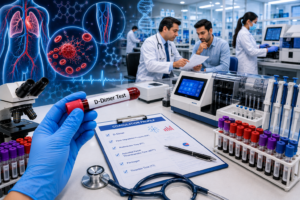
What Does a D-Dimer Test Detect?
A D-dimer test measures fragments of protein that are released when the body breaks down a blood clot. A normal D-dimer result generally makes significant blood clotting disorders less likely in appropriate clinical settings, while an elevated D-dimer may indicate increased clot formation and breakdown. However, high D-dimer levels are not specific to blood clots and can also occur in infections, recent surgery, pregnancy, inflammation, or other medical conditions. Doctors interpret the result together with symptoms, physical examination, and imaging tests when necessary.
What Is a D-Dimer Test?
The D-dimer test is a laboratory blood test that measures D-dimer, a protein fragment produced when the body dissolves blood clots through its natural clot breakdown process.
Normally, the body forms clots to stop bleeding after an injury. Once healing begins, these clots gradually break down.
During this process, D-dimer is released into the bloodstream.
Therefore, increased D-dimer levels may indicate that significant clot formation and breakdown are occurring somewhere in the body.
How Does Blood Clotting Work?
Understanding the clotting process helps explain why this test is useful.
Step 1 – Blood Vessel Injury
When bleeding occurs, the body activates clotting factors.
Step 2 – Clot Formation
A clot forms to prevent excessive blood loss.
Step 3 – Healing
After healing, the body gradually dissolves the clot.
Step 4 – D-Dimer Release
As the clot breaks down, D-dimer fragments enter the bloodstream.
The D-dimer test measures these fragments.
Why Did the D-Dimer Test Become Important After COVID-19?
During the COVID-19 pandemic, doctors observed that some patients developed abnormal blood clotting complications.
As a result, D-dimer testing became an important part of evaluating hospitalized patients with moderate to severe COVID-19.
Although most people recover without clotting problems, increased awareness has continued because clot-related conditions remain medical emergencies that require prompt evaluation.
When Do Doctors Order a D-Dimer Test?
Doctors may recommend a D-dimer test when symptoms suggest abnormal blood clot formation.
However, the test is not used as a routine health screening investigation for healthy individuals.
Common situations include:
Suspected Deep Vein Thrombosis (DVT)
DVT usually occurs in the deep veins of the legs.
Symptoms may include:
- Swelling in one leg
- Pain or tenderness
- Warmth
- Redness
Suspected Pulmonary Embolism (PE)
A pulmonary embolism occurs when a clot travels to the lungs.
Possible symptoms include:
- Sudden shortness of breath
- Chest pain
- Rapid heartbeat
- Difficulty breathing
- Coughing (sometimes with blood)
This is a medical emergency requiring immediate evaluation.
Stroke Evaluation
In selected patients, doctors may include D-dimer testing as part of a broader clinical assessment.
Unexplained Blood Clotting Disorders
Patients with recurrent clotting episodes may undergo further evaluation.
Disseminated Intravascular Coagulation (DIC)
D-dimer testing may also help assess certain serious clotting disorders under specialist care.
Who May Be at Increased Risk of Blood Clots?
Several factors can increase clot risk.
These include:
- Recent surgery
- Prolonged bed rest
- Major injuries
- Pregnancy
- Certain cancers
- Hormonal medications
- Smoking
- Obesity
- Increasing age
Additionally, long periods of sitting—such as extended desk work among Bangalore’s IT professionals or long-distance air travel from Kempegowda International Airport—may contribute to clot risk in susceptible individuals.
What Does a High D-Dimer Mean?
A high D-dimer result does not automatically mean that a blood clot is present.
Instead, it indicates increased clot formation and breakdown somewhere in the body.
Possible causes include:
- Deep Vein Thrombosis (DVT)
- Pulmonary Embolism
- Recent surgery
- Trauma
- Infection
- Inflammation
- Pregnancy
- Liver disease
- Certain cancers
- Recovery after major illness
Therefore, doctors never interpret the D-dimer test in isolation.
Instead, they combine the result with:
- Symptoms
- Medical history
- Physical examination
- Imaging studies
- Additional laboratory tests
Can a Normal D-Dimer Rule Out Blood Clots?
In appropriate clinical situations and for patients with a low or intermediate likelihood of clotting, a normal D-dimer result may help make significant blood clot disorders less likely.
However, no blood test can completely replace clinical evaluation.
If symptoms strongly suggest a clot, your doctor may still recommend imaging studies even if the D-dimer result is normal.
What Is the Normal Range?
The normal reference range depends on:
- Laboratory methodology
- Testing equipment
- Units of measurement
Many laboratories report results using FEU (Fibrinogen Equivalent Units) or DDU (D-Dimer Units).
Therefore, always interpret your result according to the laboratory’s reference range and your doctor’s advice.
Which Tests Are Often Ordered Along with D-Dimer?
Because D-dimer is only one part of the evaluation, doctors frequently request additional investigations.
Complete Blood Count (CBC)
Evaluates red cells, white cells, and platelets.
C-Reactive Protein (CRP)
Assesses inflammation.
Coagulation Profile
May include:
- PT
- INR
- aPTT
Doppler Ultrasound
Often used to evaluate suspected Deep Vein Thrombosis.
CT Pulmonary Angiography
May be recommended when pulmonary embolism is suspected.
Kidney and Liver Function Tests
Help assess overall health and treatment planning.
D-Dimer Test Cost in Bangalore
The D-dimer test cost in Bangalore varies depending on:
- Laboratory
- Testing technology
- Home sample collection
- Health packages
Since pricing changes periodically, patients should contact Prima Diagnostics for the latest D-dimer test charges and available offers.
Is Home Sample Collection Available?
Yes.
Prima Diagnostics offers home sample collection for eligible D-dimer testing across Bangalore.
Benefits include:
- Convenient appointment scheduling
- Professional sample collection
- Reduced travel
- Digital reports
- Safe sample handling
This service is particularly useful for senior citizens, individuals recovering from illness, and patients with limited mobility.
Why Choose Prima Diagnostics?
Prima Diagnostics offers dependable diagnostic services with:
- D-Dimer Test
- CBC
- CRP
- Coagulation Tests
- Heart Health Investigations
- Preventive Health Packages
- Home Sample Collection
- Digital Reports
- Experienced Laboratory Professionals
- Advanced Diagnostic Equipment
- Quality-Assured Laboratory Services
Whether you require clot-risk evaluation or preventive health screening, Prima Diagnostics provides reliable laboratory support across Bangalore.
Frequently Asked Questions
What does the D-dimer test detect?
The D-dimer test measures protein fragments released when blood clots are broken down by the body.
Does a high D-dimer always mean a blood clot?
No. Elevated levels may occur due to infections, inflammation, pregnancy, surgery, trauma, liver disease, or other medical conditions. Doctors interpret the result together with your symptoms and additional tests.
Is the D-dimer test used after COVID-19?
Yes. It became widely used during the COVID-19 pandemic to help assess clotting complications in hospitalized patients when clinically indicated.
Can I book a D-dimer test at home?
Yes. Prima Diagnostics offers home sample collection for eligible laboratory tests across Bangalore.
Is fasting required for a D-dimer test?
Fasting is generally not required unless your healthcare provider has advised additional tests that require fasting.
Where can I get a D-dimer test in Bangalore?
Prima Diagnostics provides D-dimer testing, coagulation investigations, home sample collection, and digital reports across Bangalore.
Conclusion
The D-dimer test is an important laboratory investigation that helps doctors evaluate the possibility of abnormal blood clot formation. While a normal result can make significant clotting disorders less likely in appropriate clinical settings, an elevated D-dimer does not confirm a blood clot on its own. Instead, it serves as an indicator that further clinical assessment or imaging studies may be required. This is why the test is always interpreted alongside your symptoms, medical history, physical examination, and other diagnostic findings.
Whether you are experiencing symptoms suggestive of Deep Vein Thrombosis, recovering from a major illness, or undergoing evaluation for unexplained clotting concerns, timely testing can support faster medical decision-making. Prima Diagnostics offers reliable D-dimer testing, home sample collection for eligible tests, experienced laboratory professionals, and prompt digital reports across Bangalore to help you access quality diagnostic care with confidence.