Loud snoring and feeling tired during the day are easy to dismiss. However, when they happen regularly, especially together, they may be signs of an underlying sleep problem. In particular, sleep apnea can cause repeated interruptions in breathing during sleep, which can affect sleep quality and daytime alertness.
Moreover, thyroid problems, anaemia, blood sugar abnormalities and other health conditions can also contribute to tiredness. Therefore, looking at the symptoms together can help a doctor decide which tests are appropriate.
For many Bangalore IT workers with weight gain, long working hours or irregular sleep schedules, persistent snoring and daytime sleepiness can be worth discussing with a healthcare professional.
This Blog Includes:
- Article Title: Snoring and Daytime Sleepiness? Tests for Sleep Apnea and Thyroid
- Publisher: Prima Diagnostics
- Topics Covered: Sleep Apnea, Snoring, Daytime Sleepiness, Thyroid Problems, Weight Gain, Sleep Studies and Related Health Risks
- Services Covered: Blood Testing, Thyroid Testing, CBC Testing, HbA1c Testing, Lipid Testing and Diagnostic Guidance
- Tests Included: Sleep Study, TSH, CBC, HbA1c and Lipid Profile
- Risk Factors Covered: Weight Gain, Neck Size, Loud Snoring, Breathing Pauses, Daytime Sleepiness and Irregular Sleep
- Location Focus: Bangalore, including IT workers and people with irregular or night-shift schedules
- Preparation Guidance: Test-specific preparation, fasting when required and following healthcare provider instructions
- FAQ Section: Included

Which Test Is Done for Sleep Apnea?
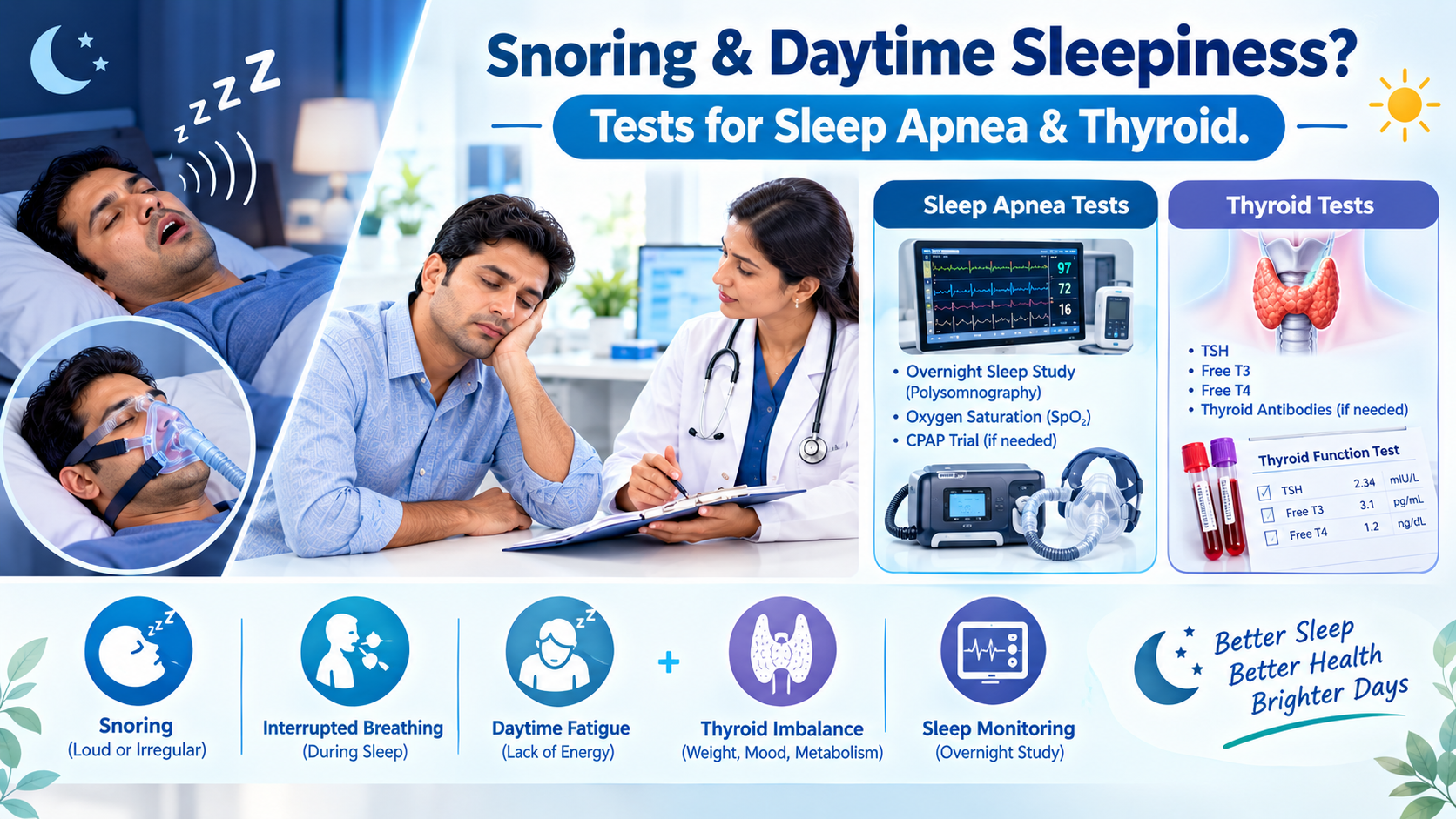
The main diagnostic test for sleep apnea is a sleep study, also called polysomnography. Depending on the person’s symptoms and risk factors, a doctor may recommend an overnight sleep study at a sleep centre or, in selected cases, a home sleep apnea test.
However, blood tests such as TSH, CBC, HbA1c, and lipid profile do not diagnose sleep apnea directly. Instead, they can help check for conditions that may contribute to tiredness or identify associated health risks.
Therefore, if loud snoring is accompanied by daytime sleepiness, breathing pauses during sleep, gasping or morning headaches, a medical evaluation is a sensible starting point.
Snoring vs Sleep Apnea
When Is Snoring Just Snoring?
Snoring occurs when airflow through the nose and throat becomes partially restricted during sleep. It can happen because of nasal congestion, sleeping position, alcohol use, weight gain, or the anatomy of the airway.
Occasional snoring, therefore, does not automatically mean that someone has sleep apnea.
When Should You Think About Sleep Apnea?
The concern becomes greater when snoring is loud and frequent and is accompanied by symptoms such as:
- Pauses in breathing noticed by a spouse
- Gasping or choking during sleep
- Excessive daytime sleepiness
- Morning headaches
- Dry mouth after waking
- Difficulty concentrating
- Irritability or mood changes
- Waking repeatedly during the night
Furthermore, a spouse may notice breathing pauses that the person sleeping does not remember.
Why a Spouse’s Observation Matters
Because sleep apnea occurs during sleep, the person may not realise that their breathing repeatedly stops or becomes restricted.
Consequently, a partner’s observation of loud snoring, gasping, or pauses in breathing can provide useful information when speaking with a doctor.
Why Sleep Apnea Matters
Sleep apnea is not simply about making noise at night. Repeated breathing interruptions can disturb normal sleep and may be associated with several health problems.
Sleep Apnea and Blood Pressure
Poor-quality sleep and repeated breathing interruptions can be associated with high blood pressure. Therefore, someone with loud snoring and difficult-to-control blood pressure may need a broader evaluation.
Sleep Apnea and Heart Health
Sleep-disordered breathing can also be associated with cardiovascular problems. For this reason, a doctor may consider the person’s blood pressure, symptoms, and cardiovascular risk factors when deciding what evaluation is appropriate.
Sleep Apnea and Blood Sugar
Sleep problems can also occur alongside metabolic conditions such as obesity and type 2 diabetes. Accordingly, checking blood glucose or HbA1c may be appropriate for some people.
However, an abnormal HbA1c does not mean that a person has sleep apnea. These tests answer different clinical questions.
Sleep Apnea and Cholesterol
Similarly, a lipid profile may be recommended as part of an overall cardiovascular risk assessment, particularly when weight gain, diabetes or other risk factors are present.
Blood Tests That May Be Considered
TSH for Thyroid Function
Thyroid disorders can contribute to tiredness, weight changes and other symptoms that may overlap with sleep-related problems.
Therefore, TSH may be recommended when a doctor suspects thyroid dysfunction.
However, TSH does not diagnose sleep apnea. Instead, it checks thyroid function.
CBC for Anaemia and Other Changes
A Complete Blood Count (CBC) measures components such as haemoglobin, red blood cells and white blood cells.
If daytime tiredness is prominent, a doctor may consider CBC testing to look for anaemia or other blood-related abnormalities.
HbA1c for Average Blood Sugar
HbA1c provides an estimate of average blood glucose over roughly the previous two to three months.
Consequently, it can be useful when fatigue, weight gain or other factors raise a concern about diabetes or prediabetes.
Lipid Profile for Cardiovascular Risk
A lipid profile measures cholesterol and triglycerides. Thus, it can help assess cardiovascular risk as part of a broader health evaluation.
Sleep Study for Sleep Apnea
Unlike these blood tests, a sleep study directly evaluates sleep and breathing patterns.
Depending on the situation, the study may monitor factors such as:
- Breathing interruptions
- Oxygen levels
- Heart rate
- Breathing effort
- Sleep-related events
The appropriate type of sleep study should be determined by a qualified healthcare professional.
Weight and Neck Size: Why They Matter
The Weight Gain and Snoring
Weight gain can contribute to narrowing of the upper airway during sleep. As a result, people who gain weight may notice that snoring becomes louder or more frequent.
However, sleep apnea can occur in people who are not overweight as well. Therefore, body weight alone cannot confirm or exclude the condition.
Does Neck Size Matter?
A larger neck circumference can be associated with a higher risk of obstructive sleep apnea because of airway anatomy.
Nevertheless, neck size is only one risk factor. A proper assessment considers symptoms, medical history and other factors together.
Bangalore IT Workers and Sleep Problems
For many Bangalore IT professionals, long hours at a desk, reduced physical activity, weight gain and irregular sleep schedules can overlap.
In addition, late-night work and screen-heavy routines can make daytime tiredness more noticeable.
Therefore, persistent fatigue should not automatically be blamed on a busy work schedule, particularly when loud snoring or breathing pauses are also present.
When Should You Consider a Sleep Apnea Evaluation?
Consider discussing an evaluation with a healthcare professional if you or your spouse notice:
Loud Snoring Every Night
Frequent, disruptive snoring is more concerning than occasional snoring.
Breathing Pauses
If your spouse notices that you stop breathing during sleep, this deserves medical attention.
Daytime Sleepiness
Falling asleep during meetings, while watching television or during quiet activities can indicate excessive daytime sleepiness.
Morning Headaches
Repeated morning headaches, particularly when combined with snoring and poor sleep, can be another reason to seek an evaluation.
Difficulty Concentrating
Poor-quality sleep can affect alertness and concentration. Therefore, persistent concentration problems alongside other symptoms should not be ignored.
Where to Start at Prima Diagnostics
If tiredness is persistent, you can start by discussing your symptoms with your healthcare provider. Based on your history, the doctor can decide whether blood investigations or a sleep evaluation are appropriate.
At Prima Diagnostics, laboratory tests such as thyroid testing, CBC, HbA1c and lipid testing can be considered when clinically indicated.
Moreover, checking the required test preparation before booking is important because preparation can differ between investigations.
For sleep apnea specifically, however, remember that a routine blood test cannot confirm the condition. A healthcare professional may recommend a sleep study when the symptoms and risk factors indicate one is needed.
Home Collection Can Add Convenience
For eligible laboratory tests, home sample collection can be convenient for people with busy schedules.
This can be particularly useful for Bangalore professionals who find it difficult to visit a diagnostic centre during working hours.
However, home collection availability depends on the test, location and appointment availability.
What to Do Before Testing
Before booking blood tests:
- Confirm which tests your doctor has recommended.
- Check whether fasting is required.
- Follow the specific preparation instructions.
- Continue prescribed medicines unless your healthcare provider advises otherwise.
- Keep a note of symptoms such as snoring, daytime sleepiness and morning headaches.
- If possible, ask your spouse or sleeping partner whether they have noticed breathing pauses.
Most importantly, do not start or stop medicines based only on a test result without medical advice.
Frequently Asked Questions
Which test is done for sleep apnea?
A sleep study, such as polysomnography or an appropriate home sleep apnea test, is used to evaluate sleep apnea. Blood tests such as TSH, CBC, and HbA1c may assess other conditions but do not diagnose sleep apnea.
Can thyroid problems cause snoring and tiredness?
Thyroid disorders can contribute to symptoms such as tiredness and weight changes. Therefore, a doctor may recommend a TSH test when thyroid dysfunction is suspected. However, thyroid testing does not replace a sleep apnea evaluation.
Is loud snoring always sleep apnea?
No. Snoring can occur for several reasons and does not automatically mean sleep apnea. However, loud regular snoring combined with breathing pauses, gasping, or daytime sleepiness warrants medical evaluation.
Can weight gain increase the risk of sleep apnea?
Weight gain can increase the risk of obstructive sleep apnea in some people because it may contribute to airway narrowing. Nevertheless, sleep apnea can also occur in people without excess weight.
Should I get a CBC if I feel tired all day?
A doctor may recommend a CBC when anaemia or another blood-related condition is being considered. However, persistent daytime sleepiness has many possible causes, so the appropriate tests depend on the overall clinical picture.
Can HbA1c diagnose sleep apnea?
No. HbA1c evaluates average blood glucose and helps assess diabetes or prediabetes. It does not diagnose sleep apnea.
Can I get blood tests through home collection in Bangalore?
For eligible investigations, home sample collection may be available. Check the required test, your location and appointment availability before booking.
Conclusion
Ultimately, loud snoring and daytime sleepiness should not always be dismissed as simple tiredness. In particular, when a spouse notices breathing pauses, gasping or repeated nighttime disturbances, sleep apnea should be discussed with a healthcare professional.
At the same time, thyroid problems, anaemia, blood sugar abnormalities and cardiovascular risk factors can also contribute to fatigue. Therefore, tests such as TSH, CBC, HbA1c and lipid profile may be considered when appropriate, while a sleep study is used to evaluate sleep apnea itself.
For Bangalore’s busy IT workforce, especially people experiencing weight gain, late-night schedules and persistent tiredness, taking these symptoms seriously can be an important first step toward understanding the underlying cause.