
Cortisol Normal Range - Morning and Evening Levels (Stress Hormone)
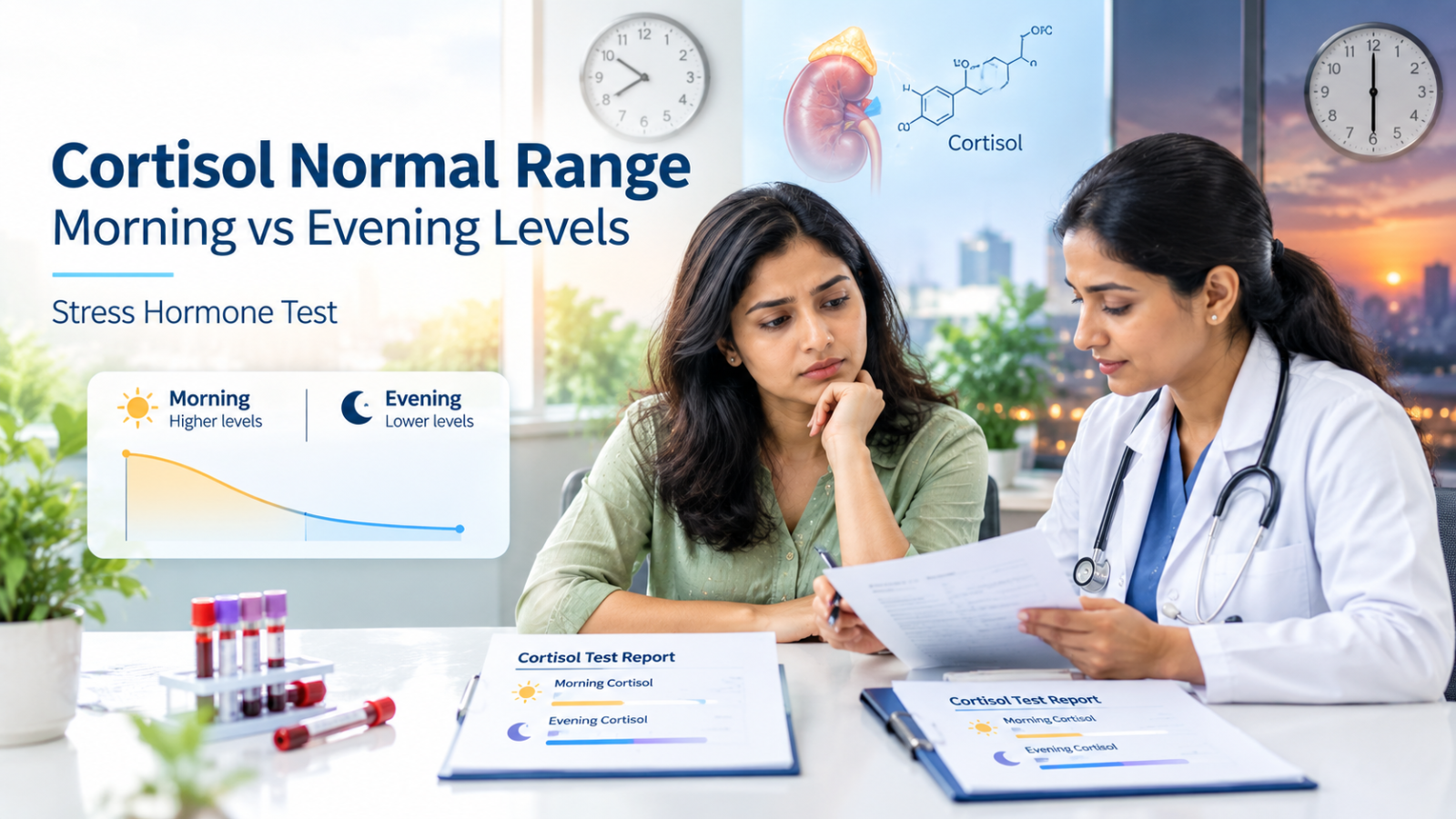
Feeling stressed, gaining weight around the middle, waking tired or struggling to sleep can make people wonder whether their cortisol normal range is in order.
Cortisol is often called the stress hormone. However, it does much more than respond to stressful situations. In fact, cortisol normally rises and falls throughout the day, helping regulate blood pressure, blood sugar, metabolism, and the body's response to stress.
Therefore, the cortisol normal range depends not only on the number but also on when the sample was collected and which test was used.
For people dealing with demanding Bangalore work schedules, irregular sleep, and ongoing stress, understanding this daily pattern can make a cortisol report easier to interpret.
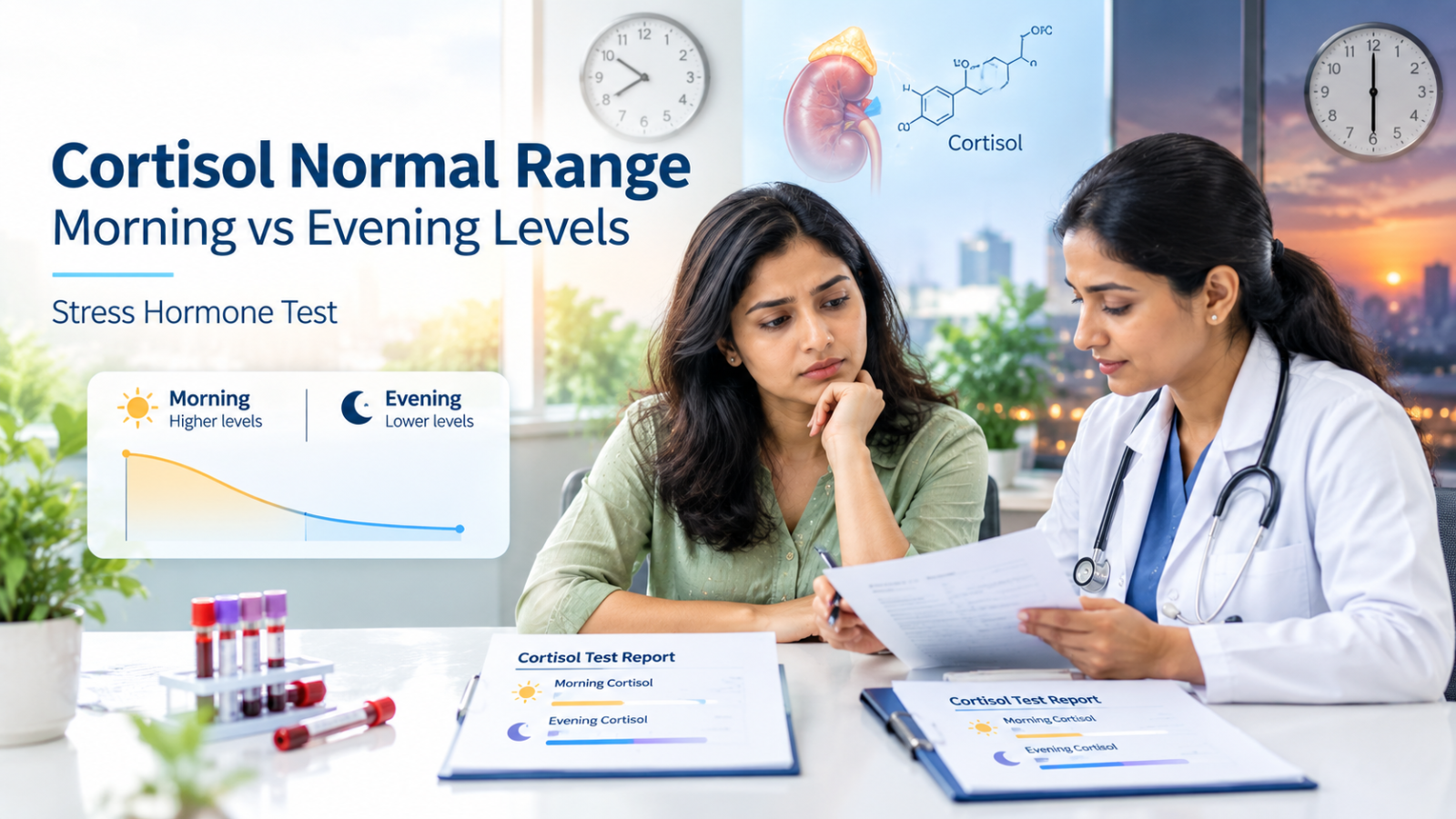
What Is Cortisol?
Cortisol is a hormone produced by the adrenal glands.
It is controlled through communication between the brain and adrenal glands and follows a natural daily rhythm.
Normally, cortisol is:
- Higher in the morning
- Lower toward evening
- Generally lowest around nighttime
This pattern is important because cortisol helps the body become alert after waking and gradually prepares it for rest later in the day.
However, stress, certain medicines, sleep disruption, and medical conditions can affect cortisol levels.
Why Does Cortisol Change During the Day?
Cortisol is not supposed to remain at the same level all day.
Instead, it follows a circadian rhythm.
For example, levels are usually higher around the time of waking. Subsequently, they decline throughout the day.
As a result, a cortisol value that appears normal in the morning may not be directly comparable with a value collected in the evening.
That is why the collection time should always be considered when interpreting the result.
What Is a Normal Cortisol Level?
A typical morning blood cortisol level is often higher than an evening level.
However, there is no single universal cortisol normal range. Reference ranges vary according to the laboratory, testing method, sample type, and collection time.
A commonly used example for serum cortisol is:
Collection time |
Typical reference pattern* |
|
Morning, around 6–8 AM |
Approximately 5–25 µg/dL |
|
Late afternoon/evening |
Approximately 2–14 µg/dL |
*These are general illustrative ranges, not a substitute for the reference range printed on your laboratory report. Always interpret your result using the laboratory's stated range.
Morning vs Evening Cortisol Normal Range
Morning Cortisol
Cortisol normally reaches a relatively high level in the morning.
This rise helps promote alertness and supports the body's transition from sleep to daytime activity.
Therefore, an 8 AM cortisol test is commonly used when doctors need to evaluate adrenal function.
Evening Cortisol
By evening, cortisol should generally be much lower than it was in the morning.
Consequently, a cortisol result that is unusually high late in the day may require further evaluation, depending on the test and clinical situation.
Why Timing Matters
Suppose someone has a cortisol value that looks high compared with a morning range. If the sample was actually collected late in the evening, the interpretation may be different.
Therefore, always record the exact collection time when having cortisol tested.
High Cortisol Signs
High cortisol can occur for many reasons, including stress, certain medications, and specific medical conditions.
Possible symptoms can include:
- Weight gain, especially around the abdomen
- Increased appetite
- Difficulty sleeping
- Anxiety or irritability
- High blood pressure
- High blood sugar
- Muscle weakness
- Easy bruising
- Skin changes
However, these symptoms are not specific to high cortisol.
For example, weight gain and poor sleep can have many causes. Therefore, symptoms alone cannot diagnose a cortisol disorder.
Does Stress Always Mean High Cortisol?
Not necessarily.
Everyday stress can temporarily influence cortisol. However, feeling stressed does not automatically mean that you have a medical condition causing persistently high cortisol.
Similarly, chronic stress, poor sleep, and irregular routines can affect the body's hormonal rhythm without necessarily producing the same pattern seen in endocrine disorders.
Therefore, cortisol testing should be considered in the context of symptoms, medical history, and your healthcare provider's assessment.
Low Cortisol Signs
Low cortisol can also cause symptoms.
Possible signs include:
- Persistent fatigue
- Weakness
- Dizziness
- Low blood pressure
- Reduced appetite
- Unexplained weight loss
- Nausea
- Abdominal discomfort
In some cases, low cortisol may be related to adrenal or pituitary disorders, certain medicines or other medical conditions.
However, tiredness alone is not enough to diagnose low cortisol.
How to Test Cortisol Correctly
When cortisol testing is used to assess adrenal function, timing is particularly important.
Why 8 AM Is Commonly Used
An 8 AM cortisol test is often chosen because cortisol should normally be relatively high around this time.
For accurate interpretation:
- Follow the laboratory's instructions.
- Arrive at the recommended collection time.
- Tell your doctor about medicines and supplements.
- Mention steroid medications if you use them.
- Avoid changing prescribed medication unless your doctor tells you to.
- Note the exact sample collection time.
Importantly, some cortisol investigations use saliva or urine rather than blood. These tests have different collection requirements.
Can One Cortisol Test Diagnose a Problem?
Not always.
A single cortisol result may provide useful information, but additional testing may be required depending on the suspected condition.
For example, doctors may use different approaches when investigating suspected cortisol excess versus suspected adrenal insufficiency.
Therefore, do not interpret one number without considering the symptoms, collection time and clinical context.
Cortisol and Sleep Problems
Cortisol normally follows a daily rhythm that is closely connected with the sleep-wake cycle.
Consequently, irregular sleep schedules, night-shift work, and significant sleep disruption can affect hormonal patterns.
If you have persistent insomnia, frequent nighttime waking, or excessive daytime sleepiness, your healthcare provider may recommend appropriate evaluation rather than assuming cortisol is the cause.
Bangalore Work Stress and Cortisol
Bangalore's demanding work culture, long commutes, screen-heavy routines, and irregular schedules can make stress and sleep problems common concerns.
As a result, searches for stress-related health testing may increase when people experience persistent tiredness, weight changes or poor sleep.
Nevertheless, not every stress-related symptom is caused by abnormal cortisol.
Therefore, if symptoms continue, discuss them with a healthcare professional before ordering hormone tests independently.
When Should You Consider Cortisol Testing?
Your doctor may consider cortisol testing when symptoms or medical history suggest a possible adrenal or hormonal disorder.
Testing may be discussed when there are:
- Unexplained weight changes
- Persistent weakness
- Significant blood-pressure changes
- Symptoms suggesting excess cortisol
- Symptoms suggesting cortisol deficiency
- Long-term steroid medicine use
- Other findings suggesting an adrenal or pituitary problem
Cortisol Testing at Prima Diagnostics
If your healthcare provider recommends a cortisol test, Prima Diagnostics can be contacted to check current test availability, collection timings, and preparation requirements.
Because cortisol is highly time-dependent, confirm the appropriate collection time before visiting.
For an 8 AM cortisol test, planning the appointment around the required morning collection window is particularly important.
FAQs About Cortisol Normal Range
What is a normal cortisol level?
There is no single universal value. Cortisol is normally higher in the morning and lower in the evening. For serum testing, laboratories may use different reference ranges, so the range printed on your report should be followed.
Is cortisol supposed to be higher in the morning?
Yes. Cortisol normally follows a daily rhythm and is generally higher around the morning period than later in the day.
Is 8 AM a good time for a cortisol test?
An 8 AM cortisol test is commonly used when assessing adrenal function because cortisol is normally relatively high in the morning. Follow your doctor's specific instructions.
Can high cortisol cause weight gain?
Excess cortisol can be associated with weight gain, particularly when it is caused by an underlying medical condition. However, weight gain alone does not prove that cortisol is high.
Can stress increase cortisol?
Acute stress can temporarily increase cortisol. However, everyday stress does not automatically mean that a person has a cortisol disorder.
What does low cortisol feel like?
Low cortisol can be associated with fatigue, weakness, dizziness, low blood pressure, reduced appetite and weight loss. These symptoms have many possible causes, so testing and medical evaluation may be necessary.
Should cortisol be tested for sleep problems?
Sometimes, but not everyone with poor sleep needs cortisol testing. Your healthcare provider can determine whether hormone testing is appropriate based on your symptoms and medical history.
Conclusion
Understanding the cortisol normal range requires more than looking at one number.
Most importantly, cortisol follows a daily rhythm. It is generally higher in the morning and lower later in the day. Therefore, the time of collection, laboratory reference range and type of cortisol test all matter.
For people experiencing persistent stress, unexplained weight changes, unusual fatigue or sleep problems, cortisol testing may sometimes be useful. However, these symptoms can have many causes, so testing should be interpreted in the right clinical context.
If an 8 AM cortisol test has been recommended, plan the sample collection carefully and follow the instructions provided by your healthcare provider or diagnostic centre.