If you have recently received a cholesterol report, you may be wondering:
“Are my cholesterol levels normal for my age?” However, cholesterol interpretation is not based on age alone. Instead, doctors consider
LDL cholesterol, HDL cholesterol, triglycerides, overall cardiovascular risk, medical history, and other health factors together.
Moreover, lifestyle factors can influence cholesterol. For example,
Bengaluru's ghee-rich foods, biryani culture, late dinners, restaurant meals, and sedentary IT work can make healthy cholesterol management more challenging.
Therefore, understanding your numbers is useful. Nevertheless, a cholesterol result should always be interpreted in context rather than judged from one number alone.
This Blog Includes:
- Article Title: Cholesterol Levels Chart by Age - LDL, HDL, Triglycerides
- Publisher: Prima Diagnostics
- Type: Chart / Normal Range Healthcare Blog
- Topics Covered: Cholesterol Levels, Cholesterol Chart by Age, LDL Cholesterol, HDL Cholesterol, Triglycerides, Total Cholesterol, Non-HDL Cholesterol, ApoB, Lipid Profile, Cholesterol in Your 20s and 30s, Diet and Cholesterol, Ghee, Biryani, Late Dinners, Sedentary IT Lifestyle, Heart Health and Patient Education.
- Cholesterol Measurement Guidance: Explains the main components of a lipid profile, including total cholesterol, LDL cholesterol, HDL cholesterol and triglycerides.
- General Cholesterol Guidance: Explains that total cholesterol below approximately 200 mg/dL is generally considered desirable for adults, while emphasizing that individual cardiovascular risk determines appropriate treatment targets.
- LDL Guidance: Explains that lower LDL is generally associated with lower cardiovascular risk and that LDL treatment targets vary according to individual cardiovascular risk.
- HDL Guidance: Explains that higher HDL is generally associated with lower cardiovascular risk while clarifying that HDL should not be interpreted independently.
- Triglyceride Guidance: Explains general adult triglyceride categories, including desirable levels below 150 mg/dL, borderline high levels of 150–199 mg/dL, high levels of 200–499 mg/dL and very high levels of 500 mg/dL or higher.
- Age Guidance: Explains cholesterol considerations during the 20s, 30s, 40s, 50s and later years while clarifying that age alone does not determine an individual's cholesterol target.
- Patient Education Focus: Emphasizes that cholesterol results should be interpreted alongside age, cardiovascular risk, medical history, lifestyle, and other relevant health factors.
- Treatment Guidance: Clarifies that patients should not start, stop or change cholesterol medication based solely on an online cholesterol chart and should consult a healthcare professional.
- Service Focus: Lipid Profile Testing, ApoB Testing, Blood Testing, Preventive Health Screening, Cardiovascular Risk Assessment and Laboratory Diagnostics.
- FAQ Section: Included.
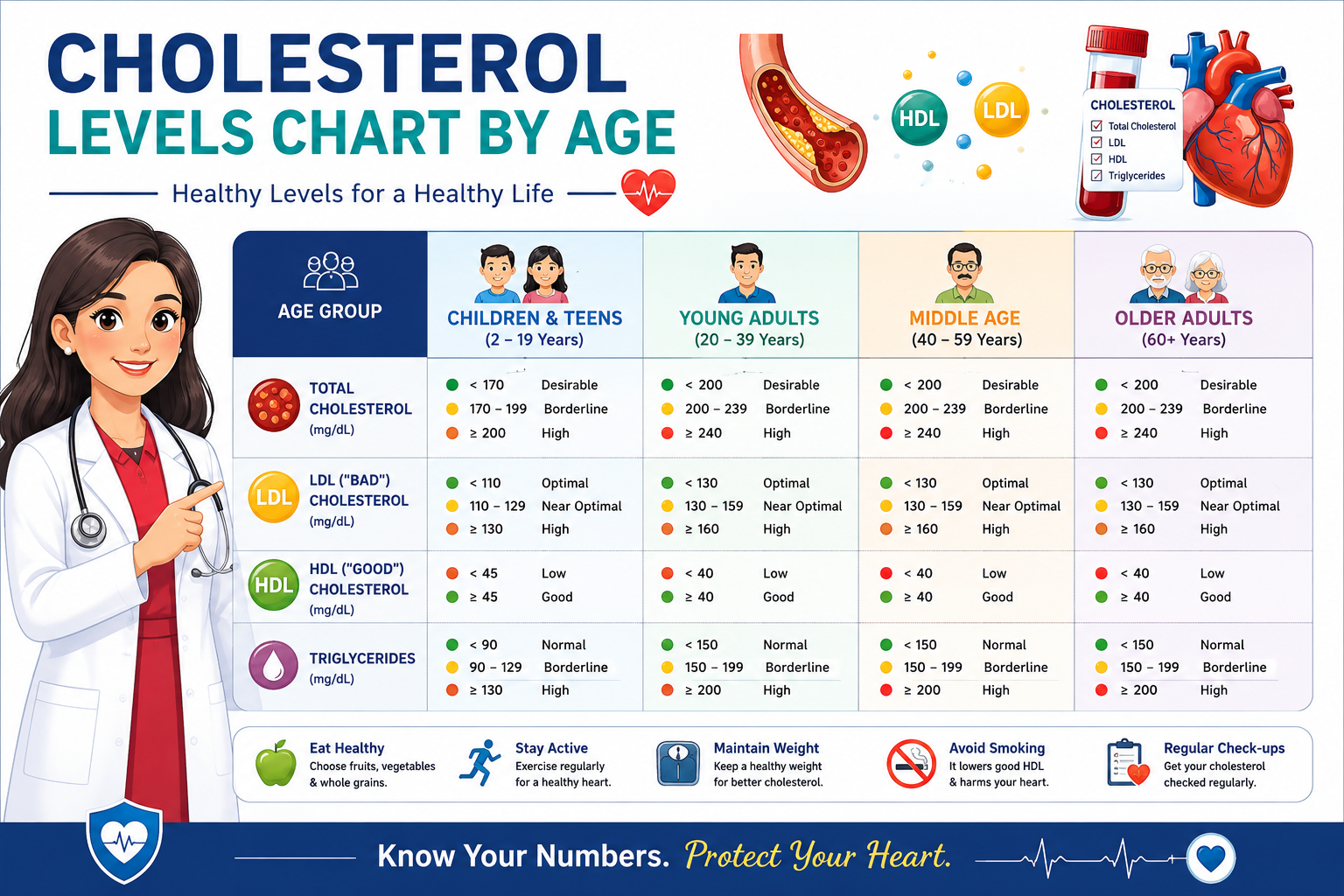
 Cholesterol levels chart by age (LDL, HDL, triglycerides)
Cholesterol levels are assessed using a
lipid profile, which commonly measures total cholesterol, LDL cholesterol, HDL cholesterol, and triglycerides. In adults, LDL is generally the primary cholesterol target, while higher HDL is generally associated with lower cardiovascular risk. Triglyceride levels below
150 mg/dL are generally considered desirable. However, individual LDL targets can be lower depending on cardiovascular risk and existing conditions.
Understanding Cholesterol Numbers
What Is Cholesterol?
Cholesterol is a waxy substance that your body needs for several important functions, including making hormones and building cell membranes.
However, excessive amounts of certain blood lipids can contribute to plaque formation inside arteries.
Therefore, cholesterol itself is not simply “good” or “bad.” Instead, the different components of your lipid profile provide more useful information.
What Does a Lipid Profile Measure?
A standard lipid profile commonly includes:
- Total cholesterol
- LDL cholesterol
- HDL cholesterol
- Triglycerides
Consequently, looking at the entire report is more informative than focusing only on total cholesterol.
Cholesterol Level Chart by Age and Gender
General Adult Cholesterol Guide
The following table provides a
general educational guide for adults. Importantly, these are not personal treatment targets, and laboratory reference ranges may vary.
| Cholesterol measurement |
General interpretation |
| Total cholesterol |
Below 200 mg/dL is generally considered desirable |
| LDL cholesterol |
Lower is generally better; target depends on cardiovascular risk |
| HDL cholesterol |
Higher levels are generally associated with lower cardiovascular risk |
| Triglycerides |
Below 150 mg/dL is generally considered desirable |
| Non-HDL cholesterol |
Lower levels are generally preferred, with targets depending on risk |
However, there is
no single LDL number that is ideal for every person.
For example, someone with established cardiovascular disease may have a much lower LDL target than a young person without major risk factors.
Therefore, your doctor may recommend a personalized target.
Cholesterol Levels by Age
Cholesterol in Your 20s
Being young does not automatically mean that cholesterol can be ignored.
In fact, cholesterol patterns can begin developing long before cardiovascular disease becomes apparent.
Therefore, people in their 20s should pay attention to factors such as:
- Family history
- Body weight
- Diet
- Physical activity
- Smoking
- Diabetes risk
- Blood pressure
Moreover, identifying unusually high LDL at a younger age can prompt earlier lifestyle evaluation and, when appropriate, medical assessment.
Cholesterol in Your 30s
During your 30s, work routines, family responsibilities, reduced exercise, and irregular meals can gradually influence metabolic health.
For Bengaluru's IT workforce, long desk hours combined with
late dinners and limited physical activity can make maintaining healthy lifestyle habits more difficult.
Consequently, periodic health assessment may be worthwhile, particularly when risk factors are present.
Cholesterol in Your 40s
As cardiovascular risk factors accumulate, cholesterol becomes increasingly important to monitor.
Furthermore, diabetes, hypertension, obesity, smoking, and family history can influence overall cardiovascular risk.
Therefore, cholesterol should be considered alongside other health measurements rather than in isolation.
Cholesterol in Your 50s and Beyond
With increasing age, cardiovascular risk generally becomes more important.
However, age alone does not determine whether cholesterol treatment is required.
Instead, doctors consider the complete risk profile, including previous cardiovascular events, diabetes, blood pressure, smoking status, kidney health, and cholesterol levels.
Does Cholesterol Differ Between Men and Women?
Gender Matters, But It Isn't the Only Factor
HDL levels and cardiovascular risk patterns can differ between men and women.
Nevertheless, there is no simple chart saying that every man or woman of a particular age should have one identical LDL target.
Therefore, rather than comparing your report directly with someone of the same age or gender, discuss your individual risk factors with your healthcare provider.
Good vs Bad Cholesterol Targets
What Is LDL Cholesterol?
LDL is commonly called “bad cholesterol.”
When LDL particles are present in excess, they can contribute to cholesterol buildup in artery walls.
Consequently, lowering LDL is a major component of cardiovascular risk reduction.
Is Lower LDL Always Better?
Generally, lower LDL is associated with lower cardiovascular risk. However, the appropriate treatment target depends on the person's overall risk.
Therefore, someone at high cardiovascular risk may have a substantially lower LDL goal than someone at lower risk.
What Is HDL Cholesterol?
Why Is HDL Called Good Cholesterol?
HDL is commonly referred to as
“good cholesterol.”
Higher HDL levels are generally associated with lower cardiovascular risk. However, simply increasing HDL through medication is not the main treatment strategy for reducing cardiovascular events.
Instead, the broader focus is usually on managing LDL and overall cardiovascular risk.
What Are Triglycerides?
Understanding Triglyceride Levels
Triglycerides are another type of fat found in the blood.
A general adult classification is:
| Triglyceride level |
General interpretation |
| Below 150 mg/dL |
Desirable |
| 150–199 mg/dL |
Borderline high |
| 200–499 mg/dL |
High |
| 500 mg/dL or higher |
Very high |
However, interpretation should take into account fasting status, health conditions, medications, alcohol intake, and other factors.
Therefore, one elevated result does not necessarily tell the entire story.
Why Triglycerides Can Rise
Diet and Lifestyle Factors
Triglycerides can be influenced by several factors, including:
- Excess calories
- High intake of refined carbohydrates
- Alcohol
- Overweight or obesity
- Poorly controlled diabetes
- Certain medicines
- Some medical conditions
Consequently, improving diet, physical activity, and metabolic health can be important when triglycerides are elevated.
Bengaluru's Ghee + Biryani Culture and Cholesterol
Does One Meal Cause High Cholesterol?
Not usually.
However, regularly consuming calorie-dense foods high in saturated fat, combined with low physical activity, can contribute to an unfavorable lipid profile over time.
Bengaluru's food culture offers plenty of delicious choices, but frequent restaurant meals, rich gravies, fried foods, ghee-heavy dishes, and biryani can make portion control challenging.
Therefore, you do not necessarily need to eliminate your favourite foods. Instead, focus on
frequency, portion size, overall dietary pattern, and physical activity.
Late Dinners and Cholesterol
Why Meal Timing Can Matter
Late dinners are common among people working long hours.
However, cholesterol is influenced by the overall dietary and metabolic pattern rather than simply the clock time of one meal.
Nevertheless, late-night eating can sometimes contribute to excess calorie intake, poor sleep, and weight gain.
Therefore, creating a consistent eating schedule can be helpful as part of a broader healthy lifestyle.
Sedentary IT Life and Cholesterol
Why Desk Work Matters
Long periods of sitting can reduce daily physical activity.
Consequently, Bengaluru's sedentary IT lifestyle may make it harder for some professionals to maintain healthy weight, blood sugar, blood pressure, and lipid levels.
Therefore, consider incorporating:
- Regular walking
- Strength training
- Short movement breaks
- Stair climbing
- Active commuting where practical
Even small changes can help create a more active daily routine.
Tests to Book for Cholesterol
Lipid Profile
The
lipid profile is the most commonly used blood test for assessing cholesterol and triglycerides.
It generally includes:
- Total cholesterol
- LDL cholesterol
- HDL cholesterol
- Triglycerides
Depending on the laboratory, calculated values such as non-HDL cholesterol may also be reported.
What Is ApoB?
When Might ApoB Be Useful?
Apolipoprotein B (ApoB) reflects the number of certain atherogenic lipoprotein particles.
Therefore, ApoB can sometimes provide additional information beyond a standard lipid profile, particularly when cardiovascular risk is difficult to assess from traditional lipid measurements alone.
However, ApoB is not necessarily required for everyone.
Your healthcare provider can determine whether additional testing is appropriate.
How to Improve Cholesterol Numbers Naturally
Start With Your Overall Diet
Rather than focusing on one food, consider the overall dietary pattern.
For example:
- Increase vegetables and fruits
- Choose whole grains more often
- Include appropriate portions of nuts and seeds
- Choose healthier sources of protein
- Reduce foods high in saturated and trans fats
- Limit highly processed foods
- Watch portion sizes
Consequently, sustainable dietary changes may be easier to maintain than extreme restrictions.
Be Smart About Ghee and Fried Foods
You do not necessarily need to completely eliminate ghee.
However, because ghee is rich in saturated fat, excessive intake may not be suitable for people trying to lower LDL cholesterol.
Therefore, moderation matters.
Similarly, reduce frequent consumption of deep-fried foods and choose cooking methods such as grilling, steaming, baking, or sautéing more often.
Exercise and Cholesterol
Move More Throughout the Day
Regular physical activity can support cardiovascular health and help improve several metabolic risk factors.
Therefore, instead of sitting continuously for hours, take regular movement breaks.
For IT professionals, even short walking breaks between meetings can make the workday more active.
When Should You Get a Cholesterol Test?
Testing Depends on Your Risk
The frequency of cholesterol testing depends on age, existing health conditions, medications, family history, and overall cardiovascular risk.
For example, someone taking cholesterol-lowering medication may require more frequent monitoring than someone with no significant risk factors.
Therefore, ask your healthcare provider how often you should have a lipid profile.
Cholesterol Testing in Bengaluru
What Should You Check Before Booking?
When booking a cholesterol test, confirm:
- Exact test name
- Whether fasting is required
- Current test price
- Home collection availability
- Report delivery options
- Any specific preparation instructions
Furthermore, if your doctor has requested additional tests such as ApoB, make sure those investigations are included in your booking.
When Should You Discuss High Cholesterol With a Doctor?
You should discuss your results with a healthcare professional if you have:
- Very high LDL
- High triglycerides
- Diabetes
- High blood pressure
- Strong family history of cardiovascular disease
- Previous heart disease or stroke
- Kidney disease
- Other cardiovascular risk factors
Moreover, do not start or stop cholesterol medication based solely on an online chart.
Frequently Asked Questions
What is a normal cholesterol level by age?
There is no single normal cholesterol number for every age. Total cholesterol below 200 mg/dL is generally considered desirable for adults, while LDL targets depend strongly on overall cardiovascular risk.
What is a good LDL cholesterol level?
Lower LDL is generally better, but the appropriate target varies according to cardiovascular risk. People at higher risk may require substantially lower LDL levels.
What is a good HDL level?
Higher HDL is generally associated with lower cardiovascular risk. However, HDL should not be interpreted alone, and simply raising HDL is not the primary treatment goal.
What is a normal triglyceride level?
For adults, triglycerides below
150 mg/dL are generally considered desirable. Levels from 150–199 mg/dL are generally considered borderline high, 200–499 mg/dL high, and 500 mg/dL or higher very high.
Can a South Indian diet increase cholesterol?
A South Indian diet can be very heart-friendly when it emphasizes vegetables, pulses, whole grains, nuts, and appropriate portions. However, frequent consumption of foods high in saturated fat, excessive ghee, fried foods, and calorie-dense restaurant meals can contribute to an unfavorable lipid profile.
Does sedentary IT work increase cholesterol?
A sedentary lifestyle can contribute to weight gain and other metabolic risk factors that may worsen cardiovascular health. Therefore, regular physical activity is important for people with desk-based jobs.
Should people in their 20s check cholesterol?
Depending on personal and family risk factors, cholesterol screening may be appropriate even at a younger age. Discuss the appropriate timing with your healthcare provider.
Is a lipid profile enough to assess heart risk?
A lipid profile provides important information, but cardiovascular risk also depends on factors such as age, blood pressure, diabetes, smoking, family history, and previous cardiovascular disease. In selected situations, additional tests such as ApoB may provide useful information.
Conclusion
Understanding
cholesterol levels is much easier when you look beyond one number.
In particular,
LDL, HDL, triglycerides, age, gender, lifestyle, family history, and overall cardiovascular risk should be considered together.
Furthermore, for Bengaluru residents dealing with
ghee-rich foods, frequent biryani meals, late dinners, and sedentary IT work, small and sustainable lifestyle changes can make healthy cholesterol management more practical.
Therefore, if you have not checked your cholesterol recently, consider discussing a
lipid profile with your healthcare provider. If additional assessment is appropriate, tests such as
ApoB may also be considered.
Most importantly, do not interpret an online cholesterol chart as a personal treatment plan. Instead, use it as an educational guide and discuss your actual results with a qualified healthcare professional.
For convenient blood testing and health screening, explore
Prima Diagnostics and check the current availability of lipid profiles, ApoB, and relevant health packages.